Inside the World's Deepest Subsea Tunnel
- Youtube Views 2,520,714 VIDEO VIEWS

03 June 2026
Video narrated and hosted by Fred Mills. This video and article contains paid promotion for Procore.
NORWAY is building the longest and deepest undersea road tunnel in the world, pushing construction to its absolute limits beneath one of the most dramatic landscapes on the planet.
The Rogfast tunnel, a twin-bore structure running 27-kilometres across the vast Boknafjord on Norway's west coast, will reach 390-metres below the surface of the fjord when complete, enough depth to fit the Empire State Building between the tunnel floor and the water above. It is a project so technically demanding that it is rewriting the rulebook for subsea construction, and one that will fundamentally change the way people and goods move through one of Europe's most economically vital regions.
The story of this tunnel begins with geography. Norway's western coastline is one of the most challenging places on earth for a civil engineer. The country's famous fjords, deep valleys carved by glaciers at the end of the last ice age, splinter the coastline into a jagged mosaic of mountains, islands and open water, making straightforward road building all but impossible.
The fjords are not simply wide. They are extraordinarily deep. The seabed of some stretches plunges further below the waterline than the mountains above them rise into the sky. The valley walls that tower over a driver on the shore continue downwards, unseen, for hundreds of metres more.
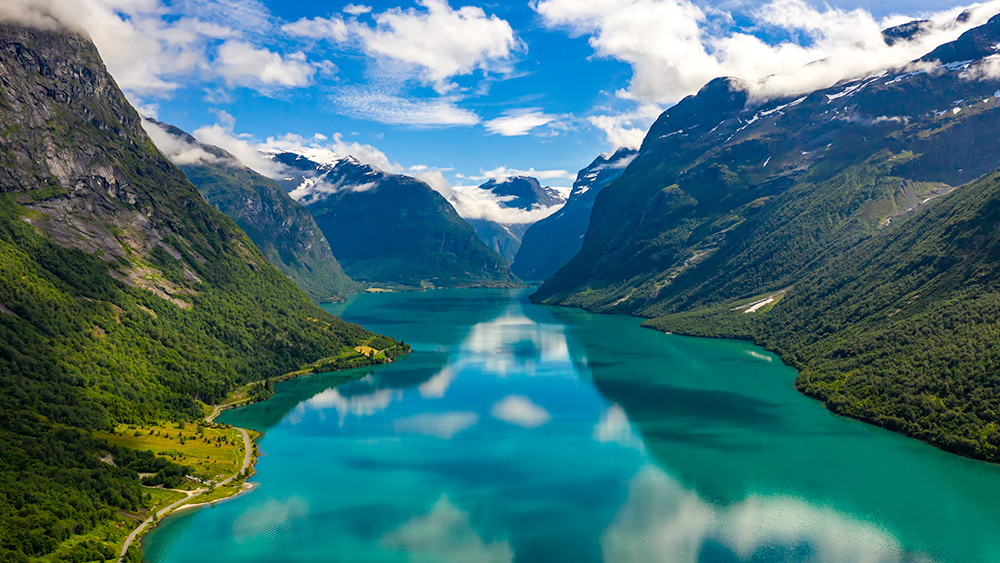
Above: Norway's fjords cover a vast range of geograpihes.
The E39 highway, which runs 1,100-kilometres from Trondheim in the north to Kristiansand in the south, currently requires drivers to take nine separate ferry crossings, more than any other single road in Europe. The journey takes around 21 hours. Norway's first postal route along this same coastline was established in 1647, and its earliest postmaster, Henrik Morian, would row across the open fjords only to face vertical climbs of 1,500-metres on the far shore. Snow and ice regularly made entire stretches of the route impassable. In many ways, the challenges facing modern engineers are not entirely different.
Since the 1990s, Norway's roads administration, Statens Vegvesen, has been working to improve the E39 with suspension bridges and more than 30 tunnels each exceeding one kilometre in length. But progress is slow. There are more than a thousand fjords along Norway's coastline, and each one is unique. Some have narrow, steep walls. Others are wide and shallow. Both present entirely different engineering problems, and there is no standard solution that can simply be applied across the board.
Boknafjord is one of the largest fjords in all of Norway. It stretches 45 kilometres inland, reaches 20 kilometres wide at its mouth and plunges hundreds of metres deep. The region it separates is home to three industries that sit at the very heart of the Norwegian economy: fishing, oil and natural gas. Together they account for more than 20 percent of the country's GDP.
At present, travelling through this area means navigating a patchwork of tunnels, bridges, islands and ferry crossings in sequence, one after another. For a highway of such economic importance, it is far from adequate. Truck traffic here runs at more than twice the national average and is growing year on year. Yet the roads are frequently narrow or single lane, and tunnel closures caused by accidents are a regular occurrence.
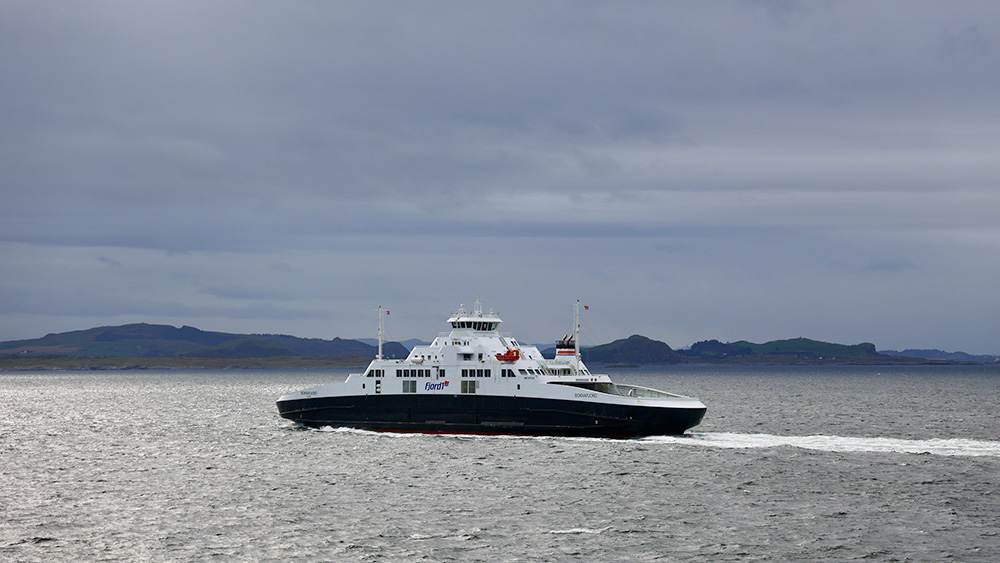
Above: A ferry crossing Boknafjord.
Construction on Rogfast is taking place simultaneously across three separate sites. The southern tunnel extends northwards from Stavanger, Norway's oil capital and the country's fourth largest city. The northern leg burrows progressively deeper, pushing towards the tunnel's lowest point. And at Kvitsøy, a small island sitting roughly in the middle of the route, crews are building the most technically complex part of the entire project: a 200-metre deep, multi-level interchange extending in four directions across four separate rock faces.
Anne-Merete Gilje, project manager at Statens Vegvesen, explains why this particular alignment was chosen. "It is quite deep further in the fjord," she says, "but there is a ridge at the outer parts. We are following that ridge so we do not have to go as deep as we would have had to go further in. Out here it is only around 370-metres deep, so we only have to go to about 400-metres at the lowest point."
That is still a remarkable depth. The English Channel, for comparison, averages around 60 metres and reaches a maximum of 174-metres. Sulafjorden, another fjord further up the E39 that engineers are separately grappling with, reaches 400-metres at its deepest point and presents its own extraordinary challenges. A floating tunnel tethered to the seabed, suspended just beneath the surface of the water, is among the ideas under serious consideration there. Nothing like it has ever been attempted anywhere in the world.
If the scale of Rogfast is daunting, the geology beneath Boknafjord makes it more so. The tunnel passes through several distinct bands of rock, between which lie fault zones where millions of years of geological movement have crushed and fractured the ground into some of the most unstable and unpredictable terrain on the entire route.
Some rock types, like the phyllite at the southern end, are dense and relatively workable, making excavation more straightforward even if the material itself has little value as road aggregate. Others, like the gneiss further north, are riddled with cracks holding enormous quantities of highly pressurised water, making that stretch one of the most unpredictable and technically demanding sections of the entire build.
Anne-Merete Gilje puts it plainly. "I think it is the geology. It is the uncertainty of the geology, because that is what can sort of destroy the whole project."
The water pressure at depth makes every unexpected encounter with the rock a potential crisis. Anne-Brit Moen, a site geologist working on the project, describes one recent episode. "Last week we had a really big breakthrough here. It was like 5,000 to 6,000 litres per minute. We are 330 metres below sea level, so the pressure of the water is like 33 bars. When there are open cracks, it just comes in and blows into the tunnel."
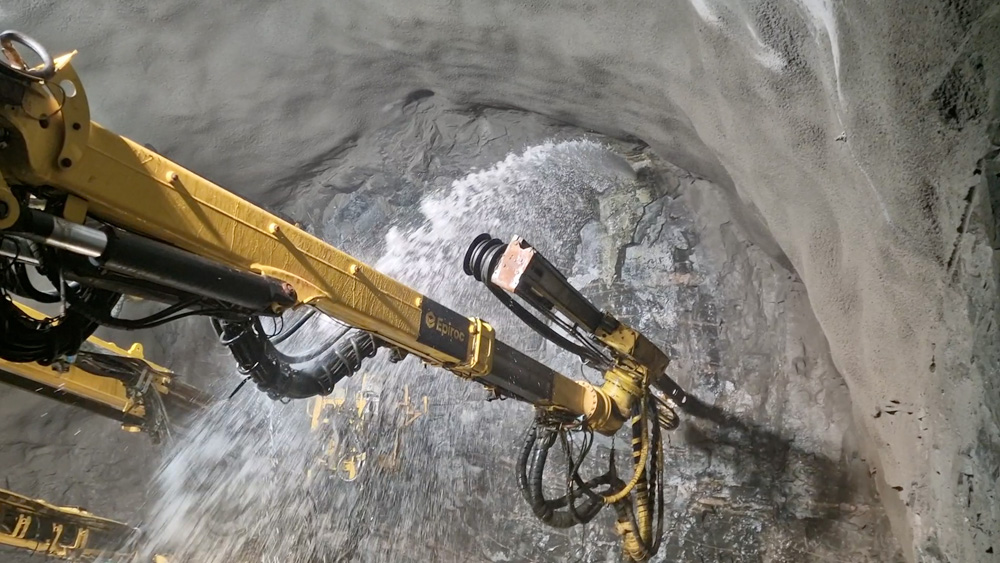
Above: Water spraying from the rockface after a breakthrough. Image: Øyvind Ellingsen / Statens Vegvesen.
For context, a typical domestic water supply operates at around three to four bars of pressure. The water encountered at this depth carries roughly ten times that force.
"We are prepared for these kinds of incidents," she adds. "We have huge pumping equipment that we can deploy quickly to get hold of the situation." But the unpredictability means that no two days underground are quite the same.
This kind of geological uncertainty is precisely why the project is not using a tunnel boring machine, the giant automated drills that have become synonymous with major tunnelling projects around the world, from Crossrail in London to the tunnels beneath the Alps.
Instead, Rogfast uses what is known as the Norwegian Tunnelling Method, a drill and blast technique refined over decades of working through the fractured and unstable rock that lies beneath Scandinavia's mountains and fjords. It is slower and more labour intensive than a TBM, but in conditions like these, its flexibility is everything.
The process begins with a drill jumbo, a large machine with four powerful mechanical arms that pushes drill bits simultaneously into the rock face. The cab looks, in the words of one observer, like something from a video game console, with joysticks, screens and controls giving the operator precise command over each arm. First, 15-metre probe holes are drilled to test for water and assess rock stability. The results of those tests dictate everything that follows.
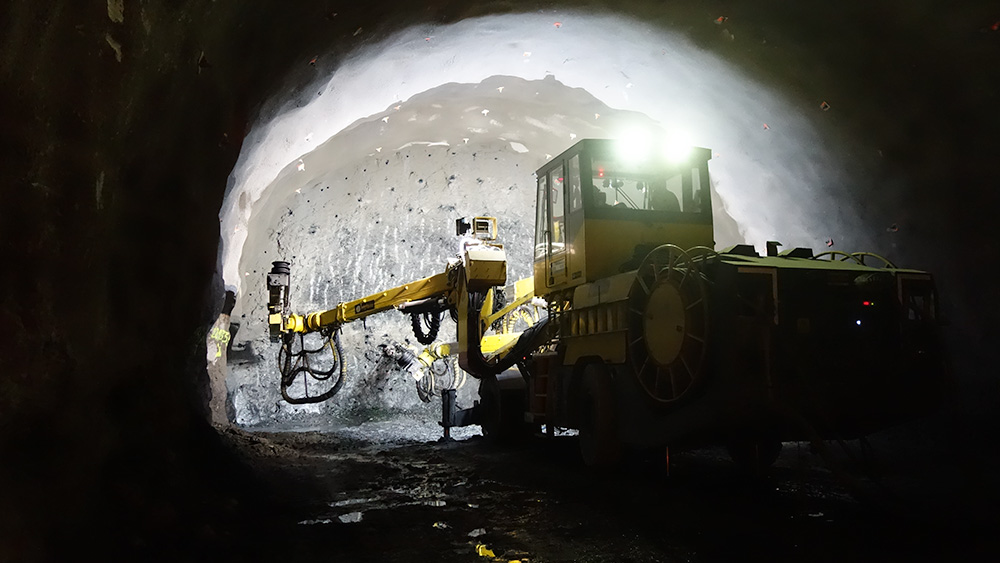
Above: A drill jumbo in the Rogfast tunnel. Image: Implenia.
Before any blasting can take place, a protective seal must be formed inside the rock surrounding the excavation area. That task falls to a highly sophisticated grouting machine, developed in Norway and unlike anything found on a standard construction site. Its tanks, kept under constant resupply, hold around 2.5 tonnes of microcement ground to particles of around 25 microns, finer than a human hair. Inside the machine, a computer blends this with water, superplasticiser and silica fumes in precise proportions.
The resulting mixture is then forced into the rock face at around 100 bars of pressure, at a rate of around 20 litres per minute. Depending on the rock formation being treated, a single operation can require between five and 75 tonnes of grout to complete.
With the seal in place, surveyors use laser-guided instruments to mark a precise grid of holes on the rock face. Working without GPS, they rely on total stations, high-precision optical devices that track positions to within millimetres. The jumbo then drills five metres into the rock at each marked point and the holes are packed with explosives. The tunnel is cleared and then comes the blast.
After each explosion, the rubble is removed and the excavated area is covered in a waterproof membrane and sprayed with shotcrete, a high-strength concrete applied under pressure. Reinforcing bolts are drilled into the walls to prevent the rock from deforming. Finally, the tunnel is lined with concrete panels. There will be 60,000 of them in total across the entire project, each one individually designed to fit its specific location.
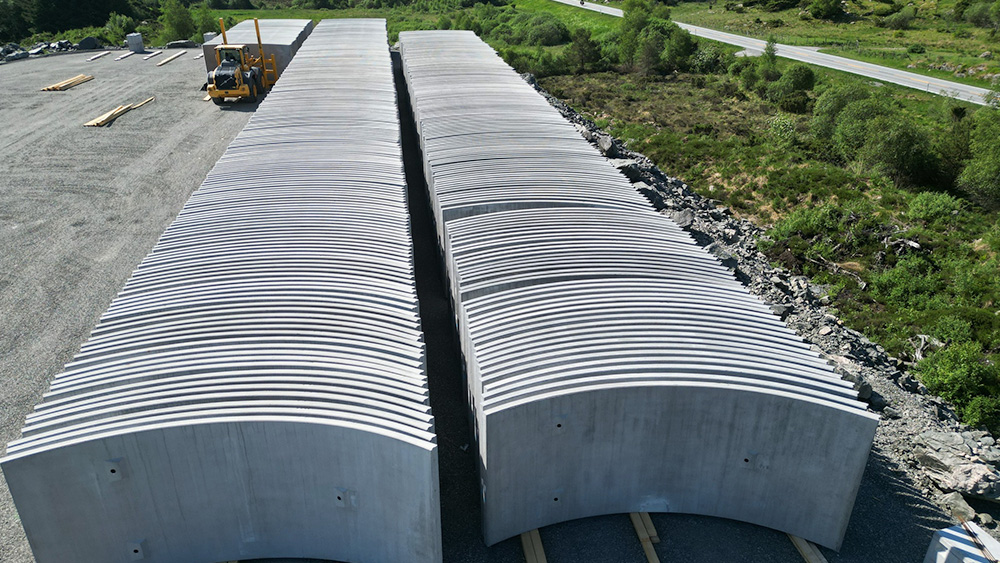
Above: Some of the 60,000 concrete panels that will line Rogfast. Image: Øyvind Ellingsen / Statens Vegvesen.
It is painstaking, methodical work. Each cycle advances the tunnel by around five metres.
Anne-Merete Gilje explains why this approach is preferable to a tunnel boring machine despite the slower pace. "Going through these large subsea tunnels with the uncertainty in the geology, it would be too risky to go with a TBM. A TBM is several hundred metres long, and if we have a water leakage or any problems, it is very hard to respond quickly. With drill and blast, if something happens we can go back and start dealing with the face immediately. It is much more flexible for this kind of project."
After every single blast, geologists inspect the newly exposed rock face, mapping its structures and properties, and deciding both what support the tunnel needs and how to approach the next round of drilling. The rock dictates the pace. There is no shortcut.
Ventilation is one of the most critical and least visible challenges in a tunnel of this length. Even a relatively short road tunnel requires mechanical help to keep air circulating. At 27-kilometres, and at depths approaching 400-metres, the problem becomes enormously complex.
Rogfast will be equipped with 245 jet fans positioned along its length, as well as ventilation towers at both shorelines designed to draw air through the system. But for a structure of this size, even that is not enough on its own.
The solution lies at Kvitsøy, a small island of around 500 people sitting roughly midway along the route. Two enormous ventilation shafts are being sunk deep into the rock beneath the island, drawing fresh air down into the tunnel far below and expelling stale air back to the surface. Without them, the tunnel simply could not function safely.
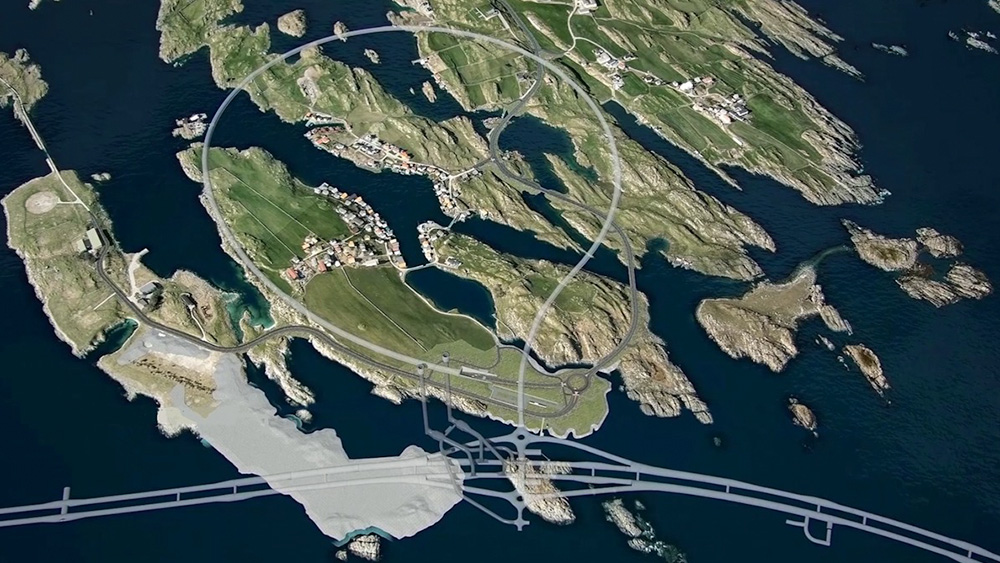
Above: An illustration of the Kvitsøy interchange. Image: Statens Vegvesen.
Each shaft was begun with a pilot hole drilled down from the surface. A drill bit 2.4-metres in diameter was then dragged back upwards through the rock, a process that took around three weeks. From there, the same drill and blast method used in the main tunnels was applied to widen the shaft to 9.4-metres. After the walls were lined with shotcrete and reinforced with bolts, crews were lowered by hoist to continue the work for a further 200-metres into the earth.
Standing at the bottom of a completed shaft and looking up, a faint sliver of daylight is visible far above. It is, by any measure, a remarkable thing to see.
Below the island, the Kvitsøy interchange is the most technically demanding section of the entire project and, by some distance, the most complex subsea road junction ever built. Two main tunnel bores meet a system of slip roads, two roundabouts, a link tunnel, cross-passages, access tunnels and the two enormous ventilation shafts, all threaded together 250-metres underground. Traffic heading north can take a slip road, navigate the deepest road roundabout on earth, and climb 4.1-kilometres up to the island surface. Traffic heading south does the same in reverse.
The result, as one engineer put it, resembles a vast underground rabbit warren, with routes going off in all directions, levels crossing over and under one another, and eight separate tunnel faces being worked on simultaneously in different directions.
Kvitsøy is not simply being used by the project, however. Under Norway's approach to major infrastructure, local communities are actively involved in shaping proposals rather than simply being presented with them. The island is receiving a permanent new connection to the main tunnel, 1.2 square kilometres of new land reclaimed from the sea using rock excavated during construction, upgraded roads and four new bridges that were completed before tunnelling underground even began.
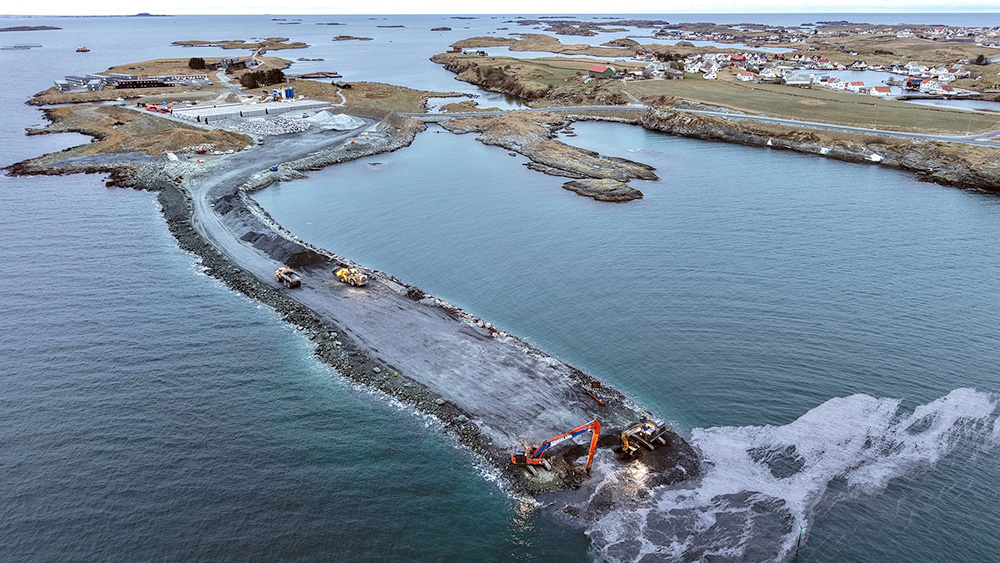
Above: Infrastructure on Kvitsøy is being upgraded in connection with the Rogfast tunnel. Image: Øyvind Ellingsen / Statens Vegvesen.
The scale of the project has required the construction teams to create something close to an underground world of their own. Deep in the southern tunnel, a mobile workshop travels with the drilling crews, moving further into the tunnel every 1,500-metres to stay close to the working face. Vehicles that break down are repaired underground rather than driven back to the surface, keeping the operation as efficient as possible.
Much of the heavy construction plant used on site is electrically powered, a reflection of Norway's broader commitment to low-emission industry. Underground, where batteries are not permitted, power is delivered via what amounts to the world's largest extension lead, a heavy cable running from the surface down through kilometres of tunnel to the machines at the face.
Rogfast is expected to be completed in 2033. When it opens, drivers will pass from one side of Boknafjord to the other in a matter of minutes, most likely without giving a second thought to what surrounds them.
Not far away sits the Ryefast tunnel, which currently holds the world record for the longest and deepest undersea road tunnel. Many of the engineers and workers now on Rogfast learned their trade building Ryefast. In breaking that record, they are in a sense breaking their own.
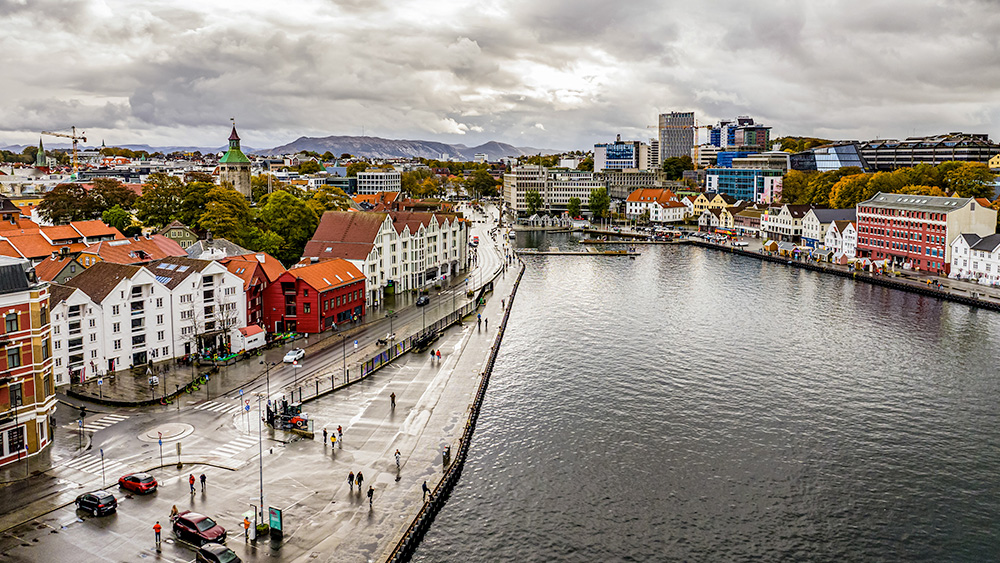
Above: The city of Stavanger is one of the cities being connected by Rogfast.
It will not be the last record to fall. Norway still has dozens of fjord crossings to complete along the E39, several of them presenting challenges that have not yet been fully solved. The floating tunnel proposed for Sulafjorden remains at the design stage. A multi-span suspension bridge with a mid-water tower anchored to the seabed is another possibility. Whatever the answer turns out to be, the people who find it will almost certainly have worked on Rogfast first.
For Norway, a country whose entire history has been shaped by the challenge of its landscape, that is perhaps fitting. For thousands of years, life on this coastline has meant negotiating with the natural world rather than trying to overcome it outright. This tunnel, deeper and longer than anything that has come before, is simply the latest and most ambitious expression of that relationship.
See how Procore AI can transform your next project here.
This video contains paid promotion for Procore.
Video narrated and hosted by Fred Mills.
Additional footage and images: Øyvind Ellingsen, Statens Vegvesen, Implenia, Femern, Rail Baltica.
We welcome you sharing our content to inspire others, but please be nice and play by our rules.
Comments