France is Building the World’s Most Expensive Road
- Youtube Views 2,643,631 VIDEO VIEWS

25 March 2026
Video hosted by Fred Mills. This video contains paid promotion for Rayon Design.
IN A REMOTE corner of France, an unfinished road is quietly becoming one of the most complex infrastructure stories in the country.
At first glance, the project appears straightforward: a new coastal highway designed to connect two key settlements. In reality, it is anything but simple. The route includes the longest bridge ever built in France, stretches kilometres out into the Indian Ocean, and has already cost billions of euros.
And yet, years after construction began, a substantial section remains missing. The reason lies in where this road is being built. Not in mainland Europe, but nearly 9,000 kilometres away, on the island of Réunion.
Located east of Madagascar, Réunion is a volcanic island in the Indian Ocean. Despite its distance, and its position closer to the tropics than to Paris, it is fully part of France. Under the Constitution of the Fifth French Republic, the country is defined as an indivisible republic, meaning overseas territories such as Réunion are governed in the same way as the mainland and represented in the national parliament.
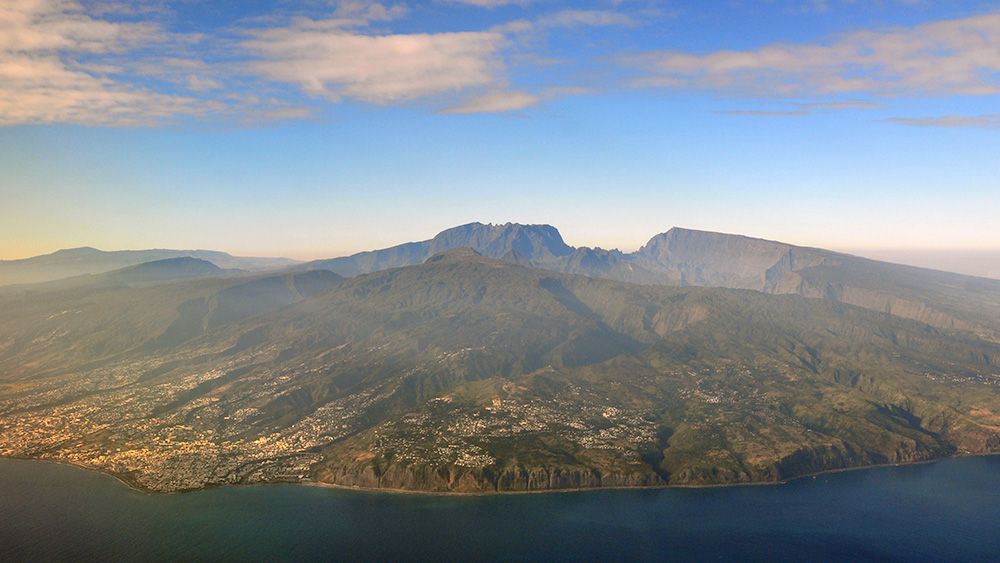
Above: Réunion.
That status has consequences. It means that a project like the Nouvelle Route du Littoral is not simply a regional upgrade, it is one of the largest active infrastructure schemes in France. The new route is intended to replace an existing coastal highway linking Saint-Denis, the island’s administrative centre, with Le Port, home to its main harbour.
Built in 1959, the original road runs along a narrow strip of land between the ocean and towering volcanic cliffs. Around 80,000 vehicles use it every day, making it one of the island’s most important transport links. It is also one of its most dangerous.
Réunion sits in a cyclone-prone region of the Indian Ocean. Severe storms regularly bring winds exceeding 200km/h, generating waves that crash directly against the road. At the same time, the cliffs above are constantly eroded by rain and heat, sending rocks and sometimes entire sections of hillside down onto the carriageway below.
In March 2006, a major rockfall killed two people when part of the cliff collapsed onto the road. The incident underscored the scale of the risk and accelerated plans for a replacement.
Engineers faced a fundamental problem: there was no safe way to widen or reinforce the existing route without exposing it to the same hazards. The solution was to move the road away from the cliffs entirely.
Initial proposals combined offshore embankments with a tunnel through the rock near Saint-Denis. However, geological surveys revealed that the volcanic formations were too fractured and unstable for large-scale tunnelling, making the plan prohibitively difficult and expensive.
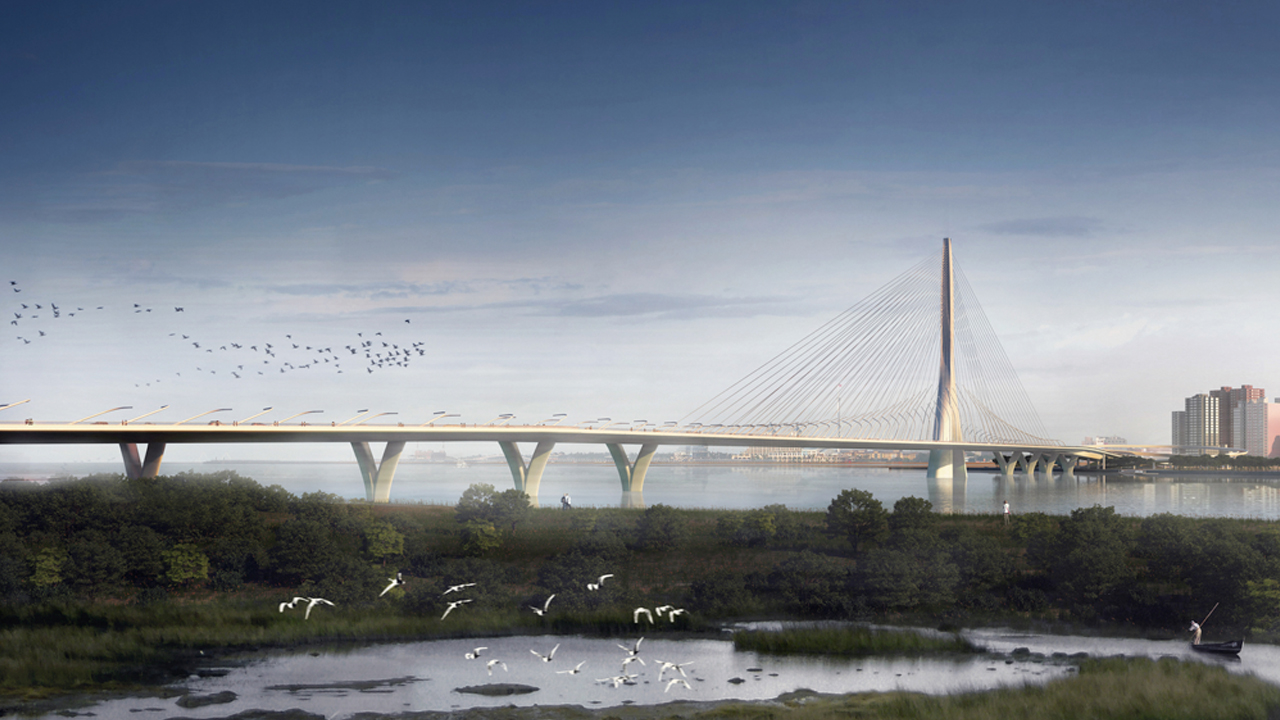
A revised design was approved in 2011. Instead of tunnelling, the road would be built largely offshore, combining massive dykes with a long viaduct running parallel to the coastline. At the centre of this plan is the Grande Chaloupe Viaduct. Stretching 5.4 kilometres and reaching up to 300 metres from shore, it forms the backbone of the route. When completed in 2017, it became the longest bridge in France.
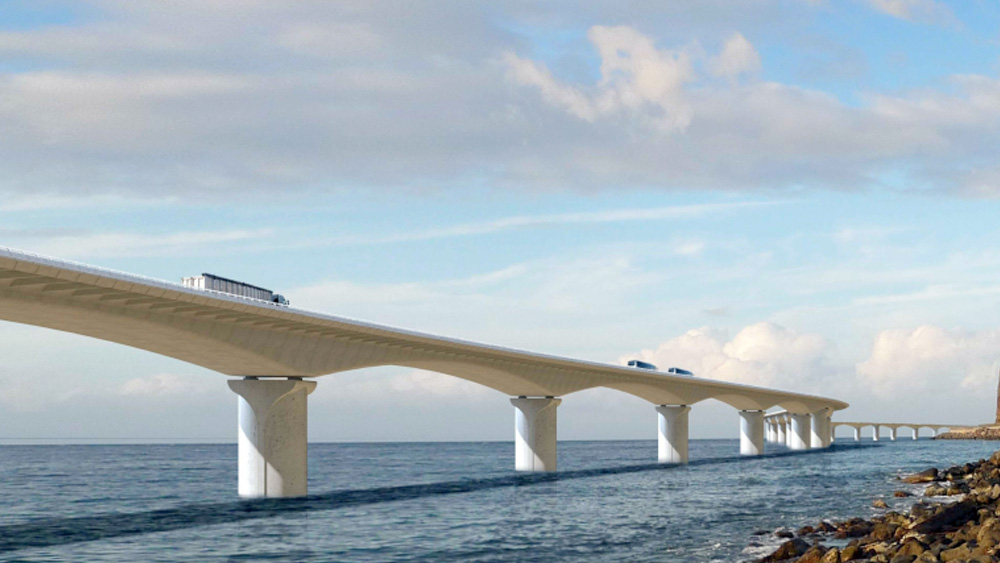
Above: A render of the Grande Chaloupe Viaduct. Image, Bouygues.
Constructing it required an approach more commonly associated with offshore energy projects than road building. Two dedicated concrete plants were built on the island to manufacture the bridge’s components. The structure itself uses a box girder design, with hollow concrete segments post-tensioned together using high-strength steel cables.
These segments rest on 48 piers, each designed to withstand powerful ocean swells while minimising resistance to waves and currents. Installing them was a major operation in itself. A specialised barge, Zourite named after the Creole word for octopus was brought in from Europe. Roughly the size of a football pitch, it is equipped with lifting systems and extendable legs that anchor it to the seabed.
From this platform, workers lowered massive concrete foundations into place with centimetre-level precision. Each base weighed around 4,500 tonnes and had to be stabilised on the ocean floor before the upper sections of the piers could be installed.
It took four years to complete all 48 supports. A launching gantry was then used to assemble the bridge deck, placing segments in pairs to maintain structural balance as the spans extended across the water. If the viaduct was the project’s most technically demanding element, the dykes proved to be the most problematic.
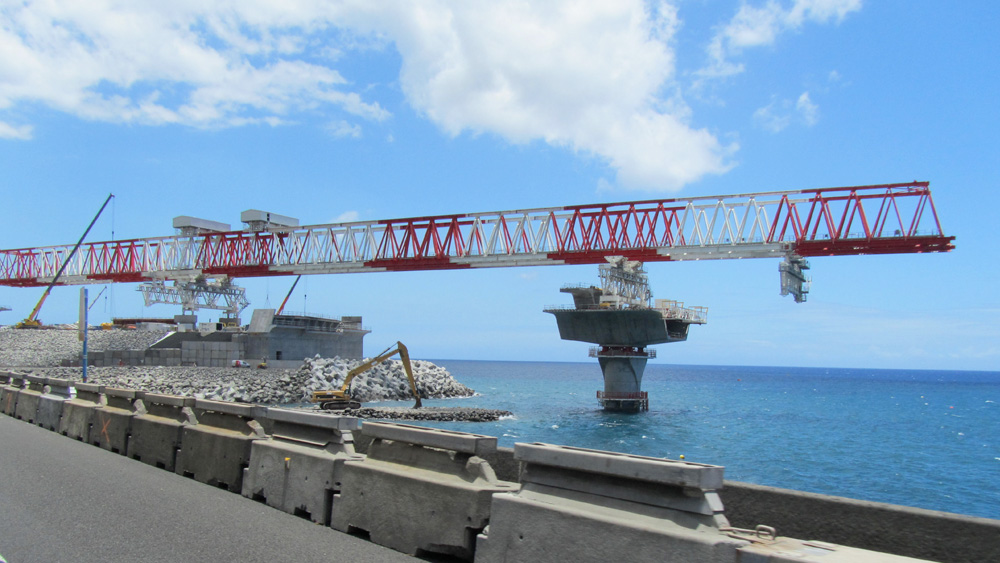
Above: Piers being installed on the Grande Chaloupe Viaduct.
These structures are designed not to resist the sea, but to absorb its energy. Built up from the seabed, they are protected by layers of rock and concrete armour. The outer layer consists of large interlocking units known as accropodes which break up incoming waves. Beneath them, progressively smaller rocks dissipate the remaining energy. The concept is well established in coastal engineering. The challenge, in Réunion, was scale.
Initial estimates suggested around seven million cubic metres of rock would be required to complete the dykes. To meet this demand, authorities proposed opening new quarries on the island. The plans quickly ran into opposition. Local residents and environmental groups argued that quarrying would damage sensitive ecosystems, generate dust and noise, and disrupt nearby communities. Réunion is known for its biodiversity, with coral reefs, marine life and protected habitats both on land and offshore.
In 2018, a court blocked the development of the proposed quarries, citing the risk to protected species. Without a reliable source of material, construction slowed dramatically.
Engineers turned to alternative solutions, including collecting volcanic rock from farmland across the island. Farmers were encouraged to clear boulders from their fields, which were then transported to the construction site. The approach provided some material and offered agricultural benefits, but it was not enough.
A review revealed that the original estimates had been significantly too low. Rather than seven million cubic metres, closer to 12 million would be needed. By 2019, work on the dykes had effectively stalled.
Costs had also risen sharply. With only part of the 12.5-kilometre route complete, the project had already exceeded $2bn, placing it among the most expensive road schemes of its kind.
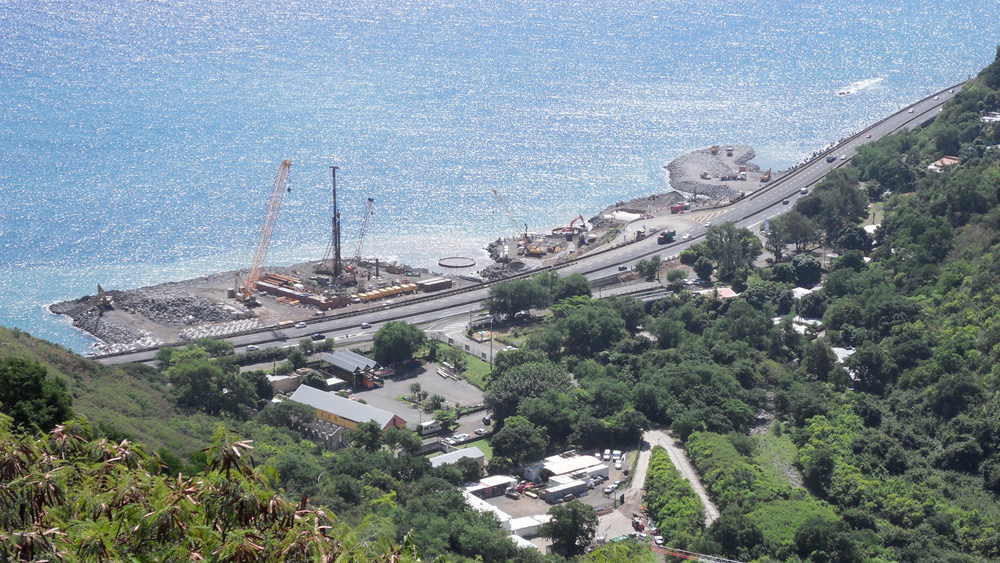
Above: The construction site of the dyke.
Further complications followed. In 2021, it emerged that hundreds of accropodes had been incorrectly installed, requiring costly rework. Faced with mounting delays and escalating costs, authorities opted for a new approach.
In 2022, the decision was taken to complete the remaining section not as a dyke, but as an extension of the viaduct, effectively turning more of the route into a bridge. While technically viable, the change comes at a price. Estimates suggest it could add hundreds of millions of euros to the final cost.
It also introduces new logistical challenges. The specialised barge used to install the original bridge piers had already been returned to Europe after work on the viaduct was completed in 2017, meaning similar equipment will need to be sourced again.
Preliminary works on the final section began in late 2025, with full construction expected to start in 2027. Completion is currently scheduled for 2030. For now, the Nouvelle Route du Littoral remains incomplete.
Sections of the new road are open and in use, but drivers must still divert onto the original coastal route to navigate the missing stretch, the very hazard the project was designed to eliminate. The situation underlines the broader challenge of building major infrastructure in remote and environmentally sensitive locations.
Réunion has a long track record of delivering complex engineering projects despite its isolation. But the new coastal road shows that even with substantial resources and political backing, geography can still dictate the pace, and the outcome, of construction.
What was conceived as a solution to one of the island’s most dangerous roads has instead become a case study in the limits of engineering ambition.
Rayon is the all-in-one, effortless CAD tool for going from concept to completion. Try it (for free) here.
Additional footage and images: France 24, Region Reunion, FOXLIMA10, O'TV Regardez La Réunion, Réunion La 1Ere, 974Runmike, Al Jazeera, IMAZ, Agence Sinusoide, Ina Actu, Viaduc Littoral NRL.
We welcome you sharing our content to inspire others, but please be nice and play by our rules.
Comments