The $4BN Megaproject Under America's Military Gateway
- Youtube Views 1,116,398 VIDEO VIEWS

27 April 2026
Video narrated and hosted by Fred Mills. This video contains paid promotion for KiwiCo.
YOU will know the Golden Gate Bridge. You’ll have seen the Channel Tunnel before (probably). But how well do you know your bridge-tunnels?
Yes, they’re very much a thing, and they’ve been around for decades. There are bridge-tunnels connecting Sweden and Denmark, joining Hong Kong and Macau, and crossing the two sides of Tokyo Bay.
It was the USA, however, that did it first. And in a place you’ve possibly never heard of. All because of the world’s largest naval base.
But, how did this trigger the need for a completely new kind of infrastructure, and why has it become a huge building site again more than 50 years later?
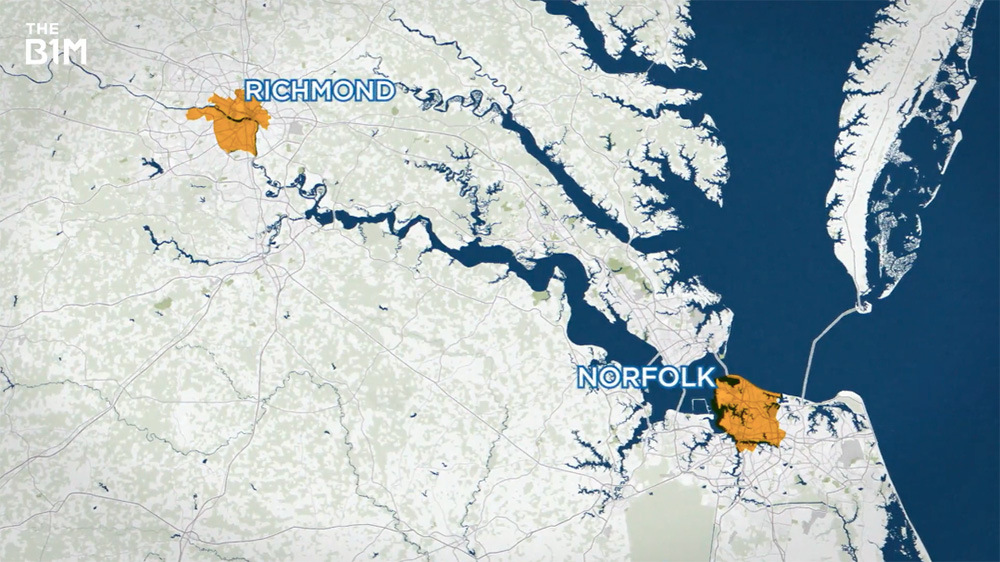
Above: Norfolk, Virginia is a small port city around 150km from Richmond, the state capital.
If you’re not familiar with Norfolk, Virginia then to be honest, you’re not alone. But while this isn’t the most famous place along America’s east coast, it does have some landmarks of its own, including one that’s kind of hard to miss — Naval Station Norfolk.
It’s the largest naval facility in the world, and the US Navy has more vessels based here than anywhere else on Earth. The city is also home to the world’s first ever bridge-tunnel.
What are bridge-tunnels?
But what exactly do we mean by that? Well, the name sort of gives it away — it’s a bridge that transforms into a tunnel when crossing a body of water, then normally goes back to a bridge again before it reaches the other side.
The reason they’re not that common is it usually makes more sense to do one or the other. After all, doing both can be, as you’d imagine, a lot more complicated.
And yet that’s what the Virginia Department of Highways — now the Virginia Department of Transportation, or VDOT — decided to do back in the 1950s.
Prior to that, anyone who wanted to travel between Norfolk and Hampton, across the harbour, would have to take the ferry.
The trouble was, it took ages, they struggled to keep up with demand and couldn’t operate in adverse weather. Clearly, a new route over the water was needed — one that could carry Interstate 64 for three and a half miles.
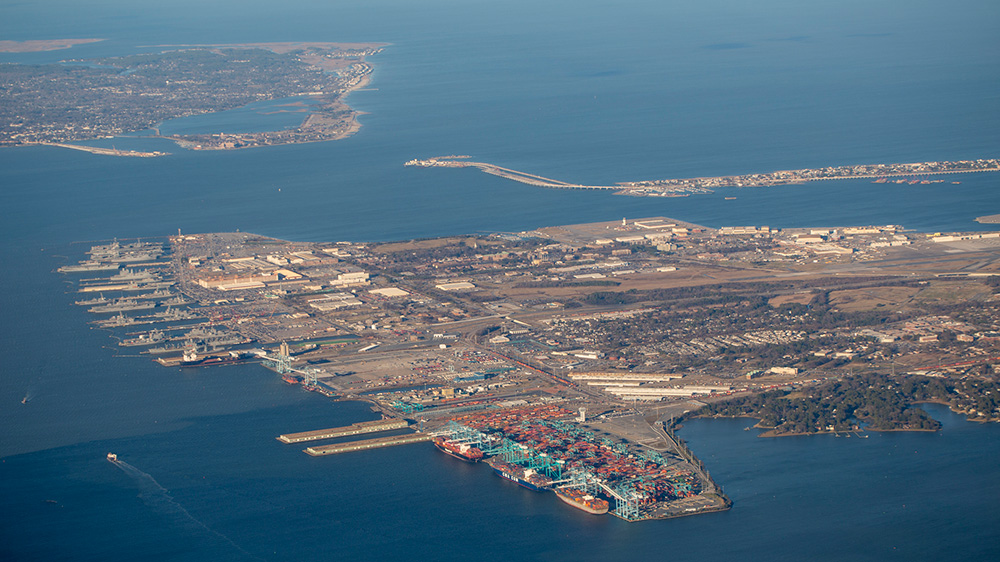
Above: An aerial view of Naval Station Norfolk and the Hampton Roads Bridge-Tunnel.
A regular bridge was not an option because huge Navy ships had to pass through the same spot. Building one tall enough for them to get under wasn’t really possible, and they couldn’t run the risk of a bridge collapsing and leaving the whole fleet stranded.
They couldn’t place it all in a tunnel either because a) that would’ve been too expensive, and b) ventilation systems in the ‘50s weren’t as good as they are now, which meant there were limits to how long a tunnel could be.
So, the choice was made to do what had never been done before — constructing two artificial islands that would allow the road to go most of the way across the water before disappearing beneath it. Then, vehicles would enter an immersed tube tunnel.
Immersive action
This is where segments of the tunnel are pre-manufactured, floated out into the water and then dropped onto the sea, river or in this case harbour bed. Next, they’re sealed together, the water is pumped out and the tunnel is covered up.
It was one of the first cases of this method being used in the US and it’s still popular today. We’ve seen it before on the Fehmarnbelt Fixed Link between Denmark and Germany, and the Scheldt Tunnel in Belgium.
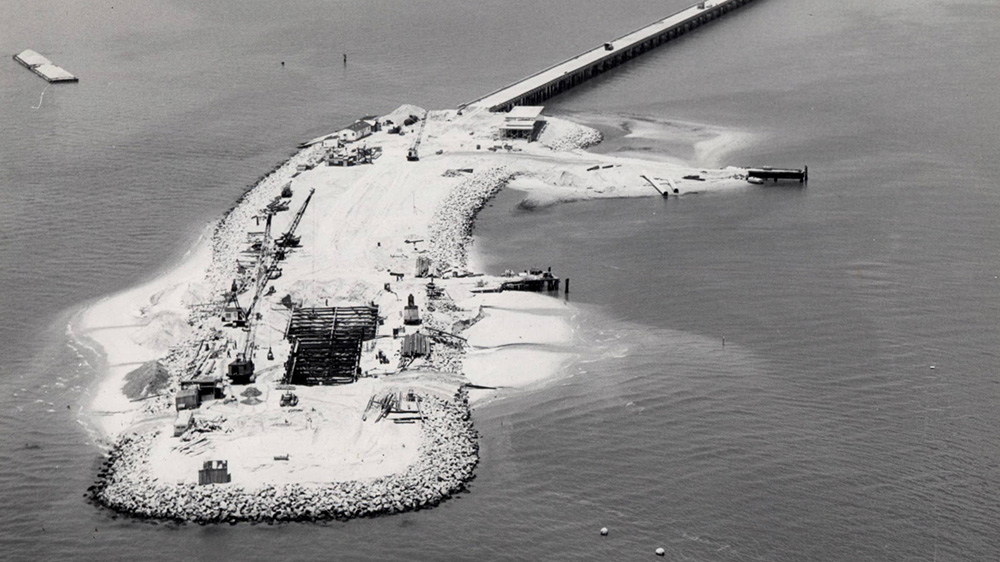
Above: Construction of the original Hampton Roads Bridge-Tunnel in the 1950s. Image: Virginia Department of Transportation.
1957 saw the opening of the Hampton Roads Bridge-Tunnel — or HRBT for short, because Americans love an acronym.
It was so successful, a pair of similar crossings were built afterwards. First there was the massive Chesapeake Bay Bridge-Tunnel in 1964, and then the Monitor Merrimac Bridge-Tunnel in ’85. And they were all built this way because they’re situated on that same shipping lane.
“One of the very unique things about our region here in southeastern Virginia that we refer to as Hampton Roads — we have the largest collection of immersed tube tunnels anywhere in the world. We have ten,” explained Ryan Banas, project director for the HRBT Expansion Project at VDOT.
“So the use of immersed tube technology — VDOT is considered a worldwide leader in using that methodology.”
Just one more lane, bro
As the years went by, however, it became evident that two lanes for the HRBT — one in each direction through a single tunnel — wasn’t going to be enough. Therefore, in 1976, a second tunnel was added.
“Upon the completion in 1976 we had two tunnels handling two lanes of traffic in either direction — so, total capacity of four lanes of traffic across the harbourm” said Banas. “However, shortly after, our local legislature started studying how we could again increase capacity.”
Yep, It was time for another upgrade because around 100,000 vehicles now use this piece of infrastructure every day in the peak summer season. And they’ve been known to experience tailbacks of up to five miles when something goes wrong on the route.
Because the lanes are narrow and there aren’t any shoulders, if there’s an accident of any kind, gridlock and bottlenecks are the inevitable result. Hence why VDOT is expanding it — again.
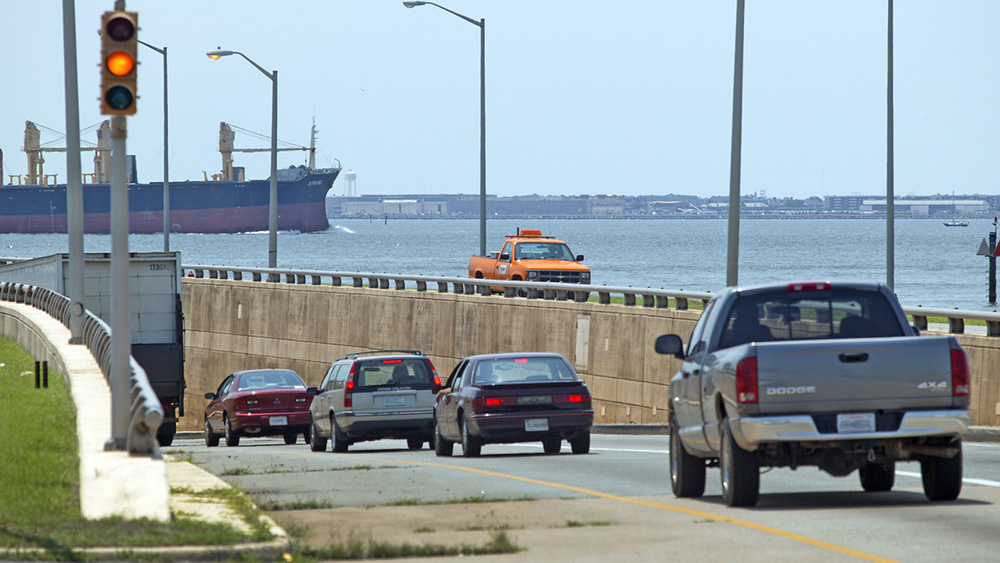
Above: The crossing regularly experiences heavy traffic. Image: Virginia Department of Transportation.
But this time they’re doing it differently. They realised instead of faffing around with more immersed tubes, they could just bore a big hole — well, two of them — between the islands.
It would require a tunnel boring machine, and a big one, at that — with a whopping 46-foot diameter and 430-foot length.
“Here in the States, bored technology in soft ground, like we have here at the HRBT, has really come on leaps and bounds in only the last 10, 15, 20 years,” said Banas. “In fact, the HRBT is using the world’s largest variable density tunnel boring machine ever fabricated.”
Called Mary, it was named after Mary Jackson, the mathematician and engineer from Hampton who worked on the NASA Space Program in the 1960s.
Mary’s task was to construct both of the roughly 1.5-mile-long tunnels, around 50 feet beneath the tubes that were built in the ‘50s and ‘70s.
Deep dive
This is because bored tunnels can’t be constructed just below the harbour bed, like immersed tubes, which are covered up after they’re placed.
If you tried to do that with a TBM, the buoyancy of the tunnel — built through saturated ground — would see it try and pop up to the surface, and that wouldn’t be good.
So, they have to dig much deeper than the immersed tunnels to leave enough earth above it — what’s called overburden — to stop that happening.
Before the project team could do any of this, though, they had to make one of the islands bigger. Otherwise there would be no room for the new trestle bridges or tunnel portals.
Fortunately, this had already been done on the south side back in the ‘70s, but the north end was still too small.
“So, our North island required our contractor to come in, build temporary breakwaters around the perimeter and offset such that we were not exposing our existing island to wave action,” revealed Banas.
“We then had to go through, dismantle the side of the island where we had all that large armour stone and riprap protection, fill that with good material that we could eventually mine through and excavate, and only then, when all of that work was complete, were we able to bring the machine onto the island.”
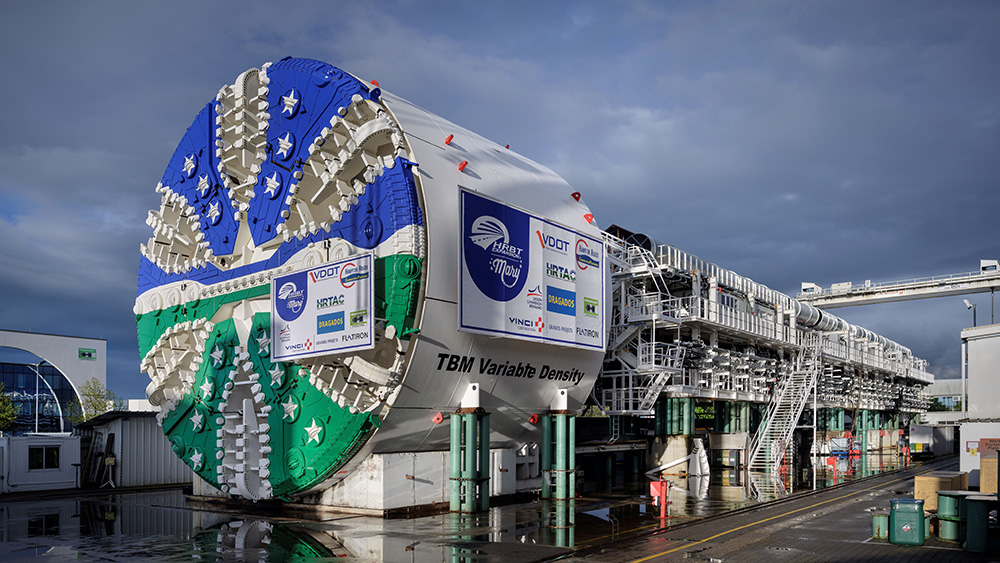
Above: According to VDOT, Mary is the largest variable density tunnel boring machine ever fabricated. Image: Virginia Department of Transportation.
But how did the TBM get to the South island, where it began its journey under the harbour? Well, first it was made in Germany and shipped to the Port of Virginia in various pieces.
These segments were then transported to the island by truck before being craned into an open pit and assembled together.
That’s what the three overlapping holes are for on the South Island. It’s a launch pit — the starting point for the TBM — while up the other end, this single opening is the receiving pit. Here is where the machine reappeared before it turned around and went back to drill the second parallel tunnel.
About-face
Yes, we do mean “turned around.” Following the first run, everything behind the shield and cutterhead was removed and the TBM was able to do one of the world’s biggest — and slowest — 180’s.
This was achieved using 16 nitrogen-infused hydraulic jacks, which helped to reduce friction on the 2,500-tonne load. But it still took 12 hours.
Nitrogen skate technology is another term for it, and it’s only ever been done once before — on the new Silvertown Tunnel in London.
Overall it took almost two and a half years to dig both tunnels, with the grand finale coming in September 2025.
By this point, Mary had burrowed through more than a million cubic yards of sand, silt and clay soil — enough to fill 70,000 concrete mixer trucks. Then it was time for her to be disassembled, with the components carried out through the same opening as before.
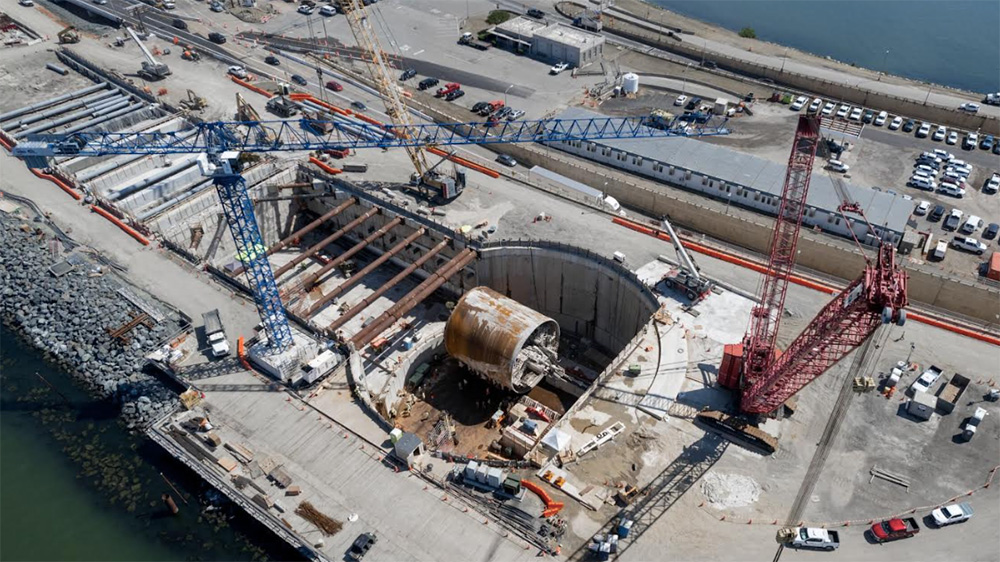
Above: The cutterhead nestled in the receiving pit. Image: Virginia Department of Transportation.
So, that covers the tunnel, but what about the bridges? Obviously, they’ve had to be made bigger to accommodate all those extra lanes, without shutting down the whole interstate.
What they’ve been doing, then, is building a wider — and higher — set of trestle bridges to carry the expanded roadway.
Meanwhile, traffic has been gradually directed onto the new segments as they complete, allowing for the old structures to be demolished.
Barges were brought in again to construct the piled foundations — or pedestals — as well as the girders that support the decks of the new bridges.
They acted as floating work platforms for the heavy cranes and piling rigs that were needed to carry out these tasks, which usually operate on dry land.
Launching forth
And yet a separate strategy was required for the Westbound North Trestle, which sits between the existing structures. It’s a tight space that barges can’t really get to.
The solution was to call in another huge piece of equipment that sounds as awesome as it looks — a beam launcher.
It was used to take the huge horizontal girders from the delivery trucks, launch them up to the uncovered foundations and then place them neatly on top.
When finished, the new bridges will bring the total number of lanes up to eight. That’s two general purpose lanes, a full-time express lane and a part-time shoulder express lane in both directions.
But of course, none of this would work without expanding the routes that connect on to the bridge-tunnel as well.
Which is why the approaching roads, from Mallory Street in Hampton to Patrol Road in Norfolk are being widened as part of the project.
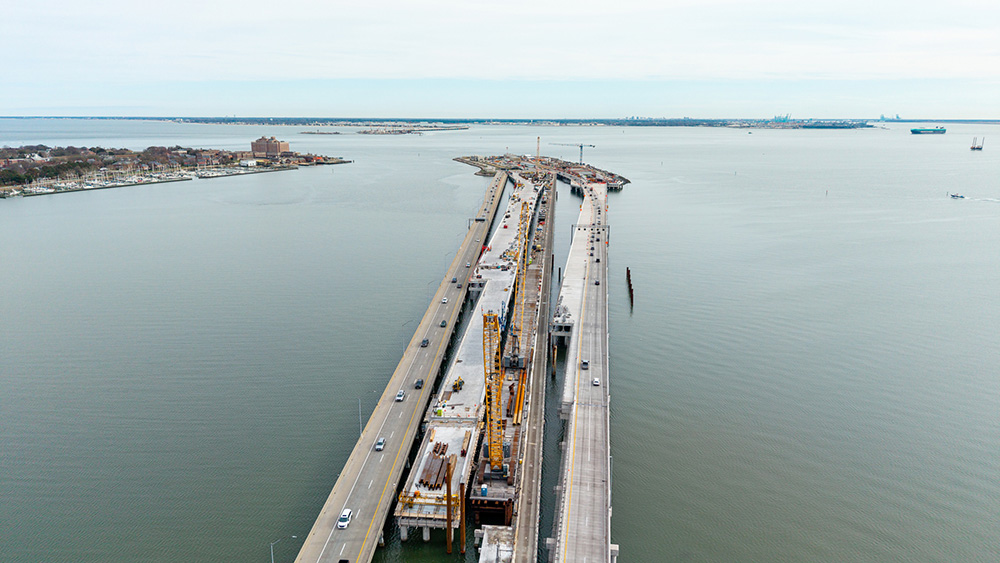
Above: Upgrading the trestle bridges was a complex challenge.
Now, if you’re wondering what the cost of all this is then the answer is quite a lot, but not as much as you might think. Just under USD $4BN. Less than Gordie Howe Bridge, for example, which didn’t even have a tunnel in the middle.
Most of those dollars come from a fund set up to finance new construction projects in the area, which in turn gets its money from local sales and fuel taxes.
Usually this is the point where we mention that this figure is drastically higher than the original estimate, or it’s pretty out of date and the actual cost is far more.
But no, not this time, which makes this a major US infrastructure project that’s managed to keep itself on budget.
Running late
Not all of this watery work has gone swimmingly, though. There has been a fairly substantial delay. According to VDOT, the design-builder “has struggled to meet projected production rates and near time completion dates.”
Hampton Roads Connector Partners is the group in question — a consortium of several major construction companies. What was initially due to complete in late 2025 will now do so in early 2027.
But this is no ordinary job. It’s the largest infrastructure project in the history of Virginia using the second biggest TBM ever deployed in the US.
They’re combining tunnelling, bridge building, road connections and marine construction all in one go, and it doesn’t get much more difficult than that.
A setback in the schedule is never good, but in this case you can perhaps understand why there have been a few unforeseen circumstances.
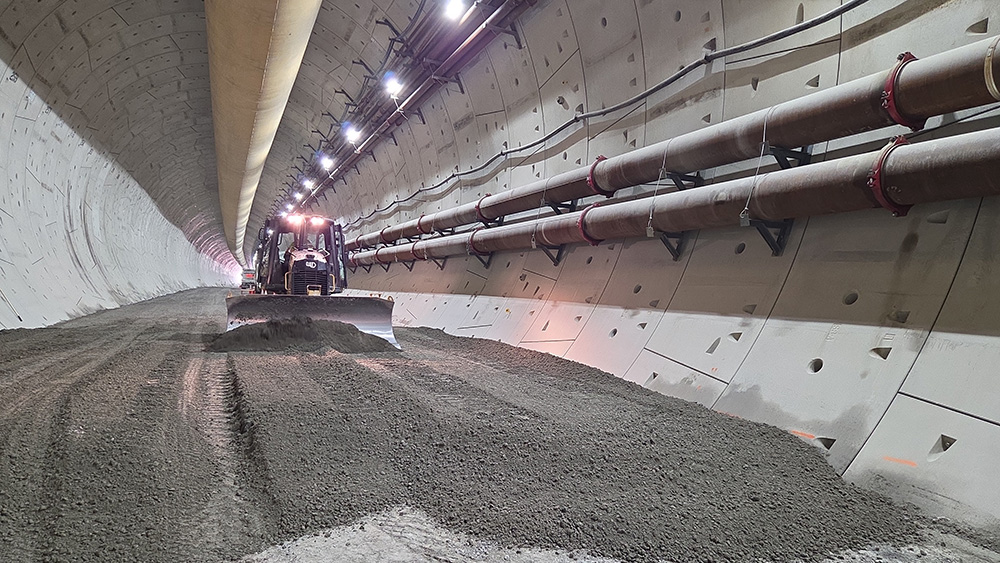
Above: Ballast placement inside one of the new tunnels. Image: Virginia Department of Transportation.
America’s ‘just one more lane’ obsession may have sparked a meme, but you can forgive the good people of Virginia for repeating it again here.
This historic crossing was never meant to handle what it’s being subjected to each day, so what we’re seeing here is an upgrade that actually makes sense.
In a country that often stumbles when trying to match its past construction achievements, could this be proof that it still has what it takes?
Inspire the future scientists and engineers that you love by visiting kiwico.com/theb1m today. Use the code THEB1M for 50% off your first monthly crate.
Additional footage and images: Virginia Department of Transportation, U.S. Navy, Ben Schumin, Gordie Howe International Bridge, Herrenknecht, Lantis, 13News Now, Warner Bros., WAVY TV 10 and WBFF FOX 45 Baltimore.
We welcome you sharing our content to inspire others, but please be nice and play by our rules.
Comments