Will Los Angeles Be Ready For The Next Olympics?
- Youtube Views 1,272,279 VIDEO VIEWS

13 April 2026
Video narrated and hosted by Fred Mills. This video contains paid promotion for Accenture.
THE 2024 Paris Olympics. Seems like yesterday, doesn’t it?
Well, 2026 means we’re now already halfway towards the next Games, and this one that has set some pretty ambitious targets.
There will be zero new venues, and not only that — it’s positioned itself as a “no-car” event. But hang on, where is it being held again?
That’s right, Los Angeles. Despite having a strong Olympic past, LA isn’t exactly known for its public transit and has numerous other challenges to overcome before the Summer of 2028.
So, what are they, and most importantly of all, will the city actually be ready in time?
The announcement
When Los Angeles was awarded the 2028 Olympic Games back in 2017, the situation was far from normal.
Paris was given 2024 at the very same event. Two host cities had never before been announced together. But there were good reasons for this.
“It became very clear that the IOC was having enormous difficulties finding cities that wanted to host the Games,” said Andrew Zimbalist, economist and author of Circus Maximus: The Economic Gamble Behind Hosting the Olympic Games and World Cup.
“And indeed, the potential hosting for the 2024 Games had four cities — four cities that had been bidding to host the games — drop out.
“When they made their decision in 2017, there were only two bidders left — one was Paris and one was Los Angeles. They were both good bets.”
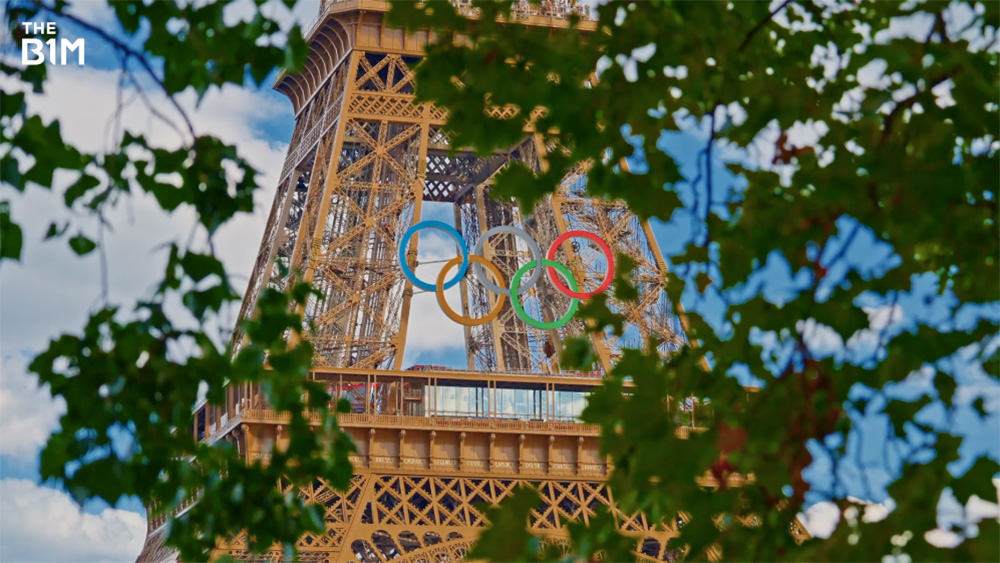
Above: Paris was handed the 2024 Olympics at the same time LA was awarded the 2028 Games.
Although Paris got 2024, LA was still a strong contender and agreed to wait another four years in return for extra funding.
Which was helpful, because the next tournament is expected to cost around $7BN.
What made America’s second city a “good bet” for 2028 wasn’t just that it would avoid another awkward round of bids from a dwindling number of candidates later on. No, It’s the fact it’s already been there and done it — twice.
Tried and tested
The first occasion was way back in 1932. Taking place during the Great Depression, there were half as many athletes competing compared to Amsterdam four years earlier.
But that didn’t stop a then-record-breaking 100,000 people turning up for the Opening Ceremony.
Fast forward half a century and LA 1984 once again saw fewer countries competing — this time due to a boycott from the Soviet bloc.
And yet, you had Carl Lewis winning four gold medals, Michael Jordan top-scoring in the basketball and, incredibly, the Games finished with an actual profit — of over $250M.
2028 will see Los Angeles become the first to hold the Olympics three times, and it’ll continue a trend set by the two previous hosts.
Both Paris and Tokyo focused on reusing venues rather than building lots of new ones. Not only did this help reduce costs; it avoided them spending huge amounts of money on giant arenas that could go on to become white elephants, as we’ve seen in the past.
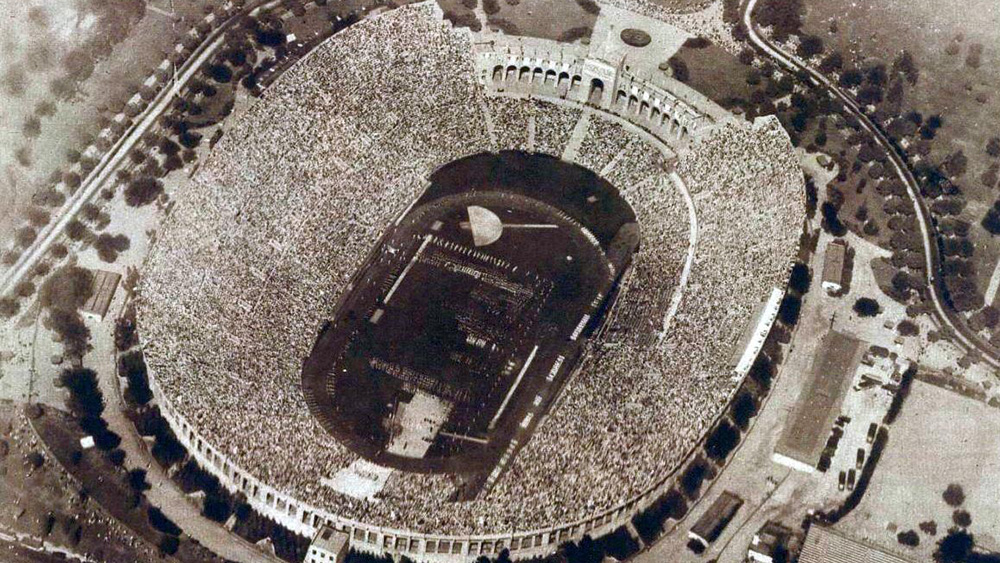
Above: The 1932 Olympic Opening Ceremony at LA Memorial Coliseum attracted huge crowds.
Paris set the bar, with 95% of its venues already existing, but LA 2028 plans to raise it further — going ahead without any new builds at all.
You can understand why, especially when many of its stadiums need very little doing to them, or they’re freshly constructed.
Take the brand-new Intuit Dome — now home to the Clippers of the NBA. No prizes for guessing that’s where you’ll find basketball.
Dodger Stadium will be for … yep, baseball, and the Whittier Narrows Clay Shooting Center is hardly going to be hosting the Dressage now, is it?
While some of the venue choices are obvious, not all of them are being utilised in the way you might think. And others need a fair bit of upgrading before they’re ready for the 2028 Games.
Making a splash
Take the new Sofi Stadium — primarily built for NFL and now set to host FIFA World Cup matches in 2026, plus the Super Bowl in 2027.
But in 2028, Sofi won’t be hosting the footie or American football, which isn’t even in the Olympics. No, fans will be coming here to watch — wait for it — swimming.
That’s right, the most expensive stadium ever built is going to be converted into the largest dedicated aquatics venue in Olympic history, with 40,000 seats.
Although details of how they will do this aren’t fully known, it will obviously involve building a giant pool into the floor. One that will have to be taken back out in time for the next NFL season later that year.
It’ll be a massive undertaking, but Paris proved this sort of thing can be done. This temporary pool, built for the 2024 Games, was constructed in just over a month.
Doing something similar at Sofi will put swimming on a much bigger platform than when LA last hosted the Olympics.
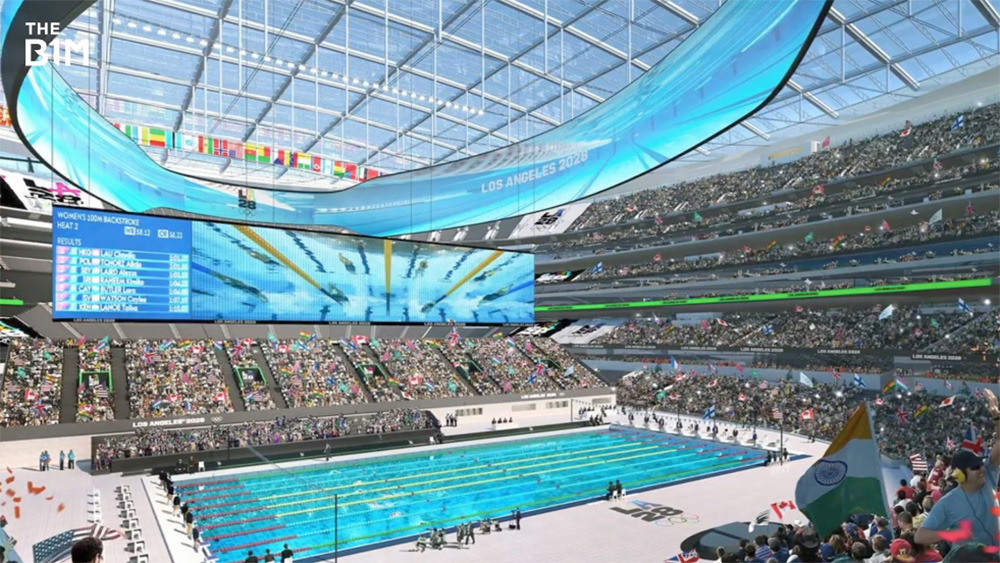
Above: A rendering of Sofi Stadium post-transformation. Image courtesy of LA28.
The original idea was for Sofi to hold the Closing Ceremony as well, with the LA Memorial Coliseum handling the opener. But plans have changed slightly. The Opening Ceremony will now be co-hosted by both stadiums.
In fact, the Coliseum is another iconic venue that’s set to undergo a bit of a transformation. Because like most main Olympic stadiums, it’s also going to be used for athletics.
Except there’s a problem. When it was upgraded in 1990, a load of extra seating was added in around the lower tiers.
Which meant more capacity, but leaving no room for something every track and field venue needs. The track.
Hold the floor
What they intend to do is build a temporary deck on the floor of the bowl, propped up on supports.
This will create the track and field, as well as space underneath for athletes to complete their warm-ups.
Overall, there will be more than 40 venues spread across the city, from Santa Monica to Anaheim, and Pasadena to Long Beach.
As for getting to these sites, with this being LA you might assume visitors will just pull up in their cars.
Well, according to Mayor Karen Bass, the plan is for people to do the exact opposite, with the main push being ‘no cars to the venues.’
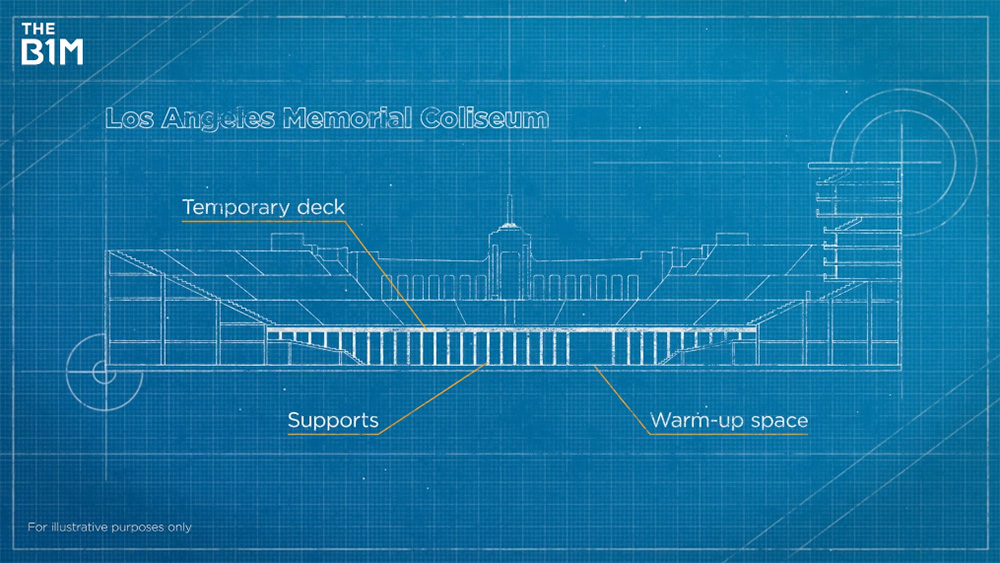
Above: How the Coliseum will be turned back into a track and field venue.
OK, but because many people still consider Los Angeles to be a car-centric city, that idea might sound kinda crazy.
Or maybe not, because LA has introduced a completely new way of getting around since it last held the Olympics, which has nothing to do with driving. The metro system.
In 1990 — just six years after the event — the city unveiled its first line, finally giving Angelinos the option to travel by rail instead of road.
Fast forward a quarter of a century and the network includes well over 100 miles of routes now stretching across the city. While much of that work took place years ago, quite a lot has been done to this infrastructure since the LA 2028 announcement.
About time
As of June 2025, the rail system has finally been linked up to the airport, on the K and C lines.
An automated people mover — also long-awaited — is set to follow in 2026. This will provide a direct rail link between the new Metro Transit Center and the LAX terminals.
Another example of recent progress is the southern section of the Blue Line — now called the A Line.
Heading Straight Outta Compton, down to Long Beach, the route was given upgraded tracks, power lines, switching and control systems in 2019.
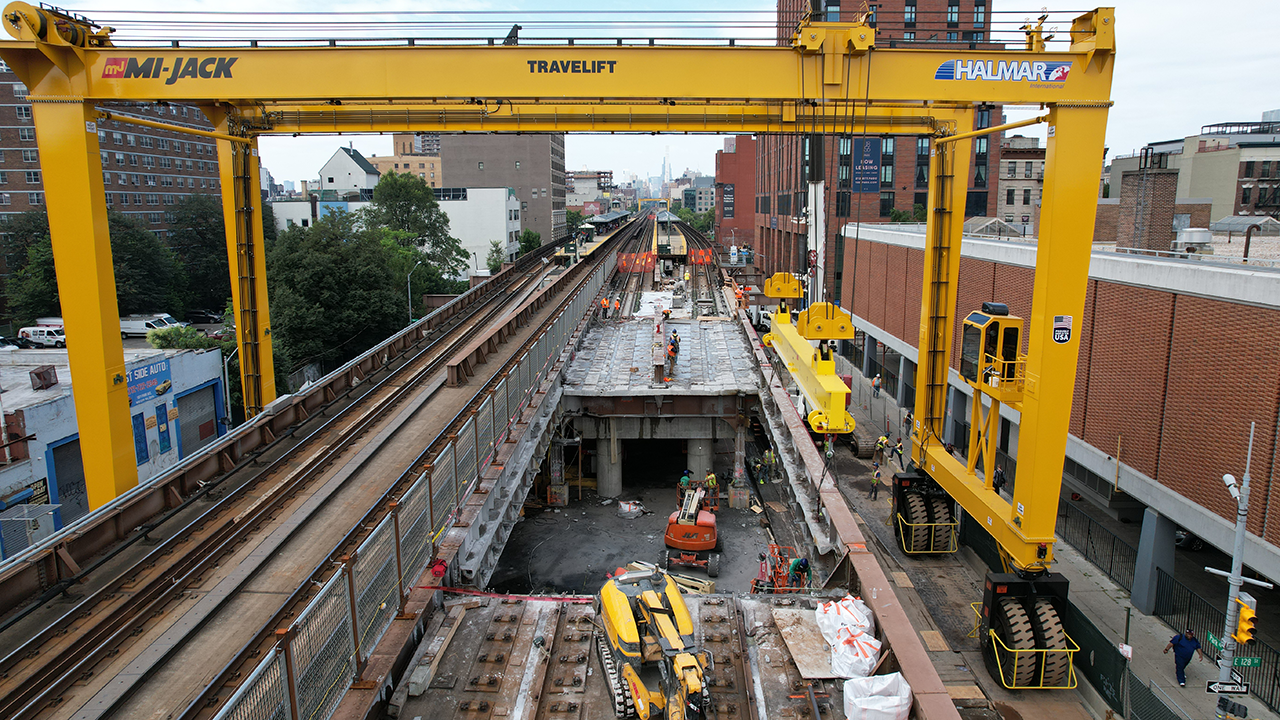
Then there’s the Eastside Transit Corridor, which will link Downtown to four of the so-called Gateway Cities in southeast LA County.
The first phase, connecting Little Tokyo to the Atlantic station in East Los Angeles as part of the E Line, completed back in 2023. Arguably the most important upgrade of all, however, is still under construction.
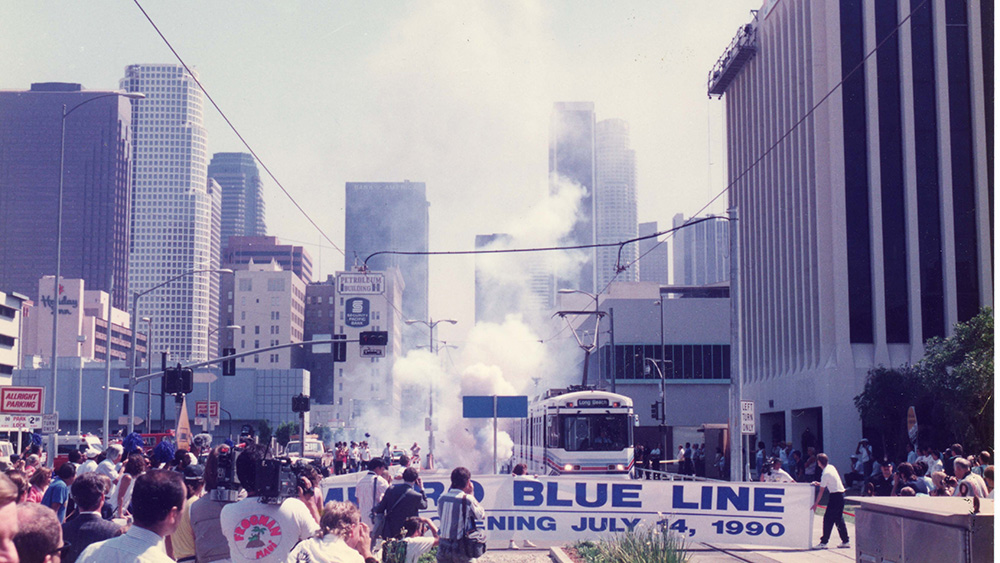
Above: The opening of what was then called the Blue Line in 1990. Image courtesy of Metro Transportation Research Library and Archive.
“The project that is most critical, not only for the games, but for the future of Los Angeles is the subway that's being built under Wilshire Boulevard,” said Joshua Schank, partner at InfraStrategies and former chief innovation officer for LA Metro.
He’s referring here to the D Line Extension. This will run from Union Station, through one of the city’s biggest retail and commercial districts, and out to the Westside.
“That's a high-capacity system in a very dense corridor, and it will move a tonne of people much faster than buses can, and obviously much more effectively than cars,” Schank continued.
While the full route — with its seven new stations — isn’t supposed to finish until 2027, the tunnelling for it concluded in 2024.
Going underground
Two tunnel boring machines spent five years digging the 14km new line, which is set to carry around 30,000 people per day.
One LA Metro Board Member called it one of the most complex engineering feats the city’s transport authority has ever undertaken.
As workers excavated around 50 feet of tunnel each day, they discovered obstacles like gassy ground, tar sands and abandoned oil wells.
Thankfully, passengers will be moving through it a lot faster when it’s in operation, carrying them from Downtown to West LA in less than 30 minutes.
These works are all part of the ‘Twenty-eight by 28’ initiative announced by the city’s former Mayor in 2018.
It’s a list of, yep, 28 transport projects the City of Los Angeles planned to complete in time for the Games, due to cost more than $26BN in total. So far, around a third of them are in operation.
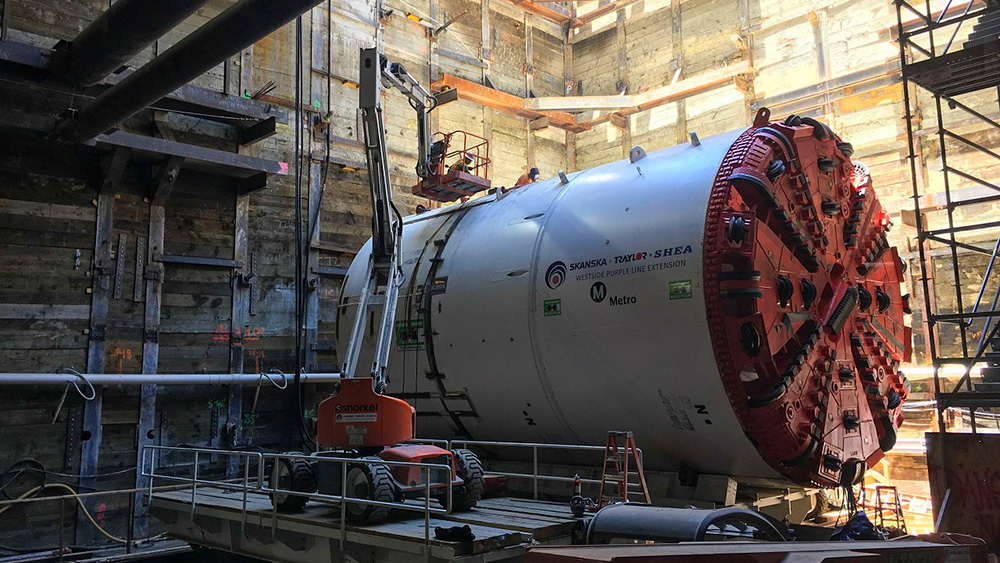
Above: One of the TBMs used to construct the D Line Extension. Image courtesy of Metro Transportation Research Library and Archive.
Now, getting people to travel by rail isn’t the only objective. A ‘no-car’ strategy doesn’t mean no roads at all. That would be impossible in a city like LA.
Those who still insist on driving will have to park away from the venues, or travel by Uber, bike or scooter via one of the planned mobility hubs.
For an event not far from Silicon Valley, it’s not surprise that tech will play a big role, but according to Schank there’s more that could be done.
“The Games are not the ideal place to test new technologies, but now is a good time to test new technologies for the Games. And so we should be doing that. We have time to test some ideas that could be very useful,” he said.
“For example, I am a big believer in on-demand transit. I helped set up the Metro Micro system here in LA, which is a microtransit provider. I think microtransit has a role to play, at least in first/last-mile services, if not more for the Olympic Games. And we've already been testing that service.”
On the Buses
The main alternative to private vehicles, though, will be the energy-efficient buses that officials hope to have running in time for the Games.
They plan to order around 2,000 of them, and bring in dedicated freeway lanes so they’re not held up in traffic.
This would be a bit of a throwback to 1984, when buses were essential for transporting people while preventing gridlock.
And yet, there’s no guarantee at the moment that these buses will actually arrive because they’re subject to federal funding, which has become a difficult issue.
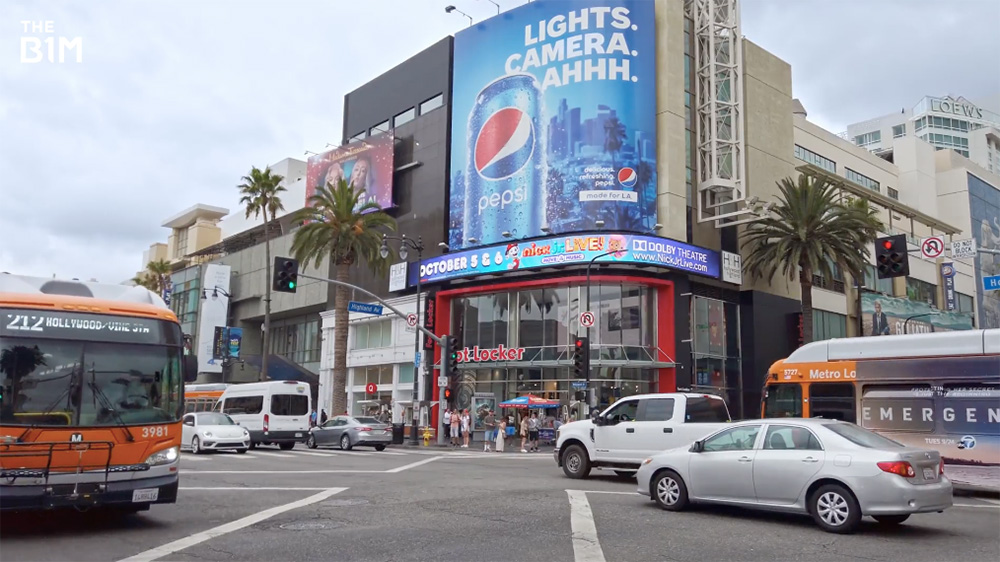
Above: Buses are set to play a big role at LA 2028.
LA transit officials have requested more than $3BN from the Trump Administration. That money would also be used to pay for other transport projects like a new system of fast lanes on the freeways, to get athletes and event workers around the city quicker.
But while Congress did approve a large chunk of funding in early 2026, it falls quite a way short of the target figure. Which raises questions about when — or if — the rest of the money will come in.
Especially when the US President’s relationship with the Mayor of LA, and the Governor of California has been a bit frosty at times.
“If Donald Trump decides at a given moment that Los Angeles is misbehaving by his standards, he could and he might well tell the Department of Transportation, ‘not 3.2 billion, only 1.2 billion,’ or whatever that number might be,” said Zimbalist.
“What is Los Angeles going to do in that circumstance? Well, they’re going to have to from the ‘no-car Games’ to the ‘some-car Games.’”
Changing the message
It could partly explain why organisers now describe the next Olympics as a “transit-first” Games instead of ”no cars.”
That’s not to say they’re making a complete U-turn — far from it. Whatever happens, public transit will be the main way people are expected to travel, and it can be done.
“If you do the right kind of communication and discussion and planning, and you put those alternatives out there, I think it is very possible,” Schank claimed. “Just to give a quick example — I did some work recently for the Hollywood Bowl, which is a very famous and pretty auto-centric venue here in Los Angeles. We've got over 50% of people now going to the Hollywood Bowl by bus.
“It was effective planning and making those buses work really well and making parking cost what it should cost, which is a lot. If you price parking and the roads effectively and you put the transit service out there, it will be the most convenient option and people will use it.”
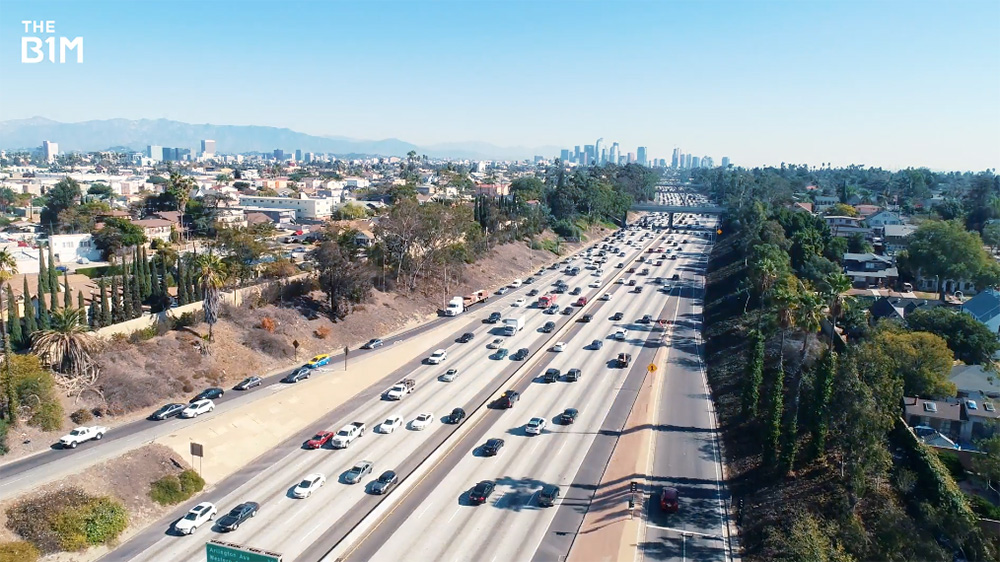
Above: The delivery of Los Angeles' 'transit-first' (formerly 'no cars') pledge is proving to be a challenge.
However, several infrastructure schemes have had their completion dates pushed back — to after the Games.
Phase 2 of the Eastside Corridor isn’t due to complete until at least 2035, and that won’t even be the full line.
It’s one of 11 projects originally in the ‘Twenty-eight by 28’ that have had to be removed. They’ve been substituted for other schemes that are either in progress or operational, and more likely to hit the deadline.
Although it might not be as bad as it sounds, as many of the names on that list were seen as ambitious from the start.
“A lot of the projects in ’Twenty-eight by 28’ I think were much more aspirational, kind of like, ‘wouldn't it be great if we got this done?’ But not all of them were realistic. And I think the folks who were there at the time knew that,” stated Schank.
The verdict
So, can we be confident, then, that the LA Olympics — the venues, the supporting infrastructure and the event itself — will be done on time, creating a successful Games? Will it come in under budget again, or at least not way over?
Zimbalist thinks the signs look promising, despite the political awkwardness, due to its ticket sales programme, TV contracts and sponsorships. But it still won’t be easy.
“I’m hopeful they’ll be able to come in on balance,” he said. “But all I would say with regard to the no cars plan is that it does create some vulnerability, both in terms of the goals of the Olympics and in terms of the financing."
Despite this, there is still time for LA to finish those last few projects that are essential, and overcome any other hurdles it finds in its way.
After all, it’s a chance for America, and its second city, to prove once again that it can put on the biggest of shows.
Schank concluded: “I would love for the rest of the world to see how fantastic Los Angeles is. You know, people like to make fun of Los Angeles for being a place that is car dependent and often vapid.
“I think that those things have a grain of truth to them, but there's so much more to it that I'd love for the world to see, and this is our opportunity to show that.”
See how Accenture is reinventing delivery with AI, data, and human ingenuity here.
Additional footage and images: IOC, Metro Transportation Research Library and Archive, LA28, ABC7, CBS LA, euronews, FRANCE 24, Jose Hidalgo, KTLA 5, LA Clippers, LA This Week, Los Angeles International Airport (LAX), Metro and NBCLA.
We welcome you sharing our content to inspire others, but please be nice and play by our rules.
Comments