
Is Canada Set to Fail on Yet Another Rail Project?
- Youtube Views 771,606 VIDEO VIEWS

20 May 2026
Video hosted and narrated by Fred Mills. This video contains paid promotion for Gamma.
HERE we go again.
A big, expensive new subway line is under construction through the heart of Downtown Toronto but with the original budget for the Ontario Line a faint glimmer in the project’s rearview mirror, what lessons have been learned from recent failures?
Toronto is the capital of Ontario and one of the most important contributors to the Canadian economy. It’s also one of the most congested cities on the planet and its infrastructure desperately needs hauling into the modern age.
That’s where the Ontario Line comes in and, short of making every Maple Leafs game-day a national holiday, it has the potential to be an absolute game-changer for the city’s residents.
The Toronto problem
Toronto’s population is expected to rise from about six million all the way up to ten million people by 2050. In fact, it has one of the fastest growing populations in the whole of North America. Hundreds of thousands of people commute in from the far reaching suburbs around Toronto each day but the city isn’t set up to cater to the increase.
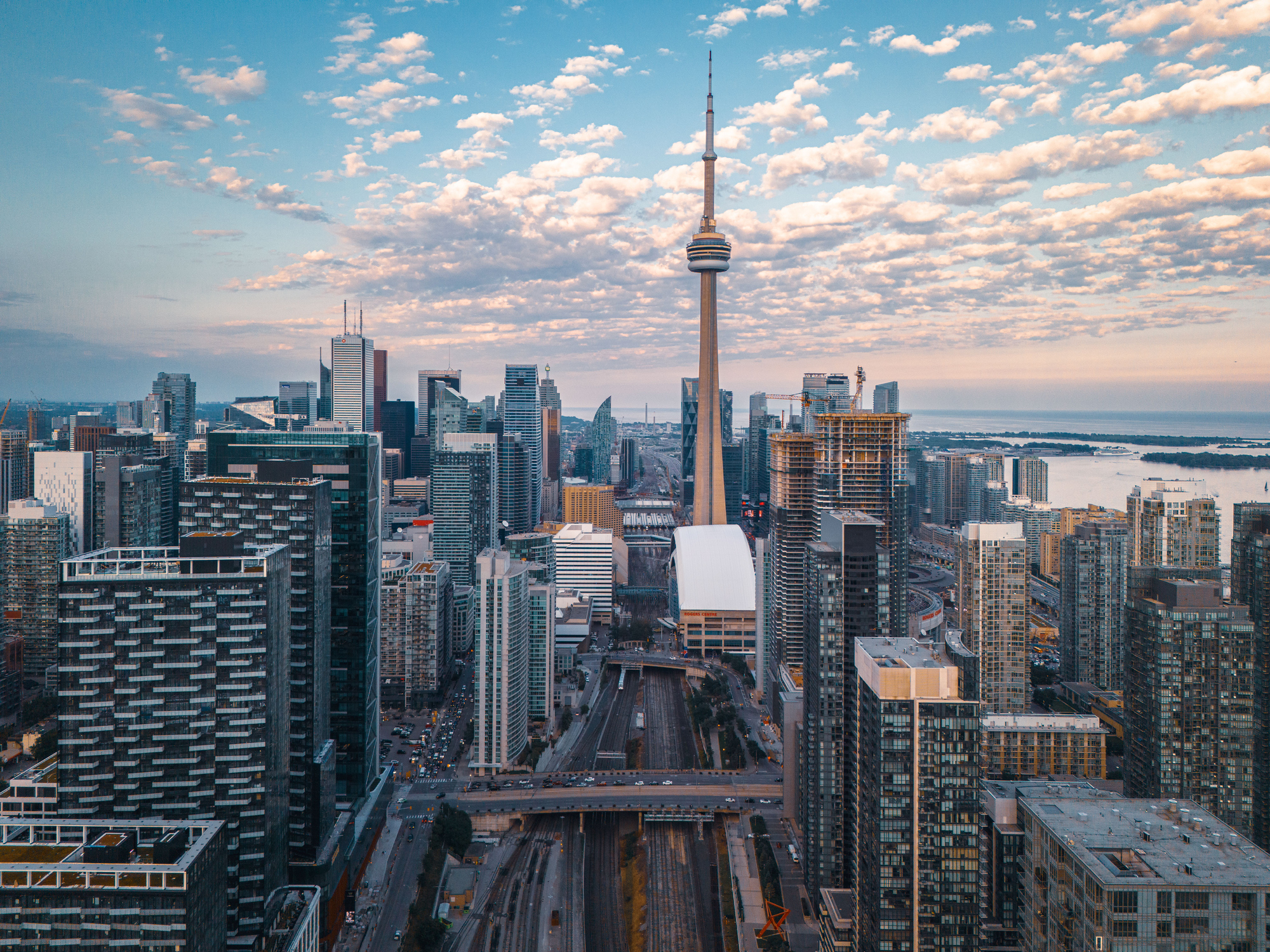
Above: Hundreds of thousands of people commute into Toronto every day.
Old housing laws limited upwards development on the outskirts meaning single-use units sprawled for miles to accommodate a growing population. Most of the jobs are in the city and so people still need to get there. Add those commuters, often travelling by car, to the workers who actually live in the urban core, alongside a historic lack of investment in rail infrastructure, and you have a recipe for chaos.
When it comes to public transport, the city is light years behind some of its global counterparts but that’s not just a Toronto problem - it’s an issue across Canada as Toronto journalist, Chris Hume explains:
"We're a country that was set up in the 19th century when conditions were completely different and we haven’t budged an inch since then. Most Canadians have never been anywhere near the Great White North and they live in the cities or suburbs but that reality is completely ignored by the legislative system that we have here. It reflects a reality that hasn't existed for decades and decades. The cities in Canada are basically handcuffed."
Local governments own about 60% of the country’s core infrastructure but receive just eight to ten cents of every tax dollar. That’s left the national infrastructure deficit anywhere from $110 billion (CAD) all the way up to a whopping $270 billion (CAD). Years of fragmented governance, regulatory complexity and slow processes have caused a real drag on development.
To give you a bit more context, as of last year Transport Canada predicted $284 billion (CAD) needs to be spent to upgrade rail services by 2070 and $3.3 trillion (CAD) needs spending on new roads and highways. These are huge sums of money but it seems Ontario is actually trying to do something about it. The Province is committing $70 billion (CAD) in what it’s describing as ‘the largest expansion of public transit in North America.’
This includes multiple new subway and light rail lines to finally connect the city, the largest of which is the Ontario Line.
The Ontario Line
The route spans 15.6km, carving through the heart of Downtown. 15 stations sit along the line which features underground, above ground and elevated track sections and once constructed it’ll change the city.
For starters, it should bring 230,000 people within walking distance of public transit, accommodate nearly 400,000 daily boardings, slash travel times to less than half along some sections of the route and lead to 28,000 fewer car trips every day.
With large chunks of the new line cutting through dense urban areas, more than half of the route will be underground and because of the mixed ground environment in Toronto's underbelly, and the important structures on the surface, specialised earth pressure balance tunnel boring machines have been called in. An EPB is more sensitive in soft soil than a hard rock TBM, controlling pressure and limiting ground settlement as it creates the twin bore tunnels.
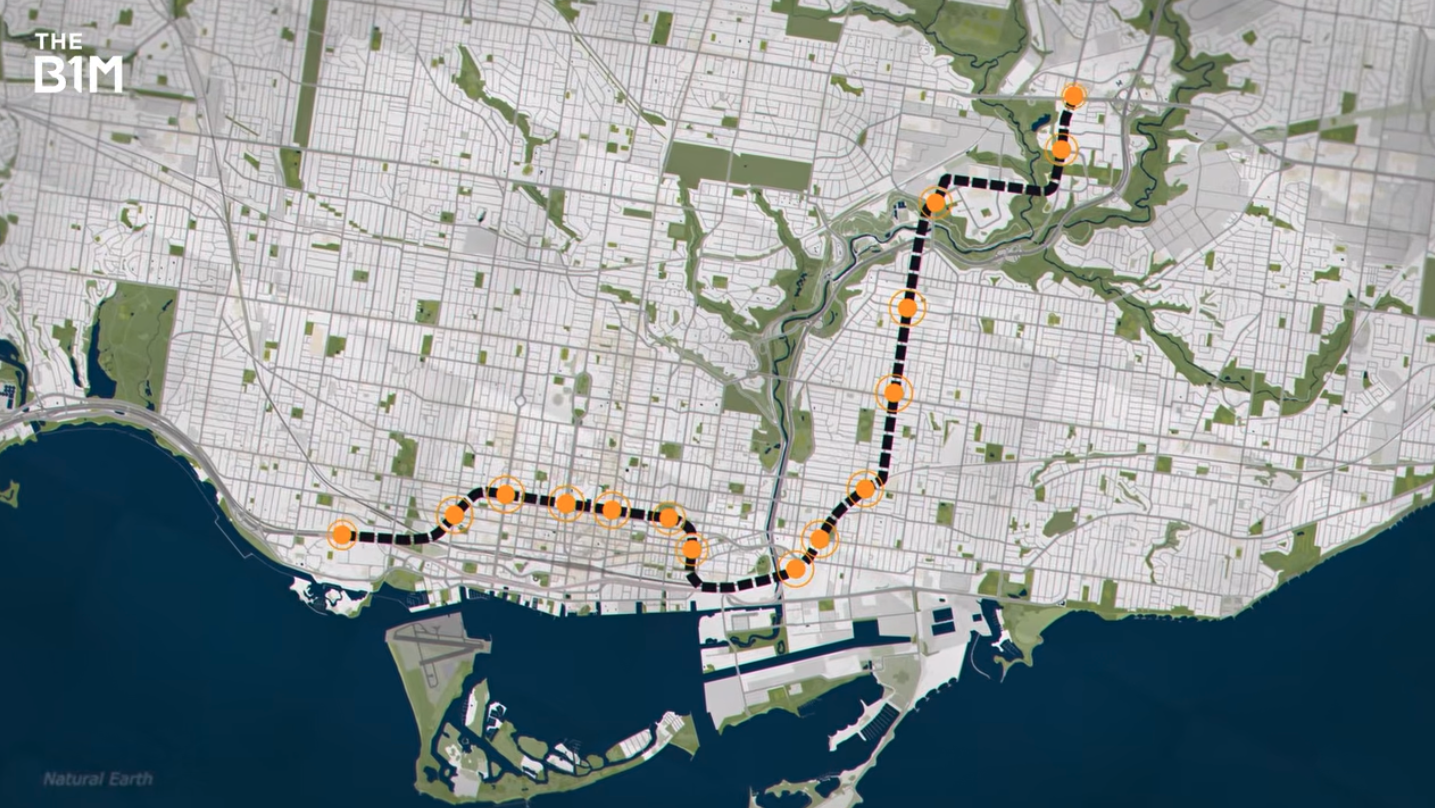
Above: The Ontario Line carves 15.6km through the heart of Downtown Toronto.
Back above ground, the route features three kilometres of elevated guideways which allow trains to travel up to 14 metres above street level and the method comes with a few key advantages.
Firstly, building largely on and above the surface, instead of deep underground, limits the number of ground condition studies you have to commission and pay for and that’s particularly pertinent through Don Valley where the earth can be pretty challenging.
Elevated guideways are constructed using a drill rig; large holes are carved into the ground to be filled, creating strong foundations - this is known as piling. Those foundations support the reinforced concrete columns, or piers, that line the route.
Horizontal beams stretch across the top of the piers to create a base for the tracks and, finally, girders create the backbone of the structure. The rail tracks then sit on top of a deck that’s made from poured concrete.
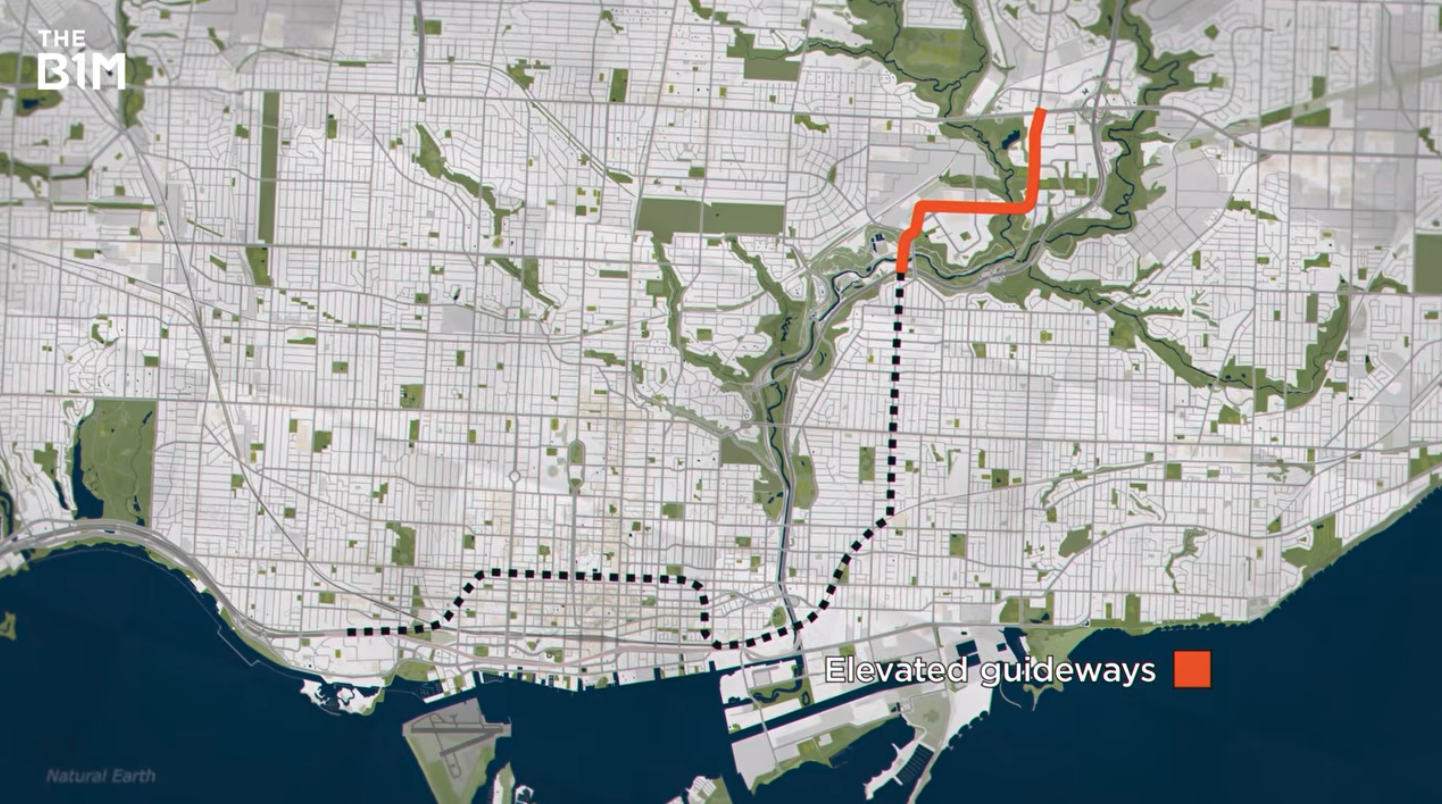
Above: Elevated guideways in the northern section of the new subway will limit the need for below ground tunnelling.
As for the 15 train stops themselves, the route will feature six interchange stations connecting to existing services, while five of the stations along the route already exist. Where the new line connects with any pre-existing underground stations, large access shafts for facilities like lifts and stairs will be driven either side of the old structure. Then, underneath the current infrastructure, a cavern will be created for the new platforms. As Hume explains, the Ontario Line seems to be a no-brainer:
"The first version of this, which was then called the Downtown Relief Line, was proposed by a New York consulting firm to the city in 1910. What this line will do is add capacity to the subway system, rather than just ridership. I think it will make a huge difference to the experience of riding on the subway. It will be transformative."
Delays and budget overruns
But the process hasn't been entirely full steam ahead. While Hume told us about a subway proposed in the early 1900s, there was actually work done on a Relief Line much more recently. The Toronto Transit Commission, supported by the Ontario government, spent millions planning and preparing to construct a Downtown Relief Line.
It followed a similar route to the Ontario Line but it was shorter, featuring just eight stations. The plan was for it to open in 2029, so about an eight to nine year construction window.
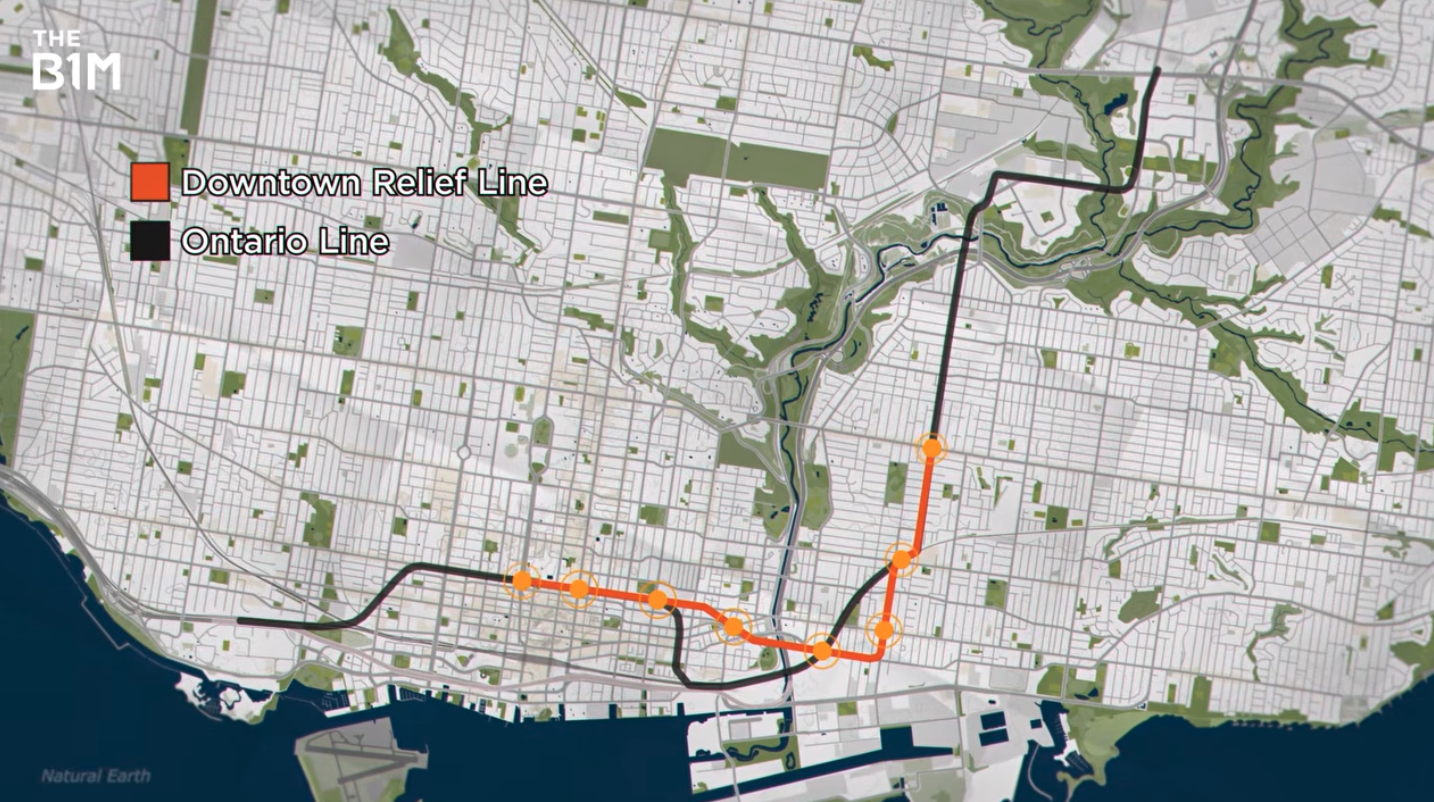
Above: The Downtown Relief Line followed a similar route to the Ontario Line but it was shorter and featured fewer stations.
Initially, cost projections sat around $6.8 billion (CAD), rising to around $8.3 billion (CAD) - a hell of a lot cheaper than the newly planned route although government officials hinted those figures would likely have risen.
In 2018, former Toronto City Councillor, Doug Ford became the Premier of Ontario and by 2019, he and his party had stepped in to take over and replace the Downtown Relief Line. The new project - the Ontario Line - would be guided forward by the city's favourite agency: Metrolinx.
"There’s a lot of animosity in the City of Toronto against Metrolinx so people’s backs have been up right from the very beginning. Historically the provincial government would have given the money to the city and the city would have handled the whole thing but that’s not what’s happening now", says Hume.
The Ontario Provincial government took charge of the project in a bid to speed up construction and limit costs which in hindsight was a bold move.
Ground was broken on the Ontario Line in 2022 and it's a fair bit longer than the original, featuring seven more stations, but it was projected to open by 2027 for a cost of around $10.9 billion (CAD). It’s now 2026 and we’re being told that timeline has been pushed back to the early 2030s with costs reportedly rising to a hefty $27 billion (CAD).
The problem is that Metrolinx simply doesn’t have a lot of credit in the bank. Residents won’t quickly forget the Finch Line which welcomed passengers onto its trains late in 2025 - behind schedule and over-budget - only for a multitude of errors to follow. Then there’s the Eglinton Crosstown, which opened six years late and way over the original budget.
But speaking in February Michael Lindsay, the President and CEO of Metrolinx, reassured reporters that learnings from past projects are being implemented and construction is on schedule. The new schedule, that is.
In terms of the soaring project costs, Lindsay argues that’s not just an Ontario problem, it’s an issue right across the English speaking world and when you look at infrastructure projects in both the US and the UK, you'll agree he has a point.
The silver lining is that work is actually going ahead to fix the desperate infrastructure situation in Toronto and as Hume points out, these developments could make all the difference:
"Everyone’s gonna love it. When they built the first line down Yonge Street all kinds of businesses went bankrupt and it was very intrusive, very disruptive. Now, life in the city would be impossible without that subway and I think in 20 years when the dust has settled people will think, 'what did we do before the Ontario Line got built?'"
Over the next decade Toronto’s transit system will completely transform. It could become an example of success rather than one of chaos and at that point, Torontonians might just look back and wonder how they ever managed before.
Try ChatGPT inside Gamma here
Additional footage and images: CBC, Transitthinker, Breakfast Television, Global News, urbanplannie, CP24, Doly Begum, CityNews, Camilo Calderón, BruceK, apertur 2.8, CTV News, Marit Stiles, The Canadian Press, Sky’s Trains, Jean-Paul Around, KAC35, Legislative Assembly of Ontario, cpac, ITV News and Joey Coleman.
We welcome you sharing our content to inspire others, but please be nice and play by our rules.
Comments