
The World’s Biggest Building Boom Isn’t What You Think
- Youtube Views 815,559 VIDEO VIEWS

20 April 2026
Video narrated and hosted by Fred Mills. This video contains paid promotion for IES.
WE are experiencing one of the fastest building booms the world has ever seen. It's being described as “a global construction frenzy that shows no sign of slowing.”
Humanity is now dependent on large-scale data centres, and that demand is only increasing. But, the strain this infrastructure is placing on our power and water sources is enormous.
“The data centre industry’s actually going to be responsible for three-four percent of global electricity consumption. So that's a huge sector,” said Alex De Vries-Gao, founder of Digiconomist and a researcher at VU Amsterdam.
And now, with AI taking our reliance to a whole new level, this rapidly-growing area of industry is under pressure to clean up its act — and fast.
But with these buildings now consuming as much energy as entire countries, what can actually be done about it?
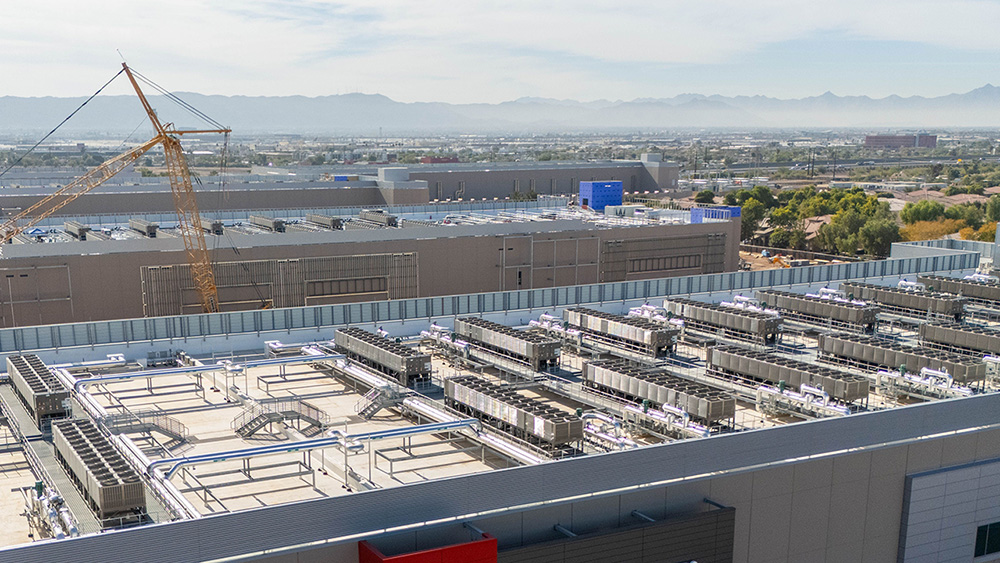
Above: Over a third of the world's data centres are in the US.
If you live in — or close to — a major city there’s a good chance you’ll have a data centre nearby. Because there are now more than 11,000 of these worldwide, across 174 countries. And unsurprisingly, over a third of them are in the USA.
Some of the largest clusters in the US are in places you might expect — like Texas and California — but the state with the most is actually… Virginia.
The UK and Germany are way behind in second and third, and the rest are pretty well spread around the globe.
Why they're needed
Because if they weren’t absolutely everywhere, we wouldn’t be able to do all those things that have become an essential part of our modern lives.
We don’t just mean the important stuff — online shopping, banking, or watching epic construction videos on YouTube.
Without data centres there would be no doomscrolling; long, boring video calls that could’ve been an email; or memes that still refuse to die. And we’d miss that … wouldn’t we?
But data centres weren’t always omnipresent. To see how quickly these structures have been expanding, it’s best to look at it from a different perspective. After all, we can’t do a video on data centres without digging into some … well, data.
For starters, take a look at the graph below. It shows the staggering growth in data centres globally over the past 20 years in terms of installed capacity.
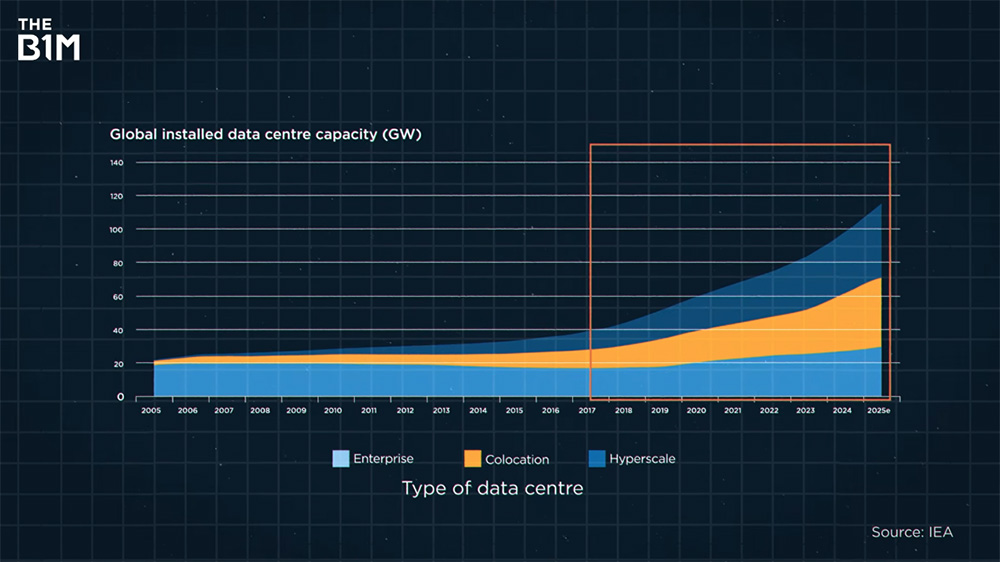
Above: Notice how things went stratospheric after about 2017.
In other words, the total amount of power available for all the equipment needed to run them. The overall figure now stands at more than 122GW.
To give you an idea of just how much that is, the total capacity of Hinkley Point C — the massive nuclear power plant under construction in the UK — is 3.2GW.
You’d need around 38 Hinkley Point C-sized nuclear plants to power just the world’s data centres (if everything was operating at 100% capacity), and they’re continuing to soar in number — and size.
“Before AI, we also had many data centres, but those data centres tended to be much smaller — like, less than 100 megawatts. But today, AI data centres can easily be 500 megawatts or even more than one gigawatt,” said Shaolei Ren, associate professor of electrical and computer engineering at University of California, Riverside.
“So, the concentration of this large power demand and other resource demand, like water, over a small area — that's a big challenge for the infrastructure.”
Colossal consumption
By 2030, data centres are expected to be consuming more electricity than the whole of Japan — double what they were pulling from the grid in 2022.
And as we just heard, the main cause of this increase is the meteoric rise of AI. Yes, every time you chuck something into ChatGPT it kickstarts a process that uses more electricity — and water — than many of us realise.
And when ChatGPT alone is processing billions of prompts every day, it’s no wonder the infrastructure that makes it all happen is having to scale up fast.
“AI systems were responsible for about 20% of total data centre electricity consumption by the end of 2024. And that number could have increased to about half by the end of last year — 2025,” explained De Vries-Gao. “So, altogether, these numbers are just becoming really big, really fast.”
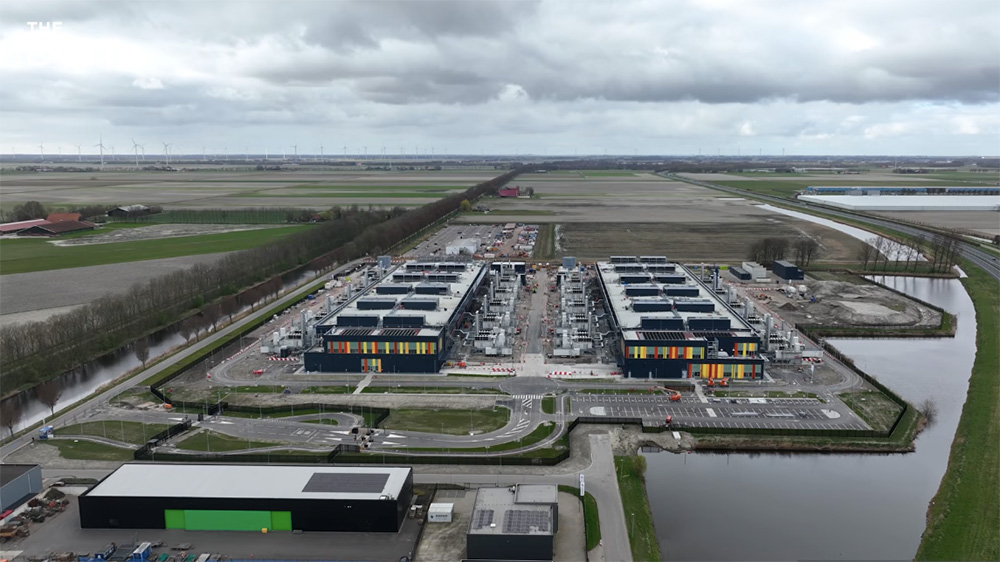
Above: Having sufficient infrastructure to support large-scale data centres has become a real challenge.
But keeping up with the demand is where things get tricky. Data centre construction isn’t just about building a great big hall and filling it with servers, despite how it might appear sometimes.
There’s a lot more to it than that, which is why the biggest facilities being built at the moment are considered megaprojects.
Firstly, you have to decide where to put them. Ideally a place with good fibre connections, water sources and for the really large ones that handle several hundred megawatts on their own — high-capacity power grids.
“Those data centres — they consume as much power as entire cities, and you can't just put those anywhere. It's actually really hard to find power grids where there is sufficient capacity to even start building a project like that,” said De Vries-Gao. “At that point, power capacity becomes the number one concern.”
Making room
There would have to be plenty of space, too — not just enough to squeeze the building into. Many are constructed with expansion in mind. Often following not long after they’re finished, and with rapid speed. The companies behind them are called ‘hyperscalers’ for a reason.
Another factor to consider is the climate and geography. Lower temperatures make it easier to keep everything cool, and it’s better if there’s no risk of extreme weather or natural disasters.
Just like with any kind of major infrastructure, if a data centre goes down it can be disastrous. A lot worse than just, I don’t know, missing out on the latest TikTok craze.
Think huge financial losses, service failures, reputational damage — all things that every company absolutely dreads.
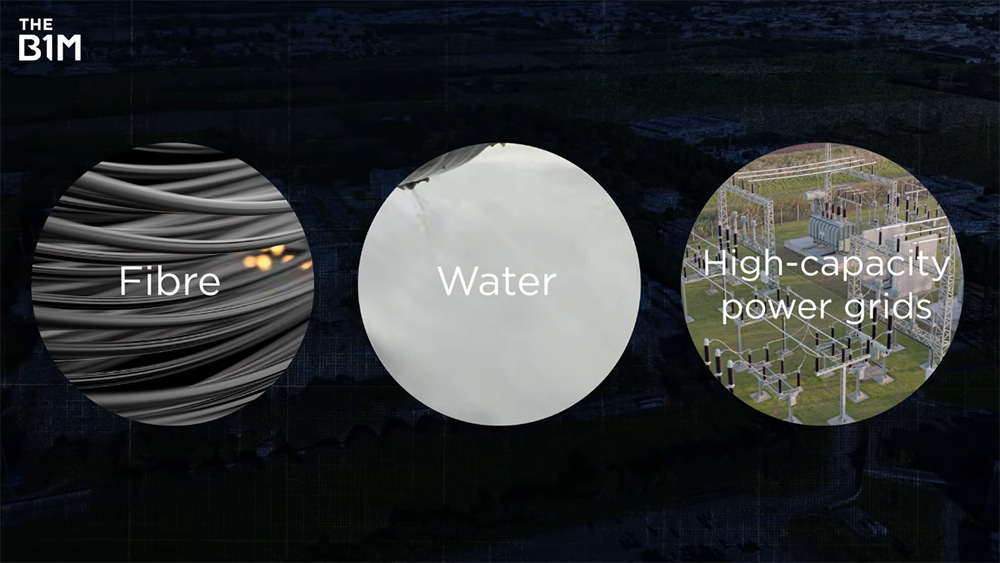
Above: There are several things to consider when selecting a location for a new data centre.
Alongside all those racks of equipment that have to be kept running 24/7, the cooling system is a key priority.
Usually, this is done in one of two ways. There’s the traditional method of circulating cold air into the server racks, normally through the floor, with the waste heat exiting out the top.
While it’s effective, even if some of the air is recycled, it’s a process that consumes massive amounts of electricity.
Alternatively, you’ve got liquid cooling, which is becoming more common as we enter the AI era.
This method involves using, yep, liquids like water or coolant to transfer the heat away, which requires less electricity and often less space.
But the flip-side is all that water has to come from somewhere, which can cause a big dilemma.
“This water is mostly coming from municipal water supplies, and that can be stressful for a lot of public water systems, especially in the US,” said Ren.
“Most of the water systems are small or medium-sized. They don't really have a lot of surplus capacity to supply to these large-scale industry users.”
Tackling the problem
OK, but what can actually be done about these crazy levels of consumption? Well, many companies are now prioritising liquid cooling, investing in their own renewable sources, and funding grid upgrades so they don’t drive up people’s energy bills.
Others are taking action in more unusual ways, with a few ideas in particular creating a lot of attention.
Several of the world’s biggest tech firms have partnered with nuclear providers. These deals would see data centres powered by reliable, low-carbon sources.
Some are even restarting plants that had previously been closed, or tapping into technology that still hasn’t quite arrived yet. Namely nuclear fusion and small modular reactors.
Or you could do what companies in Europe are doing and build your data centre underground — inside an active mine or former bunker. Great for security and keeping everything cool.
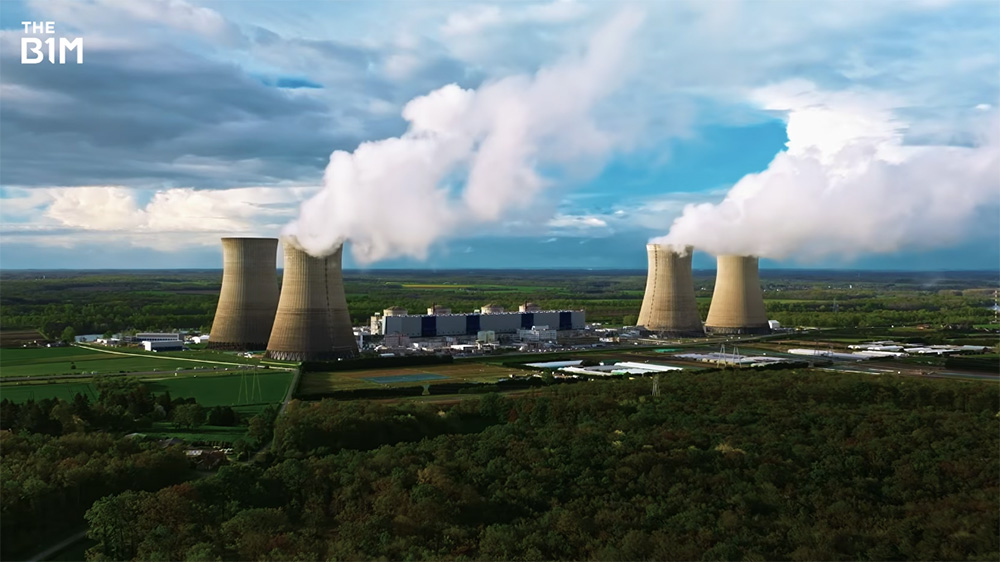
Above: Nuclear plants could be used to power multiple data centre projects in the near future.
So, we’ve talked about server racks and cooling systems, but you’ll find a lot more inside a data centre than just that.
There are plenty of other components to get in place, too — some of which might sound dull, but are essential. Security, networking, power distribution etc., which all have their own energy needs.
The trouble is, having these giant facilities popping up all over the world can have consequences for the surrounding infrastructure. And communities.
It’s gotten to a point where some people are starting to oppose these projects, especially in areas with already limited resources.
“It always depends on, what's your local situation? Are you dealing with water scarcity? Are you dealing with droughts?” said De Vries-Gao.
“And if you suddenly have a big data centre appearing, that's going to consume a lot of electricity and there's going be a lot of water consumed to generate all that electricity. That can really add to your local water stress.”
Places with the highest concentrations of new builds have become hotspots for resistance. In Virginia, at least 25 projects were reportedly cancelled in 2025 following opposition from locals.
Hundreds of data centres used over two billion gallons of water here in 2023, and there have been complaints about noise and pollution.
Because many of them are still hooked into power grids that rely on fossil fuels, and have diesel backup generators.
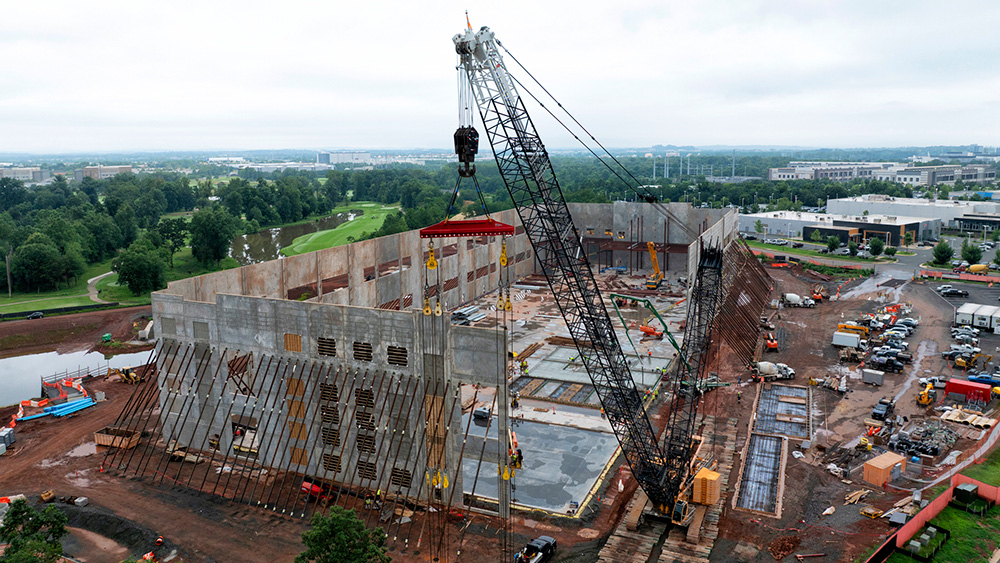
Above: A data centre under construction in Virginia, which has become known as 'Data Center Alley'.
Elsewhere in the US, others are worried their energy bills will go up, and that not enough is being done to address the impact.
The pushback we’re now seeing highlights how things really do need to change. When many of these buildings are appearing almost in people’s back yards, those affected cannot be ignored.
"Community opposition is a real challenge, is a real concern. We have to address it proactively,” stated Ren. “We need to think about how we can accommodate the new industry demand from the infrastructure side.”
“For power, if you have money, you just build power plants, but for water, you have to get new water sources that is naturally constrained.”
Muddying the waters
And yet, Shaolei believes the recent media focus — on the negative effects of water use in particular — has been a bit overblown. Because it’s not a major issue everywhere.
If there’s enough available to spare, it’s still the best way to tackle that all-important cooling problem.
“The way it is presented in the public discussion is usually not very accurate,” he claimed.“If you look at some of the data centres, they are using water just during the hottest weeks or hottest days of the year. So their annual water usage could be very low, but they use a lot of water during the summertime.
“I think a better solution to look at water is we need to use water responsibly. If there's water, I think the benefits of using water should not be denied.”
Like the technology itself, the construction of new data centres has become a complicated subject. We can’t live without them and they’re not going anywhere — quite the opposite, in fact.
But if we are going to carry on building these megastructures — and on a scale even bigger than what we’re already seeing — it’s fair to say there are some bugs in the system that need fixing first.
If you want to find out how dynamic simulation can enhance existing CFD modelling to enable high-performance data centres then you’re in luck. Because IES has just released a brand-new whitepaper on that very subject.
Download the whitepaper for free today, and see the full extent of IES’ services, here.
Additional footage and images: Bahnhof AB, Good Morning America, INSITE, KTLA5, TODAY and WFYI.
We welcome you sharing our content to inspire others, but please be nice and play by our rules.
Comments