

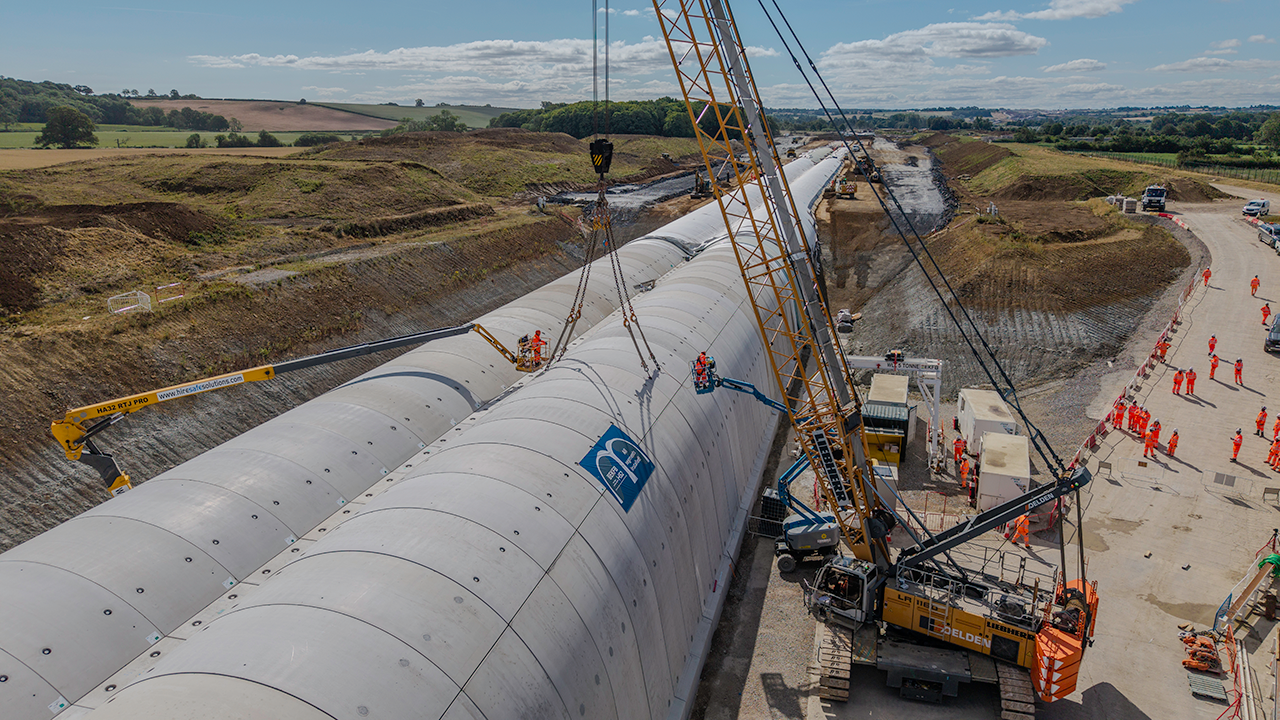

The Secret Plan to Save a Toxic Megastructure
- Youtube Views 648,565 VIDEO VIEWS

27 May 2026
Video hosted by Fred Mills. This video contains paid promotion for Rayon Design.
IF you’ve driven through Silicon Valley on Route 101 there’s a chance you will have seen something a bit strange.
And those of you who have passed through the suburbs of Akron, Ohio in the last century will surely have noticed a similar oddity.
There are another two 50 miles north of London and a further one just outside Berlin.
These are just some of the massive structures that were once used to build and store huge airships. The question we were wondering was… why are they still there?
The bigger the better
“Airships have increasing economies of size. The bigger they are, the better they are. But of course, you can only build an airship equal to the size of the hangar you can put it in,” said Barry Prentice, a professor and former Transport Institute director at the University of Manitoba and long-time airship advocate.
“I often say to people, it's not a chicken and egg question. No incubator, no egg gets hatched. You have to have a hangar in order to build an airship.”
And while these hangars all have their own unique stories, it was the Akron Airdock that went on to break records when work began on it in 1929.

Above: Construction of the Akron Airdock.
Commissioned by the Goodyear Zeppelin Corporation, it would become the largest building in the world without interior supports.
And as incredible as that sounds, it was a lot more necessary than some of the world records we see broken today.
Because this thing had to be big enough to fit the USS Akron and Macon inside. These were the largest helium-filled airships ever built, used by the US Navy for long-distance scouting and reconnaissance.
They were so big, workers had to climb huge ladders mounted on wheels to reach the upper sections during assembly.
How big?
And big is a subjective term, we get that. So we’ll help you picture it. These ships were 784 feet from nose to tail — making them more than three times longer than an Airbus A380.
Whereas the AirDock itself was a massive 1,175 feet long, and 325 feet wide. That’s enough room to fit in 130 tennis courts, or a whole skyscraper when placed on its side.
Add in a 211-foot height and you’ve got an area that’s so cavernous, if temperature and humidity levels were just right, clouds were known to form inside.
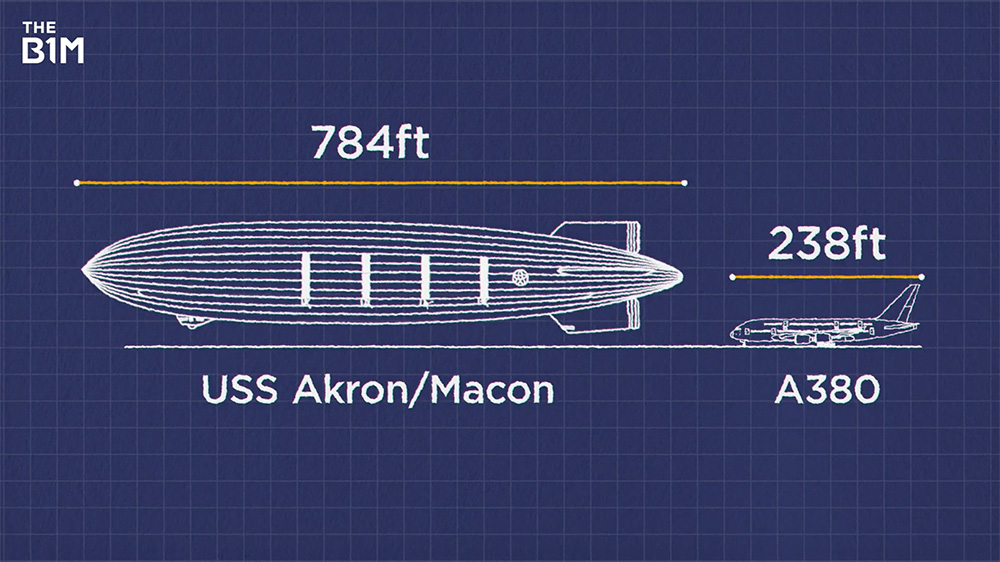
Above: The USS Akron and Macon were enormous.
More than 7,000 tonnes of steel were used to build the giant interconnected truss system that forms the main shell.
Because many of the components were prefabricated, and fitted together in repeatable sequences, the structure went up surprisingly quickly — in just 11 months.
Its semi-parabolic frame carried loads around the structure, with corrugated sheet metal providing a durable cover. Later it was sealed with an asphalt coating, followed by a rubber skin.
But what’s perhaps most impressive about this building — aside from its size — are the openings at each end.
Sliding doors
Yes, we’re referring to those ‘orange peel’ doors. When they had to open, it was not a case of just turning a handle and pushing. Because they weighed 600 tonnes. Each.
They were placed on wheels that connected to a set of tracks, allowing the doors to roll outwards.
But even on wheels, these things were heavy, so a great deal of force was needed to make them move at all.
Which is why they were hooked up to individual power plants capable of opening or closing them in five minutes.
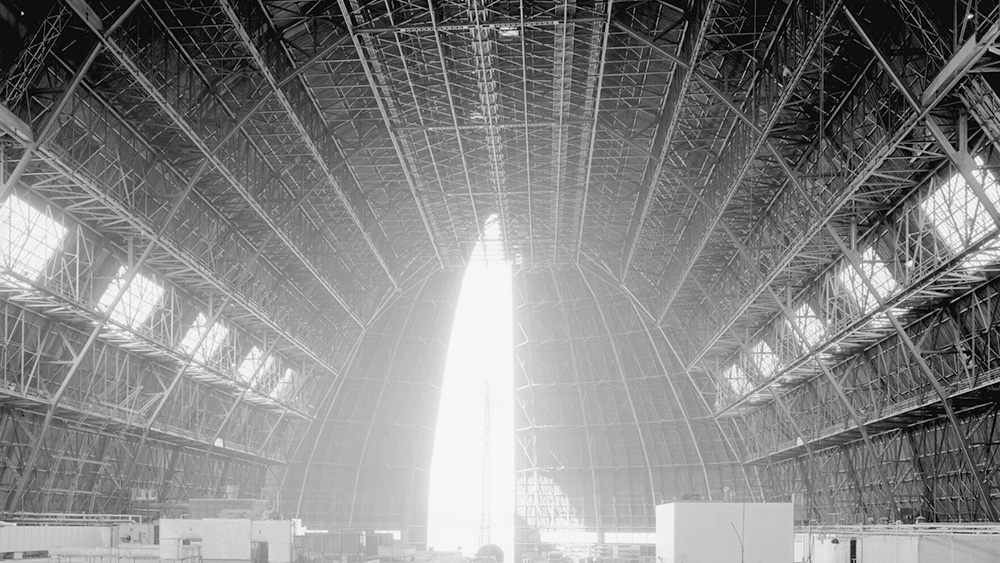
Above: Looking out through the orange peel doors from inside Akron Airdock.
Much more advanced than what was found on even older hangars like the UK’s brilliantly-named Cardington Sheds.
But that’s because these were built in 1915, during the First World War, and had a much simpler — but more problematic — opening system.
“They had doors that just slid sideways, and so they slid past the opening of the hangar, but that meant that as the air was blowing around the hangar they caused turbulence,” explained Prentice.
“So, as the airship was trying to get out they would be buffeted. You can't hold a big airship like that.
“And then the orange peel ones, like the ones in Akron — they sort of nest together as they come open.”
West side story
The thing is, though, when you’ve got aircraft that are designed to travel thousands of miles and operate around the world you need more than one place to put them.
Which is where that one in California came in — built on the site of the naval air station Moffett Field.
Hangar One became the West Coast base for the Macon, allowing it to carry out missions in the Pacific.
Unsurprisingly, it had very similar dimensions to that other structure in the Midwest. But they weren’t built entirely the same way.
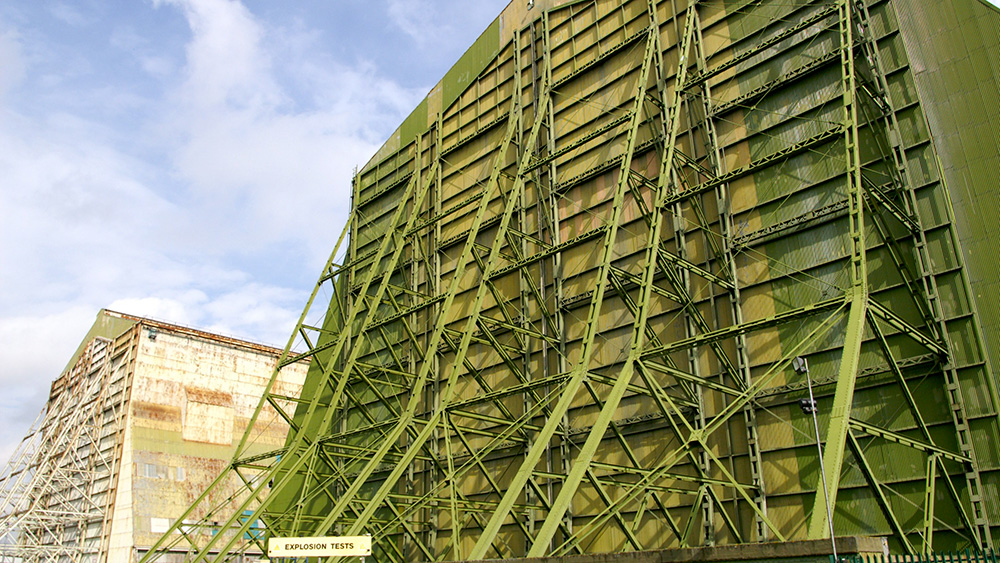
Above: Outside the UK's Cardington Sheds. Image: David Merrett.
While it too had a steel truss system, Hangar One’s heavy use of cross bracing gave it a skeleton structure, instead of a series of arches.
Plus, its more rounded shape made it highly aerodynamic — just like the aircraft themselves.
Reducing wind resistance meant less disturbance for the airships when leaving and docking. Which was helpful given we’re not far from San Francisco Bay and its windy coastline.
Another difference was the choice to line the exterior with a lead-based paint.
A very popular thing to do at the time, which as you’d imagine, became a bit of a problem in the future.
The airship bubble bursts
By the early 1930s, several of these giant facilities had been constructed on both sides of the Atlantic, and the airships they were built to serve became a feature of many skylines.
And yet, in case you haven’t noticed, they’re no longer seen looming over New York, Berlin or … the Pyramids. How come?
the 1937 Hindenburg disaster, where the largest aircraft in history was destroyed by fire in less than a minute.
The incident effectively ended the passenger airship industry, along with the rise of jet planes of course.
But it wasn’t the only tragedy. Years earlier, both of those vessels made in the AirDock met similar fates.
In 1933, 73 died when the Akron crashed in a storm off New Jersey. Then, in 1935, bad weather struck again and took down the Macon — this time on the other side of the US.

Above: While most of the crew survived the Macon accident, two sadly lost their lives.
You’d think, perhaps, that in the decades that followed, with the zeppelin era well and truly over, these great big buildings would also be wound down. After all, what possible use could there be for them?
Well, several, as it turns out. For a while the AirDock continued to make blimps for the Navy during and after World War Two.
These were smaller than the old airships and non-rigid, which made them safer.
“They actually were very successful in the convoys across the Atlantic,” said Prentice.
“When the airships were guiding the convoys, they never had submarine attacks. Because the airships could easily spot the submarines.
“There were 300 or more of these Navy blimps that were built and flown. And the last ones flew in about 1962.”
Keeping busy
Since the ‘60s, the Airdock has found all manner of other uses. It’s been a centre for R&D, aerospace and engineering projects — even an office space and movie set.
But not on the same level as Cardington Sheds, which is now Cardington Studios. Batman has been imprisoned here, Dick Van Dyke loved to sing and dance around the place, and it was a Rebel Base in Stars Wars — twice.
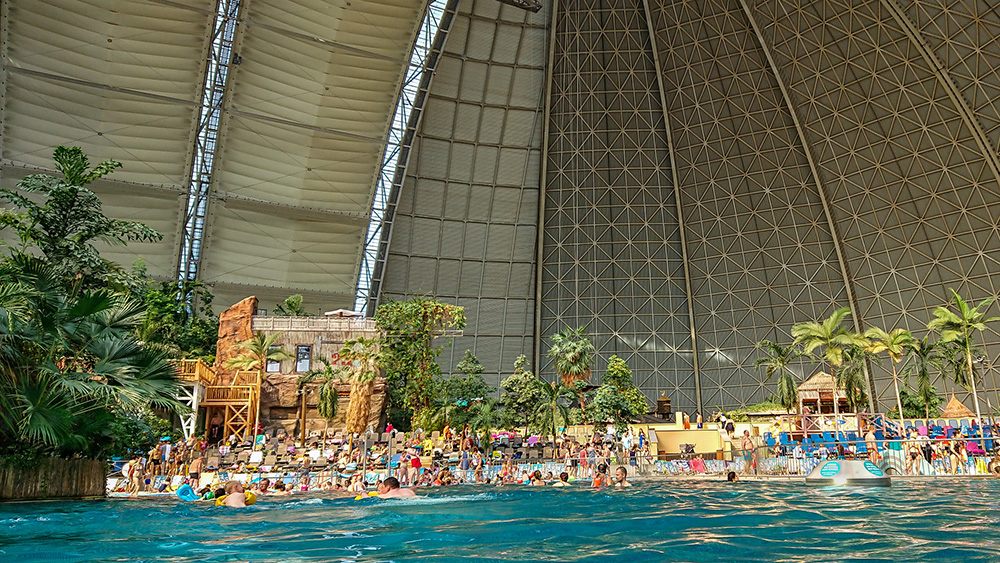
Above: The former CargoLifter hangar in Germany is now the world’s biggest indoor water park. Image: Gilbert Sopakuwa.
The story of Hangar One, on the other hand, has been a bit more up and down.
After the Hindenburg, that airfield it sits on soon became home to the Ames Research Center.
Founded in 1939, it was one of the main laboratories for the National Advisory Committee for Aeronautics, or NACA.
Which went on to change its name to one you just might have heard of: NASA.
Then, in the 1940s, Hangar One gained a couple of younger siblings — Hangars Two and Three.
They were smaller but still huge, constructed even quicker, and made partly from wood. Because steel was in short supply due to the war effort.
After the war, these structures spent decades storing various types of aircraft, and housing numerous research projects.
Protecting history
By the ‘90s, Hangar One was on the National Register of Historic Places after NASA acquired Moffett Field from the Navy.
It was already listed as a Naval Historic Monument, so there was clearly much interest in preserving this iconic landmark.
Come 2003, however, Hangar One found itself in a spot of trouble, and it was the outer shell that was to blame.
Toxins were discovered in environments close to the airfield, and these were traced back to the structure.
“One of the principal contaminants was PCBs — polychlorinated biphenyls — and NASA did some excellent forensic work to determine that the PCBs in the wetlands were coming from Hangar One,” said Lenny Siegel, co-founder of the Save Hangar One Committee — a group of environmentalists and veterans who campaigned for the preservation and reuse of the structure.
“And that's when we realised that the skin and roof of Hangar 1 were this revolutionary material from the 1930s that incorporated lead, asbestos, and PCBs — perhaps one of the first known uses of PCBs.”
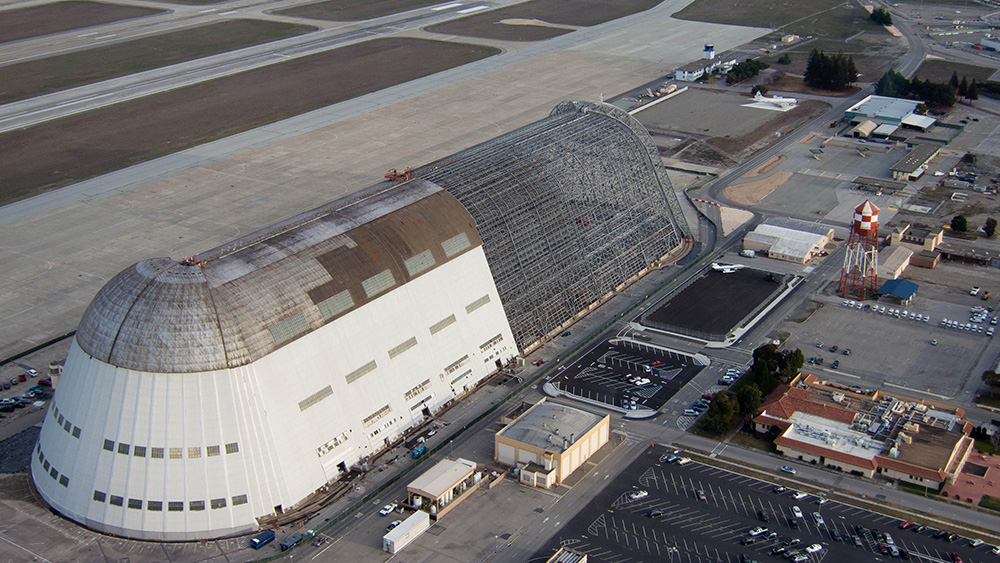
Above: As a result, the roof, sides, doors and windows of Hangar One had to be removed piece by piece. Image: Nelson Minar.
That didn’t mean everything had to be disposed of, though. Some of the wood that was taken out ended up in the corporate areas of the new Levi’s Stadium — home of the San Francisco 49ers.
Meanwhile, however, the much older structure that it came from remained in a bit of a sorry state.
For years, it sat there stripped and exposed, with many fearing it would be demolished even with those protections.
Despite strong support for a restoration, nobody had put forward a plan. Until 2014, when a certain tech firm stepped in to lease the airfield from NASA for a 60-year term.
Saving Hangar One
“Eventually we got the federal government and NASA to agree to lease out 1,000 acres at Moffett Field, and one of the conditions was that Hangar One be recovered by the lessee,” explained Siegel.
“And although there were two bidders, the only one that really had the resources to do it was Google, which formed Planetary Ventures to carry out the work.”
The company stumped up most of the funding for a full revamp of Hangar One, which didn’t get underway until 2022.
Fast forward to 2025 and at last it was more than just a giant steel frame again. The main structure had been cleaned before getting new doors, sidings, windows, roof and cladding.
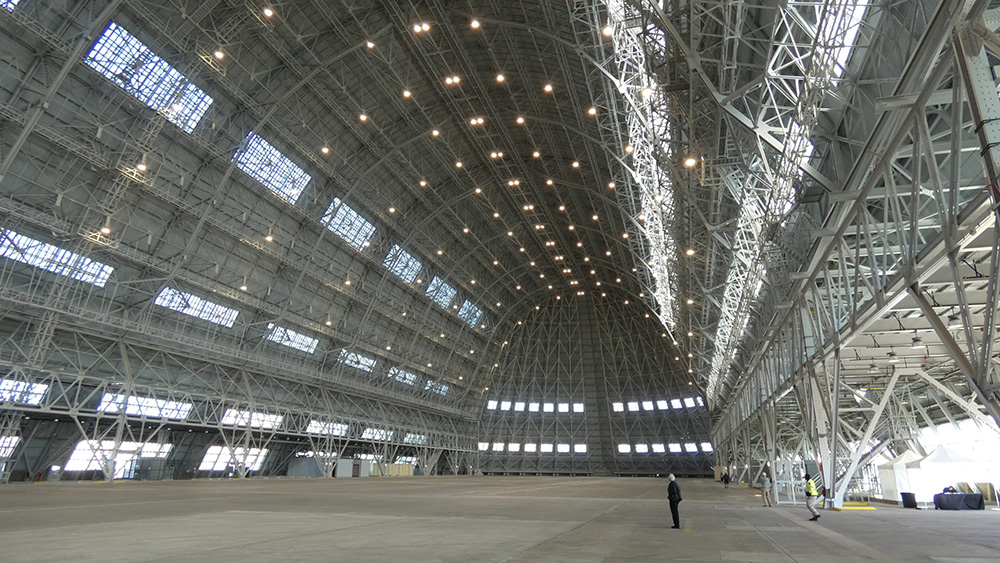
Above: The inside of Hangar One post-restoration. Image: Steve Williams.
As for why an offshoot of one of the world’s biggest tech firms would do this, well, that’s still not been officially confirmed.
In the original NASA press release, there were some details. It said Planetary Ventures would use Hangar One for “research, development, assembly and testing in space exploration, aviation, robotics and other emerging technologies.”
A director of the company was asked to elaborate on what will happen here after the project’s completion. He replied: “We’re still working on it. But we’re committed to innovation.”
Right. Guess we’ll just have to wait and find out then. Or maybe they’ll opt to keep those great big doors firmly shut, and what goes inside remains a closely guarded secret.
But wait… there’s still something we haven’t explained.
A new path
In late 2025, a new airship was seen flying over San Francisco — the largest aircraft constructed since the 1930s.
Named Pathfinder 1, it’s over 400 feet long, so a fair bit smaller than the giants of the past.
But unlike those before it, Pathfinder 1 is fully electric. The originals relied on internal combustion.
And it comes from a company called LTA Research. LTA stands for ‘Lighter Than Air’. Helium, in other words.
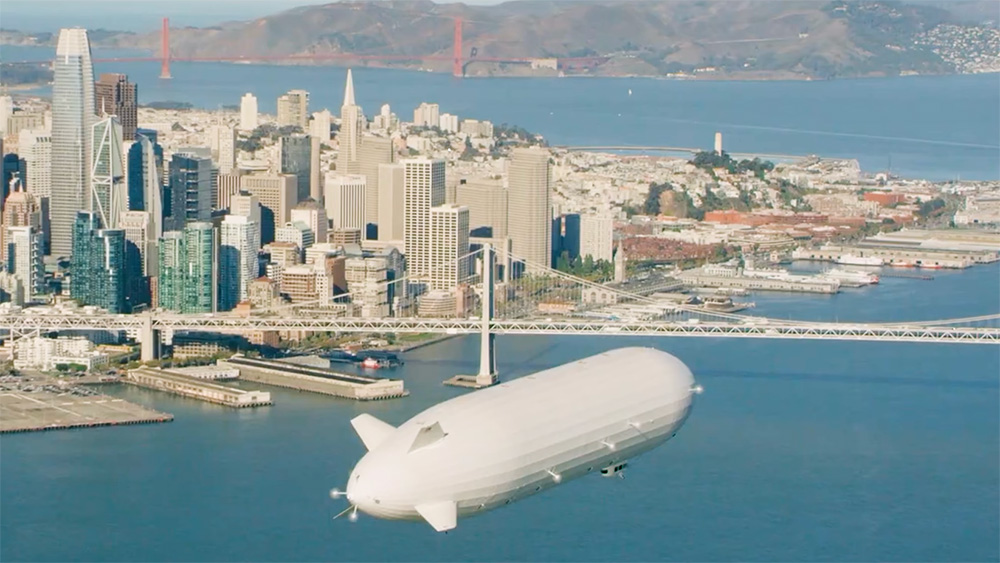
Above: Pathfinder 1 in the sky above San Francisco. Image: LTA Research + KRON4.
Having already acquired the Airdock in 2022, they’re now operating from Moffett Field too, as a tenant.
And they also have ties with Google. LTA is funded by Sergey Brin, who launched the tech giant alongside Larry Page.
But the firm isn’t operating out of Hangar One, or at least they haven’t said they are.
Instead, they’ve been using Hangar Two to build and store their impressive new creation.
Which, as of right now, is only a prototype. Still, the fact they’ve managed to get one in the air shows what they’re doing is possible, and may be about to scale up.
Because the reason LTA bought the Airdock was to develop an even bigger airship, which Barry believes could be the answer to Hangar One’s big secret.
“I think it’s going back for airships. They definitely want to build airships and I think they look to build very large airships, and here is a very large hangar which is what you need for a very large airship,” said Prentice.
“There's no reason that airship hangar now won't last another 100 years because they're very well-built structures in the first place.”
Indeed, it’s just one of a series of historic megastructures that have managed to survive well into the 21st Century.
All while staying at the forefront of engineering, filmmaking and, er, aquatic entertainment, despite their original purpose dying out.
Time for a comeback?
Or are we about to see an airship resurrection, especially when LTA isn’t the only company trying to bring them back?
Barry is very confident of that, although most likely as a way of moving freight for the time being.
“I think they're going to be mainly used for cargo and that's simply because you can carry very big loads and you can cross oceans at low cost,” said Prentice.
“Whether we'll get back to crossing oceans in airships, as passengers, I'm not so sure. It's hard to think of a day when we won't have passenger jets, but you never know whether the airship might find itself in that position again.”
Rayon is the all-in-one, effortless CAD tool for going from concept to completion. Try it (for free) here.
Additional footage and images: ABC, Alexander Avtanski, Anchor Bay Entertainment, Bill Dickinson, David Merrett, Erik Charlton, Flying Whales, Gerd Danigel, Gilbert Sopakuwa, Google, Hybrid Air Vehicles, Ian Abbott, James Duncan Davidson/O’Reilly Media, Inc., KRON4, LTA Research, Mik Peach, NASA, NBC, Philip Jeffrey, Sceye, Steve Williams, Studio Ghibli, Universal Pictures, University of Akron, University of Manitoba, U.S. National Archives and Records Administration, Warner Bros, and wcolby.
We welcome you sharing our content to inspire others, but please be nice and play by our rules.
Comments