

This Will be Africa’s First Mega-Airport
- Youtube Views 1,529,805 VIDEO VIEWS

08 July 2026
Video hosted by Fred Mills. This video contains paid promotion for Incogni.
THIS probably sounds like a cliché but Bishoftu Airport (BIA) is about to change the world of travel forever. It costs a whopping $12.5 billion dollars and you won’t find it in America, Europe or Asia. Over in East Africa, Ethiopia has begun work on the biggest aviation project in the history of the continent.
While facilities like Cairo International and O.R. Tambo are well established hubs, welcoming 20 to 30 million passengers annually, Bishoftu Airport will soar above those figures. Forget 30 million, Ethiopia’s new hub is preparing for a staggering 110 million travellers per year. That’s millions more than Heathrow, Istanbul, Dubai or even Hartsfield-Jackson. It could become the busiest airport we’ve ever seen.
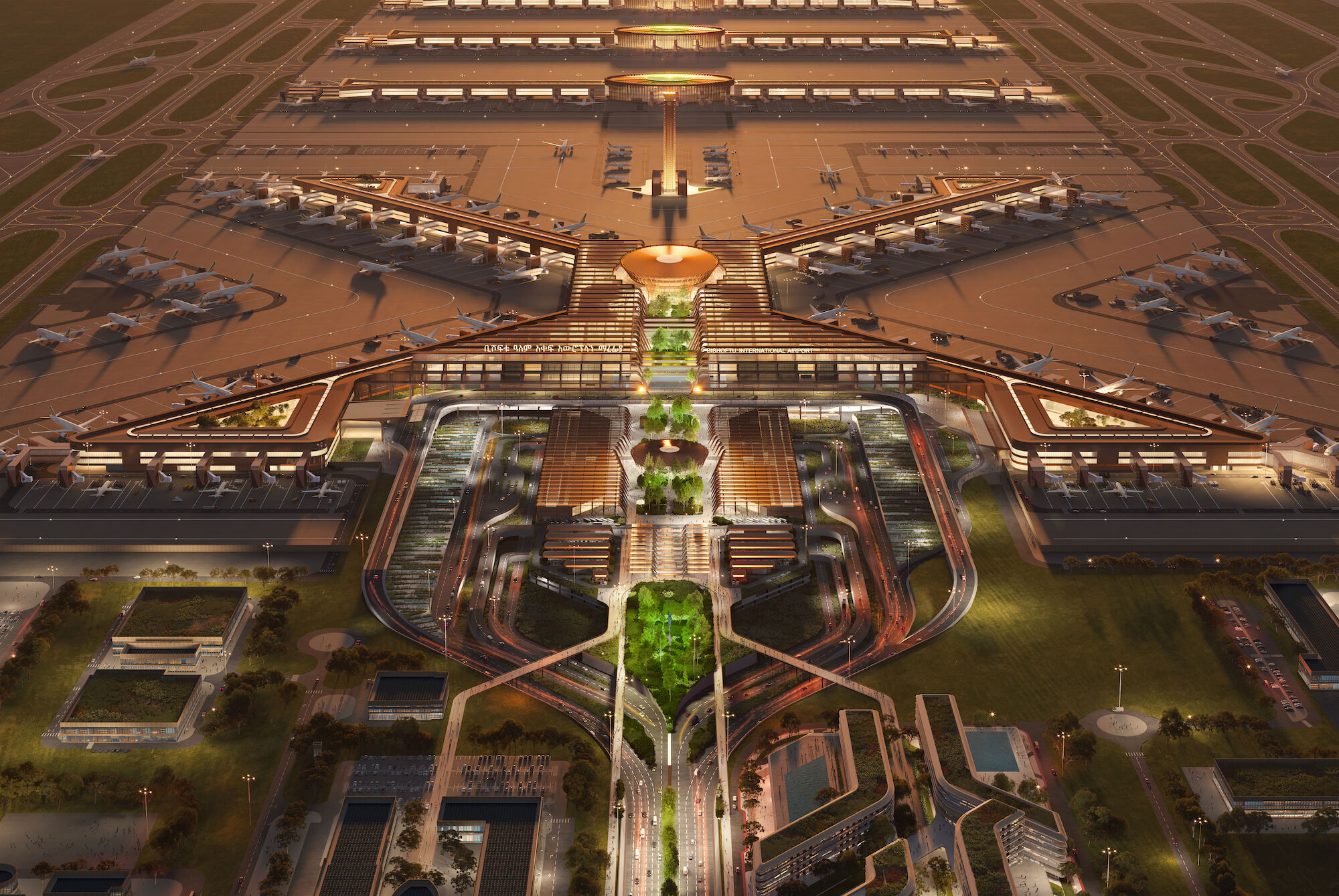
Above: BIA will be one of the busiest air-hubs in the world. Image: ZHA
An industry taking off
Africa has one of the world’s fastest growing aviation markets. Between May 2025 to May 2026, airline capacity for the continent rose by 6.7%, which is around 24 million seats. For context, within the industry one of the key measuring sticks for growth is airline capacity which boils down to the number of seats being flown. If an airport increases its capacity by booking more airline slots, bigger planes or increased flight capacity, it’s a sign that things are on the up.
During that same period, airline capacity in Southeast Asia grew by 1.7%, Europe saw a 2% increase and worldwide, the average was just 1% and so 6.7% is huge. Over the next twenty years, Africa’s aviation market is forecast to grow by more than 4% year on year. The market is rife with long-term opportunity, with hundreds of millions more passengers expected to take to the skies over the coming decades and that’s not a coincidence.
Agenda 2063 is a 50-year blueprint to transform Africa into a global powerhouse. The plan aims to, amongst other objectives, improve infrastructure and visa-free travel across the continent for its citizens. Several nations are already easing entry rules to boost tourism and increase intra-continental travel and actually, some countries no longer ask African citizens to hold a visa at all. There’s huge evidence of this working elsewhere - such as the Schengen Area.
But as demand and airline capacity increases, the travel hubs need to grow in tandem. As things stand, only 19% of intra-African routes feature direct flights, and if you look across the continent, there’s no true mega-hub. North America has Hartsfield-Jackson, Europe has Heathrow, South America has Guarulhos, Asia has Dubai International and Oceania has Sydney Airport. It’s time Africa had a giant of its own.
The home of BIA
Bishoftu Airport is about more than just creating a massive travel hub, envied around the world: there’s an element of practicality at play.
Ethiopia’s current key hub is Addis Ababa Bole International which welcomes more than 20 million passengers a year. But while 22 million is impressive in its own right - similar to Budapest or Tampa International - Addis Ababa Bole is projected to hit capacity within the next couple of years. To take Ethiopia’s reputation in the aviation market to the next level, its current airport would need a pretty extensive redevelopment and that’s a problem.
Addis Ababa Bole faces the same issue as airports in Sydney, Mumbai, London and basically any other major travel facility built in a city: it’s trapped in. As you can imagine, expanding the existing footprint would be more than a little bit disruptive which brings us to Bishoftu. About 35 kilometres away, the new site is less densely populated which makes it a much better location to construct a massive $12.5 billion airport.
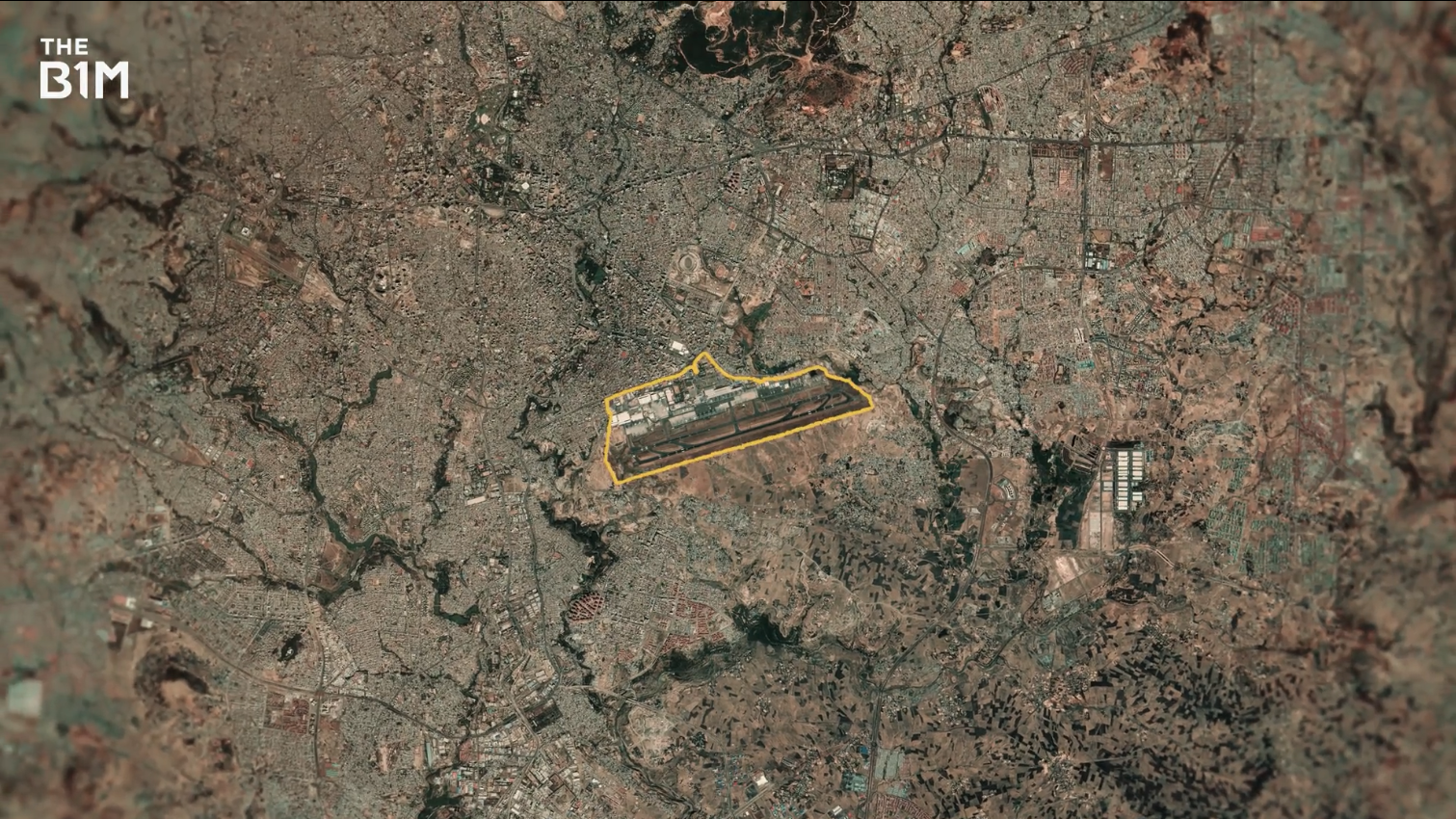
Above: Addis Ababa Bole International is surrounded by urban spaces making expansion challenging.
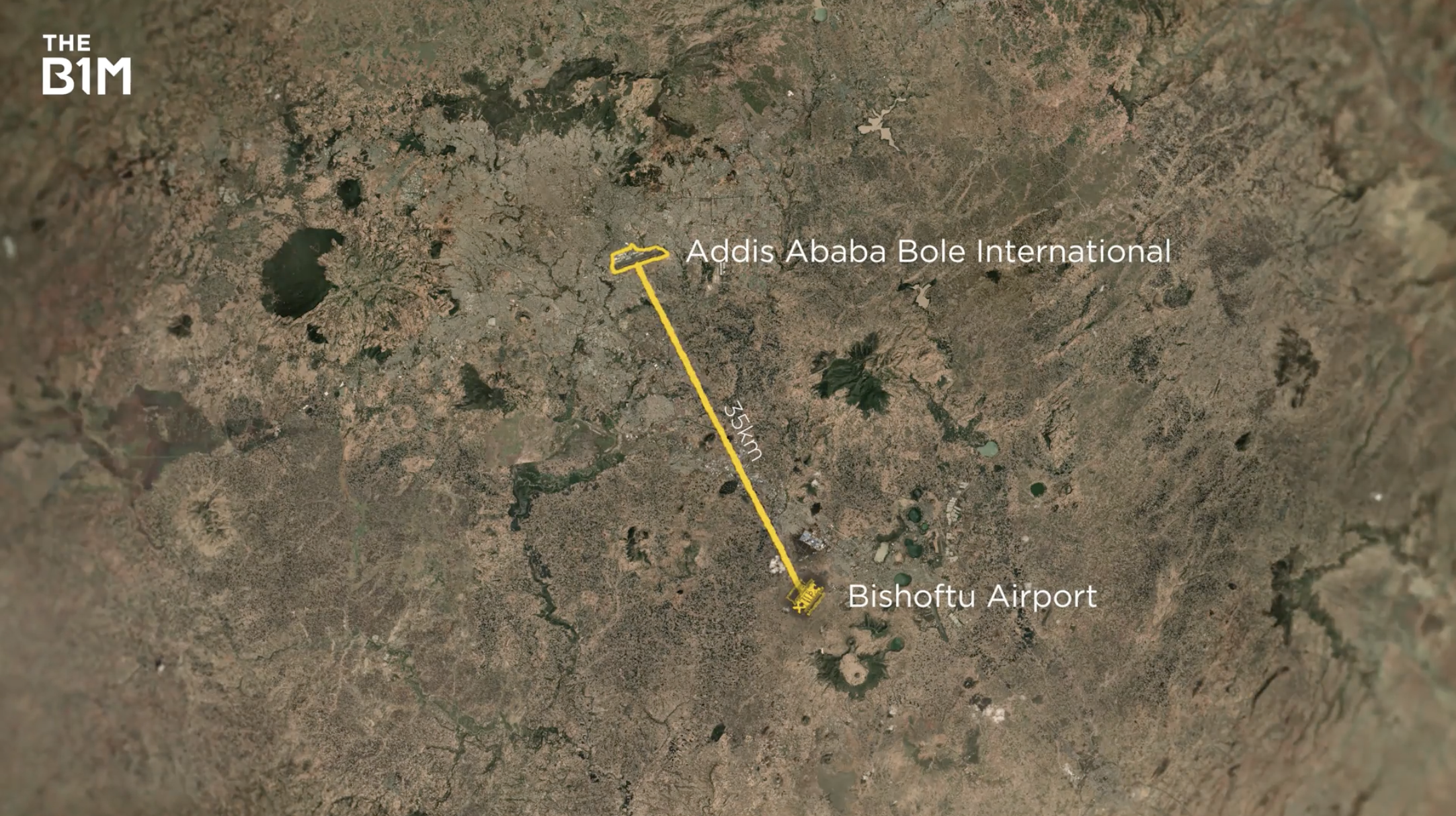
Above: Bishoftu Airport is about 35km away from Addis Ababa.
Supported by about $4.5 billion of funding from Ethiopian Airlines, a further $8 billion is yet to be agreed, although negotiations continue with the likes of the US and China.
The aim with Bishoftu International is to create a global travel hub connecting Africa, the Middle East, Asia and Europe. Ethiopia has looked at the Dubai and Istanbul models where massive airports were constructed with the aim of becoming stopover hubs that process crazy numbers of passengers and cargo. They fancy a piece of the action.
While Bishoftu will eventually welcome up to 110 million people every year, that’s only one part of the picture here. Ethiopia is landlocked, and so another key component of this new mega-port is cargo. Bishoftu is looking to see four million tons per year, which would place it in the top five cargo hubs worldwide and along with 110 million annual passengers, that's no mean feat.
Designing a mega-airport
Under the creative influence of Zaha Hadid Architects, Bishoftu has been designed to function as more than just a big terminal and a few long runways: it’s an airport city. That means on top of the airport, they’re building hotels, retail spaces, offices, cargo processing facilities and the obvious travel components key for an airport to be, well, an airport.
The focus is on developing a site that can expand into a little city in its own right and they’re becoming pretty common as nations look to take advantage of the economic potential a travel hub offers. They can be a whole lot more than just a passport checkpoint.
Ground-breaking at Bishoftu took place in January 2026 and land clearance is well underway. That’s 35 square kilometres of ground that needs levelling by December. Comparatively, Heathrow is just 12 square kilometres and JFK International is about 21 square kilometres.

Above: Ground clearance has begun to create the platform for Bishoftu Airport. Image: Ethiopian Airlines.
Construction has been broken into phases. The first focuses on passenger facilities, support infrastructure, the airfield, travel connections to the site, runways and cargo facilities. That’ll be ready for 60 million travellers a year by 2030. Each facet draws inspiration from Ethiopia’s landscape, culture and climate.
For instance, the terminal facilities and piers will be connected through a central spine, referencing the Great Rift Valley which cuts through the country, passing near Bishoftu. That spine should enhance efficiency, slashing transfer distances between gates. It’s a crucial aspect of the design because up to 80% of people who land at Bishoftu will never leave the airport, instead using it as a transfer facility for an onward destination.
All of these facilities are being constructed 35km from Addis Ababa because of space but there’s also a secondary reason. Bishoftu sits at an elevation of about 1,900 metres which is around 400 metres closer to sea level than Addis Ababa. While you might think that makes life harder, because aircraft will have to climb and descend further to reach cruising altitude or land on the runway, that's not the case. The lower altitude improves performance.
As you’ll know, if you’ve ever been up in the mountains, the higher you climb, the thinner the air. Not only is it harder to breathe up there but for a plane hurtling down a runway, a lack of density makes life that little bit tougher. Without getting into the nitty gritty of aerodynamics, denser air improves aircraft performance because it allows jet engines to suck in more air molecules and therefore produce more thrust. The denser formation supports lift too, increasing pressure underneath the wings.
Ethiopian Airlines says taking off from the new airport will require less fuel which means they can fly further, offering better long-haul range and that’s key for any global aviation hub looking to become a stop-off point for flights around the world.
Over the next two years construction will continue with the first runway and passenger terminal, alongside the road links to the site. In time, the area will gain those additional runways, a second passenger terminal and a 38 kilometre rail line to Addis Ababa. However, as with almost any major infrastructure project, there’s opposition.
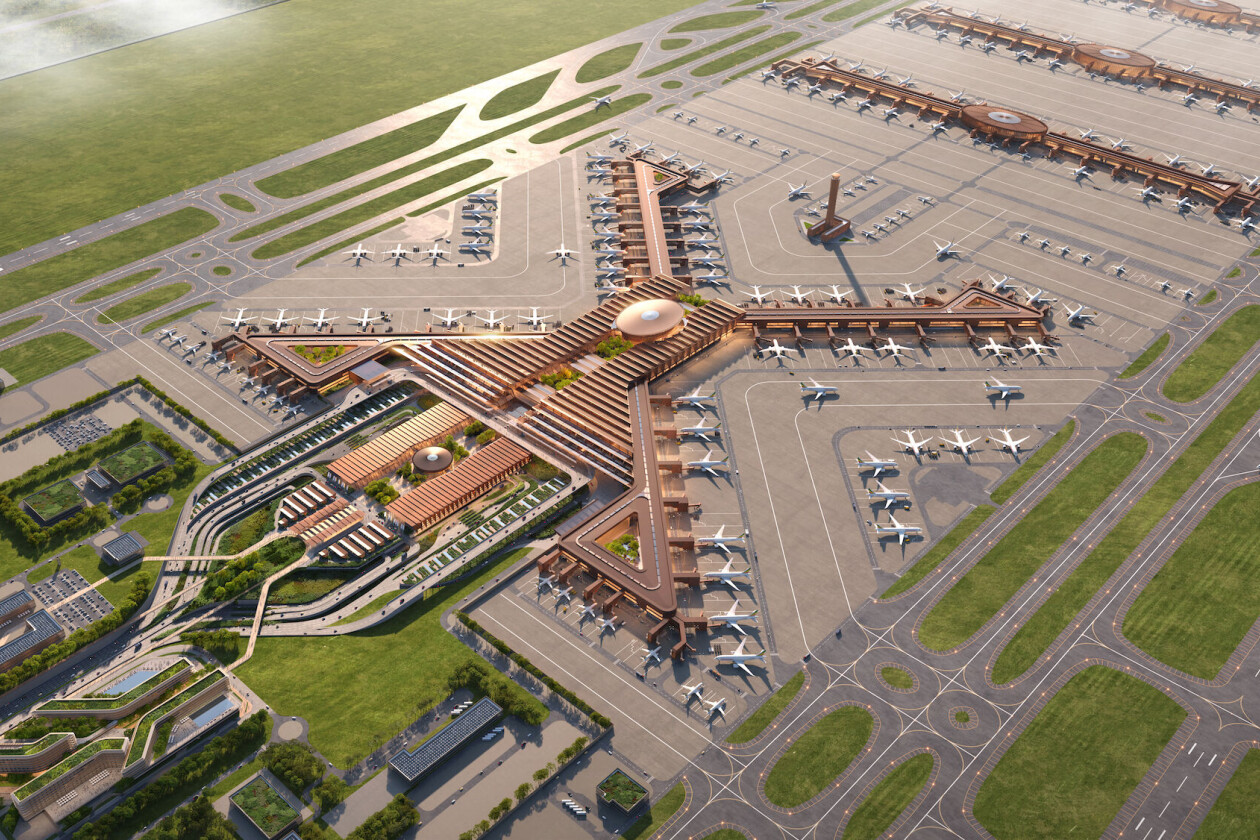
Above: A render depicting Bishoftu Airport's first terminal. Image: ZHA
A real challenge
About 15,000 people will be displaced by this new airport, which includes thousands of farmers. Addis Standard reported in February that Ethiopian Airlines built and awarded housing to displaced farmers but some residents report a lack of compensation and adequate resettlement support. At the time Ethiopian Airlines Chief Executive Officer, Mesfin Tasew, claimed the farmers who’d lost their land had “already moved into their new houses.” There are also questions about how a country with a comparably low GDP can afford to spend this amount on a single piece of infrastructure, although it’s worth pointing out the government itself isn’t paying for Bishoftu Airport.
Supporters of the development believe this will be transformative for the nation and while that might be true, establishing a giant isn’t as straightforward as just building a huge terminal and expecting 110 million people to turn up. Bishoftu Airport is competing with a number of established global air hubs like Dubai International, Istanbul and Heathrow - just to name a few. Even within Africa, Egypt is looking to overhaul Cairo International, the continent’s biggest airport. Currently welcoming 30 million people a year, the plan is to double capacity but even if Cairo welcomes 60 million passengers a year, it’s still not on the same scale as the world’s busiest airports.
Ethiopia plans to leverage its position to build upon what we already pointed out is one of the fastest growing aviation markets in the world. That’ll support the African Continental Free Trade Area, an agreement between more than 50 countries to grow the African market through a reduction in tariffs, improved relations and simpler trade processes. Many African cities are short on direct intercontinental flight paths so, this could become that connection point.
Then there’s Ethiopian Airlines, a dominant carrier in the country. It’s one of the best connected airlines around and so it’ll bring its well established connections to Bishoftu. In turn, the airport offers Ethiopian Airlines a massive new base to expand from. In fact, the carrier is already adding new jets to its long-haul fleet to develop further connections across the continent and onto the rest of the world. And let’s not forget cargo. Ethiopian Airlines is already a massive carrier of freight which goes hand-in-hand with the aims of this new hub.
The fact BIA is being constructed from scratch is another reason for optimism. This is a bespoke mega-hub and so there’ll be no aging infrastructure and no merging of old and new. The site is custom designed with huge cargo zones, rail links and a massive terminal dedicated to swiftly organising passengers.
Of course, it would be naive to deny the challenges that lie ahead. There are no guarantees enough people will travel through Bishoftu Airport to make it worthwhile, with established rivals not too far away in the Middle East. Full funding is still to be secured and while reports look promising, closing $8 billion in one year is a big ask.
What we do know is that Africa’s aviation industry is on a sharp upward trajectory. There’s opportunity here for those bold enough to take action and given the promising early signs, don’t be surprised if in years to come you find yourself sitting in an airport lounge in Bishoftu, while you wait for your connecting flight.
They can't harm you, if they can't find you! Use code theb1m at the link below and get 60% off an annual plan: https://incogni.com/theb1m
Additional footage and images: Ethiopian Airlines, Zaha Hadid Architects, Dennis Jarvis, Alan Wilson, Londisland and Lufthansa Cargo.
We welcome you sharing our content to inspire others, but please be nice and play by our rules.
Comments