One of History's Greatest Buildings is in Danger
- Youtube Views 553,204 VIDEO VIEWS
10 June 2026
Video hosted by Fred Mills. This video contains paid promotion for Rayon Design.
THIS building has a story unlike any other. Once the jewel in the crown of two giant empires, for 1,500 years it has just about survived wars, looting, fires and multiple earthquakes.
But a recent surge in seismic activity has sparked fears this magnificent structure could be in mortal danger when a very big quake hits in the future – and that really is not a case of ‘if’ but ‘when’.
And while it’s survived a lot during the last millennium and a half, the damage that has built up over centuries is now starting to show.
Which is why Hagia Sophia, one of our planet’s most historic buildings, is now going through the biggest and most important upgrade of its long, eventful life.
Without it, this unofficial wonder of the ancient world could become ancient history.
Best of both worlds
There’s nowhere else like Istanbul. It's the only major city in the world that straddles two continents; divided by the Bosphorus Strait.
And overlooking this busiest of waterways is Istanbul’s most iconic landmark: the majestic Hagia Sophia.
The name means ‘Holy Wisdom’, but in Ancient Greek. Which gives you a real sense of just how old, and globally significant, this building is. Angkor Wat, the Tower of London, Notre Dame, the Vikings — all of them came after it.
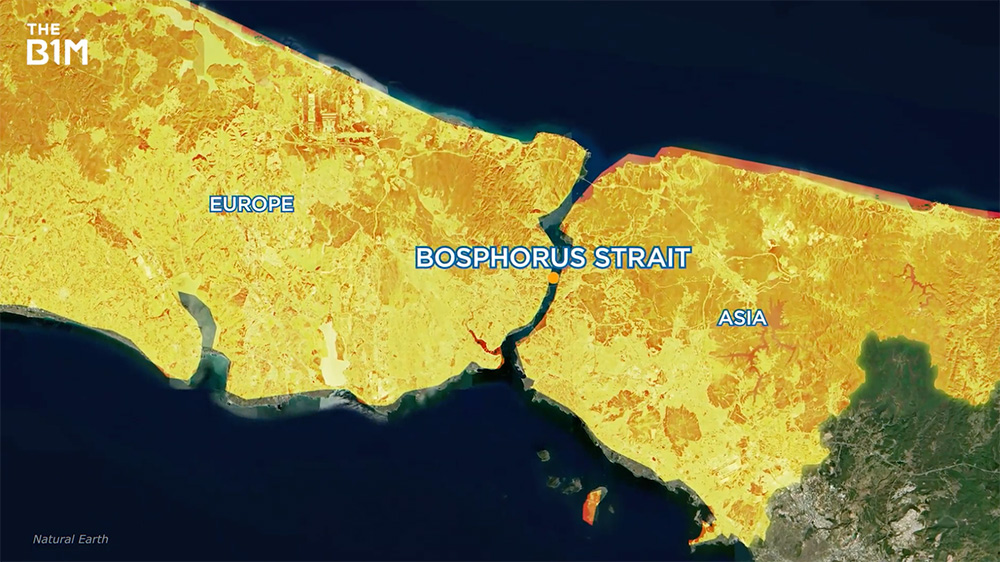
Above: Istanbul is positioned right on the spot where Europe and Asia meet.
Stand outside it today, though, and you might wonder what all the fuss is about. Because it’s virtually disappeared underneath a mountain of scaffolding.
We’ll come on to why that’s had to happen very soon, but before we tackle the present and future, it’s important to understand this structure’s extraordinary past.
After all, many consider this to be on a par with the Pyramids, the Colosseum and the Great Wall of China as one of the greatest structures ever built.
Finished in 537 AD, it was the main cathedral of Constantinople for over nine centuries — Constantinople being the former name of Istanbul, when it was the capital of the Eastern Roman, or Byzantine, Empire.
The man in charge
It was so spectacular, Emperor Justinian I, who commissioned it, is thought to have shouted out “Solomon, I have surpassed thee!” upon its completion.
He was talking about King Solomon and his Temple, which — if you know your scriptures — was a major flex.
“Justinianus tried to show his power to the public. That's why he started a very big project. It's all politics, you know, as today,” said Dr. İlknur Türkoğlu, an assistant professor at Istanbul Gelisim University’s School of Applied Sciences, Conservation and Restoration of Cultural Properties.
“So, the structure of Hagia Sophia took only five years. He wanted to build a very big, very impressive building in a very short time.”
But like any big-thinker, Justinianus didn’t let his need for speed stop him from having grand ambitions. The giant central dome was designed to give the impression it was floating above the floor.
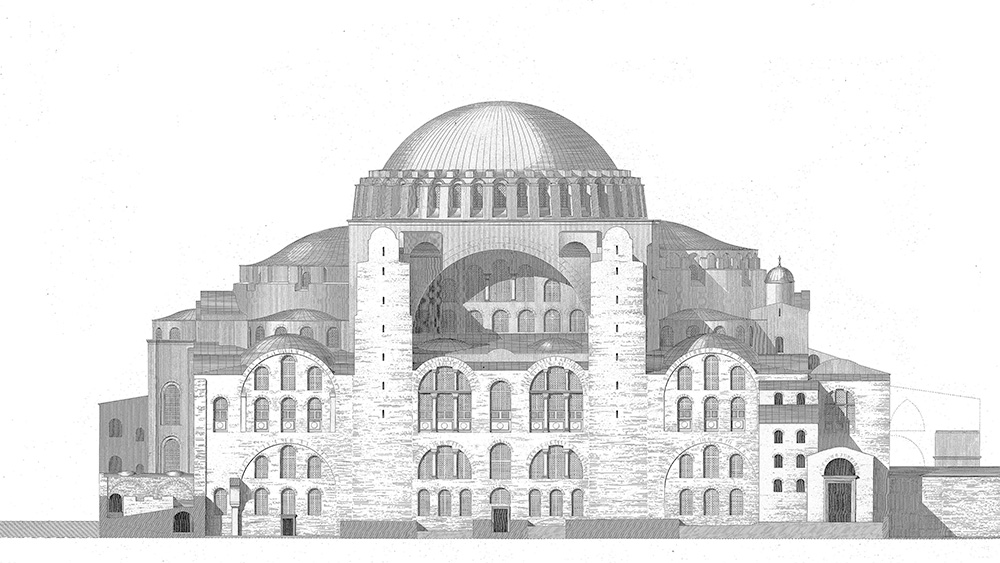
Above: An illustration of Hagia Sophia during its time as the Great Church of Constantinople, with its 31-metre-diameter dome.
And it would’ve been successful in its illusion, because this is when a certain building innovation was used for the very first time.
They’re called pendentives. It’s where four curved triangular segments are placed at the top of a square base to create a circular dome.
But with so much vertical force pushing downwards, and lateral thrust pushing outwards, the dome needed additional support.
“That's why they built the main dome with two half-domes,” explained Yasin Karabacak, a professional tour guide in Istanbul and author of several books on Hagia Sophia.
“They were supposed to use four half-domes to support the building, but when you use four half-domes, you need four giant pillars and they [would] dominate the building.”
Set to the east and west of the main dome, these semi-domes help to channel some of the weight and thrust down to the arches, piers and foundations. The buttresses on the north and south sides do a similar job.
Full of surprises
And yet there’s much more to this building than its most prominent feature. You see, while Hagia Sophia isn’t technically considered one of the Ancient Wonders of the World — only the Great Pyramid remains from that list — take a look at the below.
It's a set of eight green marble columns brought in to support the arches and galleries — or upper floors — of the cathedral.
They’re believed to have been recycled from the Temple of Artemis, which is — was — one of the ancient Wonders.
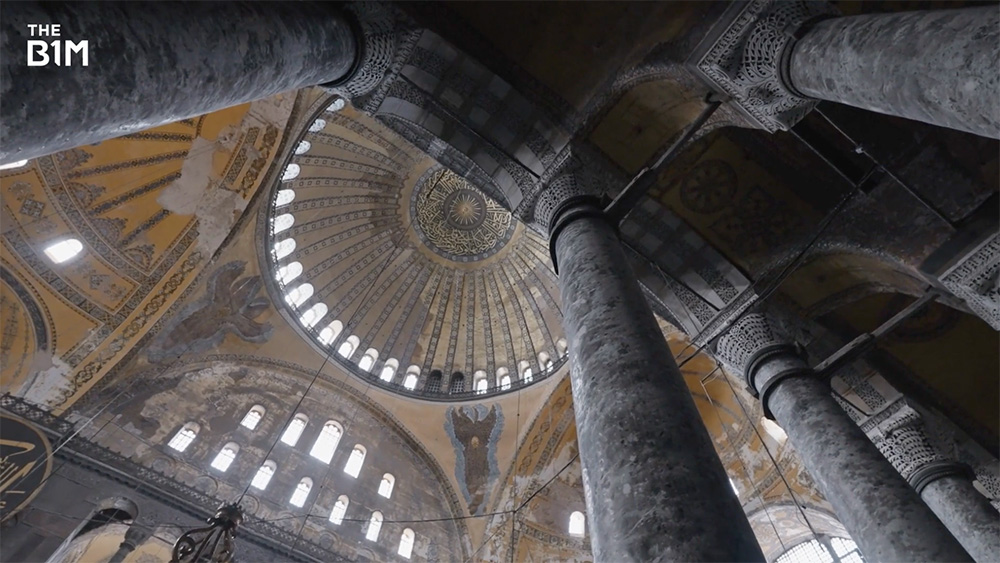
Above: A view of the columns and the underside of the main dome.
Meanwhile, a type of red stone set into the floor could only be found in Egypt’s Eastern Desert. You’ll find it in the Omphalion, the site where Emperors were crowned for hundreds of years.
Meanwhile, the yellow stone found in the decorative wall coatings came from Syria, marble was shipped from what is now Tunisia and Algeria… In other words, materials were sourced from far and wide.
While all of this goes to show what people in power were capable of even way back in history, it’s nothing in comparison to the power of nature.
“Big earthquakes happened in several cities close to Istanbul, like the earthquake in 1999,” said Türkoğlu. “It happened to another city, but it affected Istanbul a lot.”
But natural disasters are hardly a problem exclusive to the modern era. The architects of Hagia Sophia wouldn’t have known they were working close to a fault zone.
Large earthquakes were recorded in what is now modern-day Greece, Italy and Turkey around the same time this building was starting out.
It explains why there were some complications in what was actually the third attempt to build this place.
The dome's downfall
Just over 20 years after completion, in the year 558, the now iconic dome collapsed. It had fallen victim to one of these earthquakes, but not only that — engineers realised it had been built too shallow.
You see, even with those pendentives, loads were being transferred to the walls, which caused the supporting structures to crack, shift and weaken.
Adding more lateral forces, like you get in an earthquake, proved to be the final straw. So, the dome was rebuilt with a higher crown — or apex — and a series of ribs, ensuring forces were distributed straight to the structural supports instead.
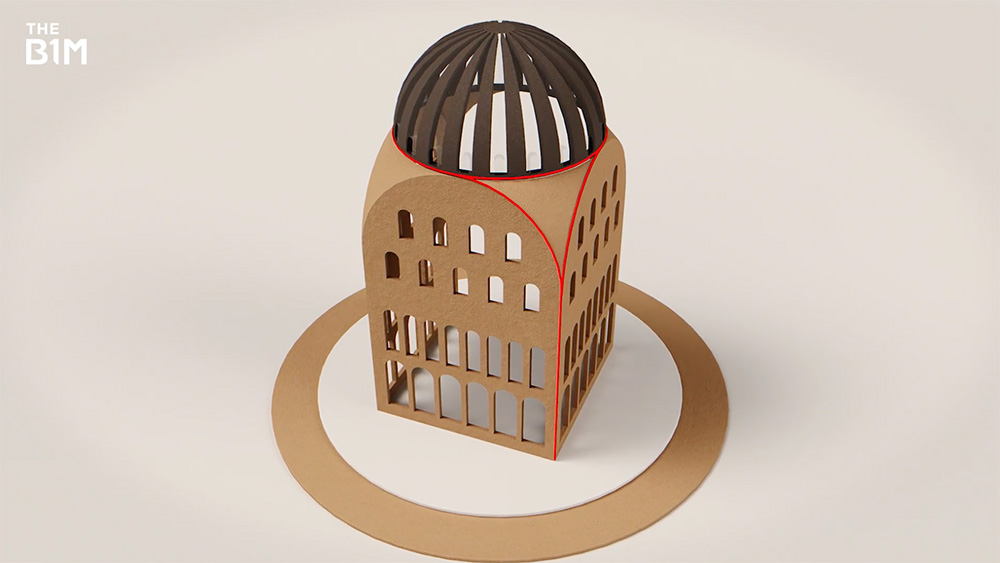
Above: A graphic showing the newly-rebuilt dome above the pendentives and support structures.
But there was more trouble to come. Once rebuilt, the dome suffered further partial collapses in the 10th and 14th centuries — often caused by earthquakes.
The dome you see today hasn’t actually changed much since the 15th century — some 600 years ago. That’s when Constantinople fell to the Ottoman Empire, and Hagia Sophia was converted from a church to a mosque.
As you can imagine, that led to several changes. For example, many of the Christian mosaics were covered up or plastered over, before being rediscovered much later.
Sinan the saviour
This was when the towering minarets, which are used to recite the call to prayer were constructed. The first two were built shortly after the conquest, but the others were added a century later, and not just for religious reasons.
“When the city was conquered by the Ottomans, the building was not in good condition,” said Karabacak.
“In the 16th century there was a big problem — the building was about to collapse. So, Mimar Sinan, who was the most famous architect in our history, added two more minarets.
“When you look at the base, they are huge — they’re much bigger than other minaret bases because each minaret is a buttress. So, they’re actually supporting the building.”
After that, the next 400 years or so passed without too much drama. Well… for Hagia Sophia at least.
That was until the mid-1930s, when this city once again found itself adapting to a completely new regime.
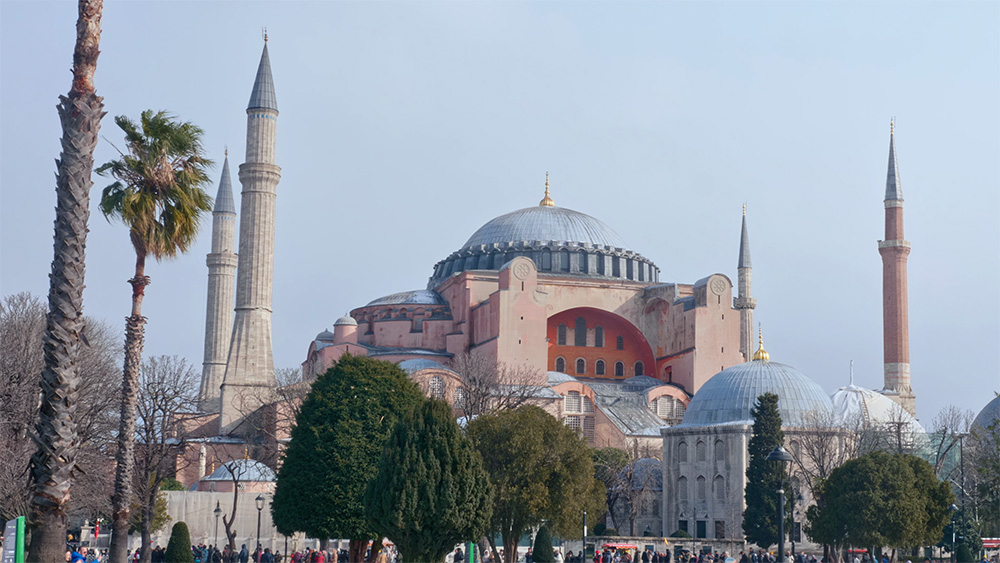
Above: The four minarets at Hagia Sophia are not all the same. Image: Ibrahim Bennett.
A decade before, the Ottomans had been overthrown, and the Republic of Turkey was born with a series of secular reforms.
Founding father Mustafa Kemal Atatürk wanted to show the world his new country didn’t favour any particular religion.
As proof of this, Hagia Sophia was turned into a museum, so people from all walks of life could sample its unique history.
Christian mosaics hidden for centuries were uncovered and displayed next to the Islamic calligraphy of later centuries.
The latest chapter
But there was to be one more transformation as Hagia Sophia entered the decade we’re now currently in.
2020 saw President Erdogan reverse the decree from 1934, which led to it becoming a mosque — again.
It means the main floor is now exclusively for Islamic worship, whilst the galleries above are open to non-Muslims.
Despite being popular with many Turks, choosing to make what had become a shared heritage site a religious building again didn’t please everyone.
Still, the fact there has been so much debate about what it should now be used for shows just how important this building still is to people across the world.
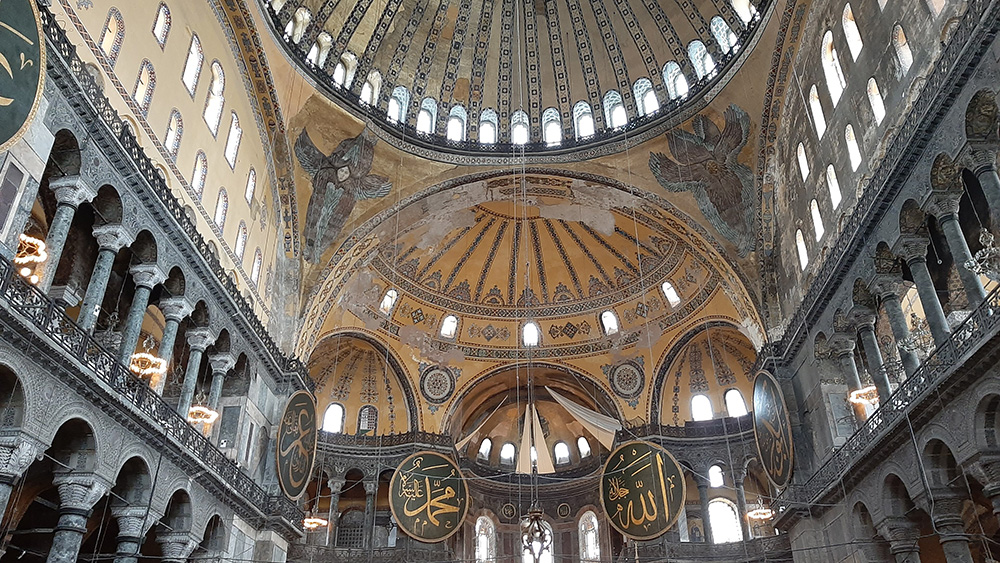
Above: Nowhere else would you find so much iconography, from both of the world’s biggest religions, in the same building. Image: ImanFakhri/CC BY-SA 4.0
But what had to happen next was beyond dispute. Because by then it was 2023 — the year Turkey faced two devastating earthquakes on the same day.
The impact was devastating for the Turkish people, with the most severe destruction seen in the south-east and centre of the country.
Although situated away from the worst-hit areas, a multi-year plan was drawn up to address “centuries-old fatigue” in the structure of Hagia Sophia. And, of course, make sure it’s ready in case the next disaster hits closer to home.
Assessing the situation
Two years later, work on reinforcing the building properly began. Immediately, the complexity of this challenge would’ve been unmistakable for the restoration team — because they didn’t yet know what state the dome was in.
So, one of the first jobs was to make a series of openings, allowing them to see inside. They discovered that over time, and after previous collapses, extra material had been added to give the dome its ‘roundish’ shape.
Which means that technically, it’s no longer actually a perfect circle. And more importantly, these interventions made the dome heavier than it should be.
“We opened 24 spaces symmetrically above the dome. During the history, you can say that it has three parts from different centuries … in some places, they cannot fit each other correctly,” said Hasan Firat Diker, lead architect for the restoration and a professor at Fatih Sultan Mehmet Vakıf University’s Faculty of Arts, Design and Architecture.
“It had been filled with soil and some wooden structure — wooden beams — in order to make it ‘roundish.’ So they added extra loads to the dome. One of the main aims is to remove the extra loads, make it lighter.”
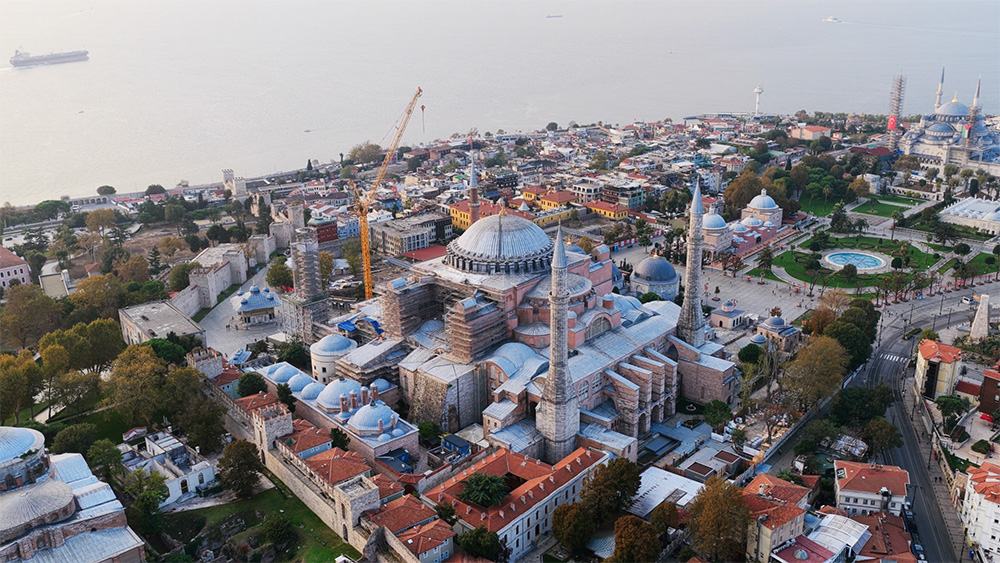
Above: Hagia Sophia is now a construction site once again.
Above this, the team discovered that the lead coverings on the main and semi-domes are now worn and damaged. So they’re being replaced, which will help strengthen the system that supports them.
Because this will open up part of the roof, the dome is being shrouded by a steel structure to protect it from the elements, as well as prevent damage to the inside of the building. Including the historic artwork, which has already been experiencing centuries of wear and tear.
“We took the decision to make a great scaffolding to keep the main dome from the outer weather effects,” said Diker.
“Even rain of half an hour can damage … not only the dome itself; we also need to preserve the mosaics beneath it. So we had to be very careful.”
Under the dome
To support the steel structure and prevent it from adding more weight to the dome, while giving workers access to the inner side, four large piers were installed underneath.
Although quite hard to miss, the towers have actually been carefully arranged so they don’t get in the way of worshippers. And yet, this restoration is about more than just the dome — there’s loads to do.
“They're also restoring the floor, columns, mosaics. The marble floor has damage,” explained Karabacak.
“The marble floor of the upper gallery was restored before it was open to the public as a museum. They're going to do the same thing on the ground floor."
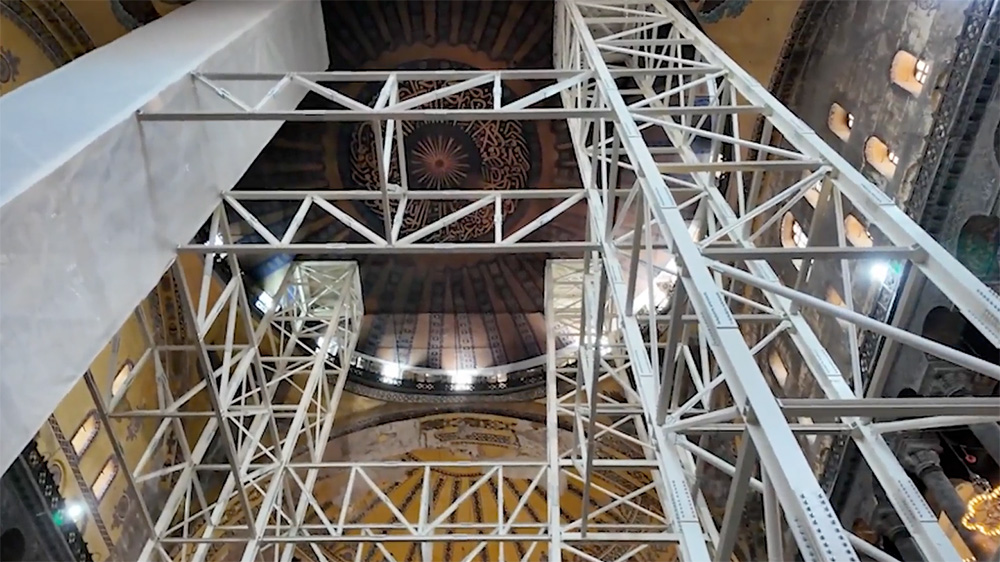
Above: The steel platform built inside for the restoration is hard to miss. Image: Yasin Karabacak
Much effort has gone into being as non-intrusive as possible with the restoration. After all, this is an active place of worship and a UNESCO World Heritage Site.
But still, the methods used to bring heavy materials inside has created concern. Trucks and cranes were driven right inside for the first time ever — onto a surface that was built centuries before these vehicles even existed.
In other words, the floor wasn’t originally designed to carry this sort of weight, so you can understand why people were concerned.
Doing the groundwork
Thankfully, Hasan and his colleagues made preparations beforehand. They tested the soil, commissioned radar scans and carried out load calculations before building a special platform to support the weight of the trucks.
“There is a multi-layered temporary floor … before the cranes get inside,” Diker said.
“There are many, many layers — sand at least to the thickness of 10cm, and then very different kinds of membranes and wooden floors etc.
You can imagine how stressful it must have been for the team — despite all those tests and preparations, there were surely some nerves about what would happen if something didn’t go to plan at that point.
As for what they need to do to give the dome more seismic resistance, well, because the project is still in its early stages, a lot of the details are still being worked out.
But one thing they know they have to address is where the main and semi-domes, which aren’t properly connected, could strike — or ‘hammer’ — against each other in an earthquake.
“The main issue here is the hammering case. During the earthquake, semi-domes who were constructed to support it, may be harmful for the main dome,” said Diker.
“So in this restoration we attempt to connect these points with the main dome in order to make them work together, not individually.”
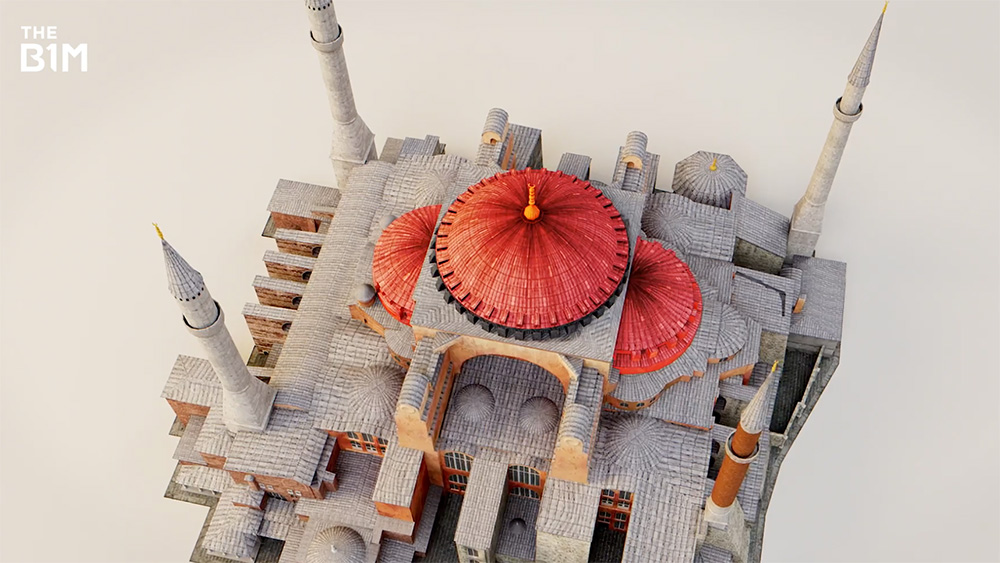
Above: The spaces between the main dome and semi-domes will be a key area of focus.
While we wait for the most critical phase to get started, there has been a remarkable discovery. When examining the western garden and northern facade, workers uncovered a tunnel network that’s even older than Hagia Sophia — from about 1,600 years ago.
The fact that we now know there are ancient structures above and below the ground here makes it even clearer just how important this project is.
Because if it isn’t completed, who knows what the end result might be. We’ve seen how incidents like the fire at Notre Dame in Paris and the collapse of ChristChurch Cathedral caused heartbreak around the world.
Should Hagia Sophia find itself in a similar situation, when it’s managed to stand firm for so long, the response would be truly seismic.
It’s why projects like these are so important — restorations that prevent disasters like the ones we saw in France and New Zealand.
Because too often we find ourselves mourning the loss of great buildings when it’s already too late.
“There is not a lot of buildings still standing [that are] that old. Whenever I go into Hagia Sophia, I feel every inch of the building is precious. It is a common heritage,” concluded Türkoğlu.
“It is the heritage of two very important religions and it is the heritage for lots of political figures also. That's why we have to handle it carefully. Very carefully.”
Rayon is the all-in-one, effortless CAD tool for going from concept to completion. Try it (for free) here.
Additional footage and images: ABC News, Al Jazeera, BBC News, CBS News, Daily Sabah, DW News, i24 News, Mehmet Nuri Ersoy/X/Republic of Türkiye Ministry of Culture and Tourism, NTV, Sky News and TRT World.
We welcome you sharing our content to inspire others, but please be nice and play by our rules.
Comments