The €7BN Mega-Canal That Will Reshape Europe
- Youtube Views 1,341,043 VIDEO VIEWS

15 June 2026
Video hosted by Fred Mills. This video contains paid promotion for Bentley Systems.
THIS is the largest megaproject of its kind anywhere in Europe. What is now a big muddy trench is set to become a critical new trade route, connecting France to Belgium, the Netherlands and beyond.
But it’s not simply a new road or railway; this is a canal, and a seriously big one. It’ll have super-deep locks so extraordinary they’re expected to become tourist attractions, dozens of bridges that will allow huge boats to pass under — and over — the existing infrastructure, as well as a complex design that’s pushing engineering and technology to the absolute limit.
And it’s all being built in an area with an astonishing past, including the setting for one of the deadliest battles in history.
Waterway to get around
Ah, the canals of Europe. They’re great for a bit of scenery, but are they actually still, you know, useful?
Sure, if you wanted to take a boat tour of Amsterdam, glide under the bridges of Bruges or just skim a few stones to pass the time then the answer would be yes. But is that it? Well, no. Not even close.
Because the continent’s inland waterways, as they’re also known, remain one of its most important infrastructure networks.
In 2024, almost half a billion tonnes of goods were transported across the EU via these systems, and that number has been increasing.
Most of this activity takes place in just three countries — the Netherlands, Germany and Belgium. Hardly surprising when they’re covered in canals that join up with some of Europe’s biggest ports like Rotterdam, Antwerp and Hamburg.
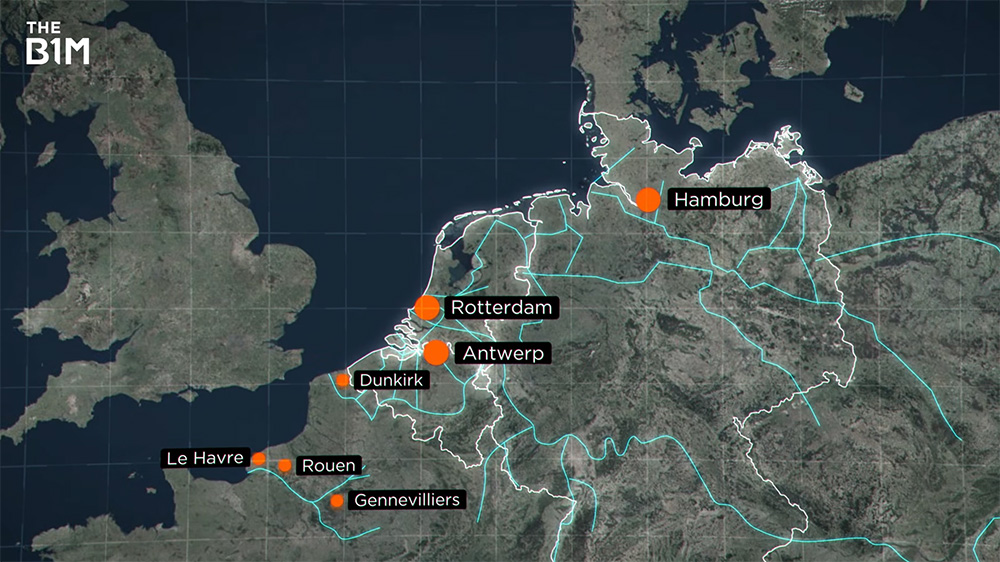
Above: A map showing some of Europe's most important ports and waterways.
Don’t forget about France, though. It has 8,500km of navigable waterways, making it the largest network of any European country. The trouble is, they don’t connect very well with those other nations.
There is one major route that sort of brings them together — the Canal du Nord, which runs from the north of France down to the Seine basin.
It took more than half a century to build. Why so long? Well, they had a pretty good excuse for the delay — two World Wars, actually.
And with a lot of the fighting — on both occasions — taking place in this very region, we’ll give them a pass. But unfortunately, after all that time, it started to become obsolete very quickly.
“The Canal du Nord is an old canal that was started in the 1900s, and which was completed in 1965," explained Benoît Deleu, technical director at Société du Canal Seine-Nord Europe. "The Canal du Nord today does not allow the navigation of large boats, and therefore does not enable navigation of the majority of the European fleet.”
Enter the Seine-Nord Europe Canal
So now, France is having another go with a new canal that will do more than just replace its earlier effort.
Because this one looks set to be a real tour de force. Or maybe the creme de la creme of canals?
With a 107km length and 54-metre width, the Seine-Nord Europe Canal is considerably longer and wider than its predecessor.
It’ll be suitable for vessels over seven times larger than what the Canal du Nord can manage.
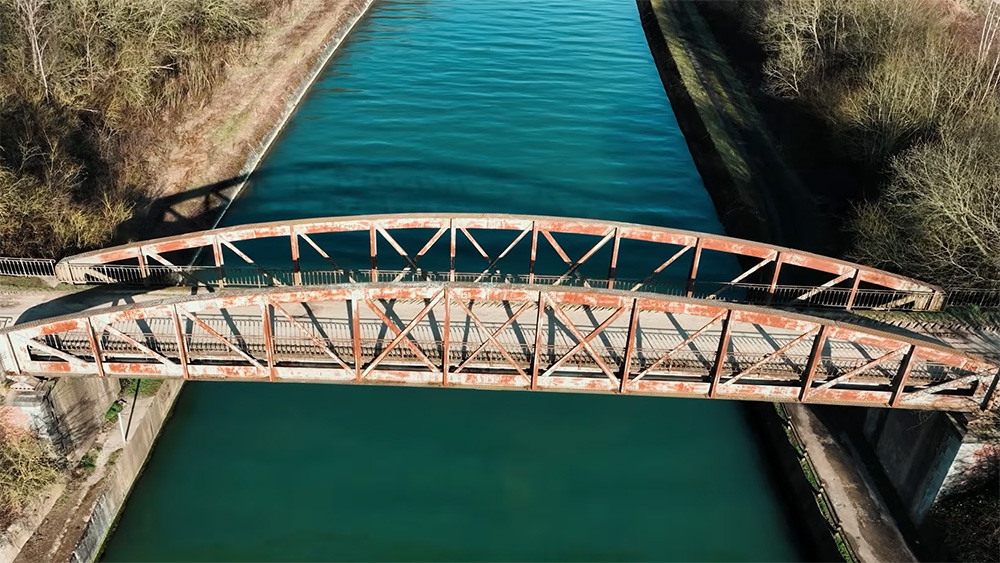
Above: The Canal du Nord is not suitable for big, modern barges.
It’s all set to cost €7.3BN, and half of that is EU funding. The rest is coming from the French government and the various regions and departments that the canal will pass through, from Oise in the south to Nord in the … well, the North.
If you’re not familiar with France, it’s split into 13 metropolitan regions, and within those are 96 departments.
We could go into the divisions below that and start talking about arrondissements, communes and cantons but it’s super complicated so… sorry. Not today.
The benefits
This critical new waterway is set to seriously boost trade, speed up navigation and reduce pressure on other modes of transport. Across Europe, not just France.
That’s due to its connectivity with those European neighbours via what’s called the Seine-Escaut River Link.
“The Seine-Escaut link is a European link that will allow for the development of large-gauge waterways, both in France and Belgium, specifically in Flanders and Wallonia," said Deleu. "[It is] a project that will allow for the development of river transport, thus effectively providing a large-gauge network for the transport of goods.”
It's what makes it a crucial component of the EU’s Trans-European Transport Network. Which, to remind you, is that huge interconnected system of railways, roads, ports and — obviously — canals spread all over the member states.
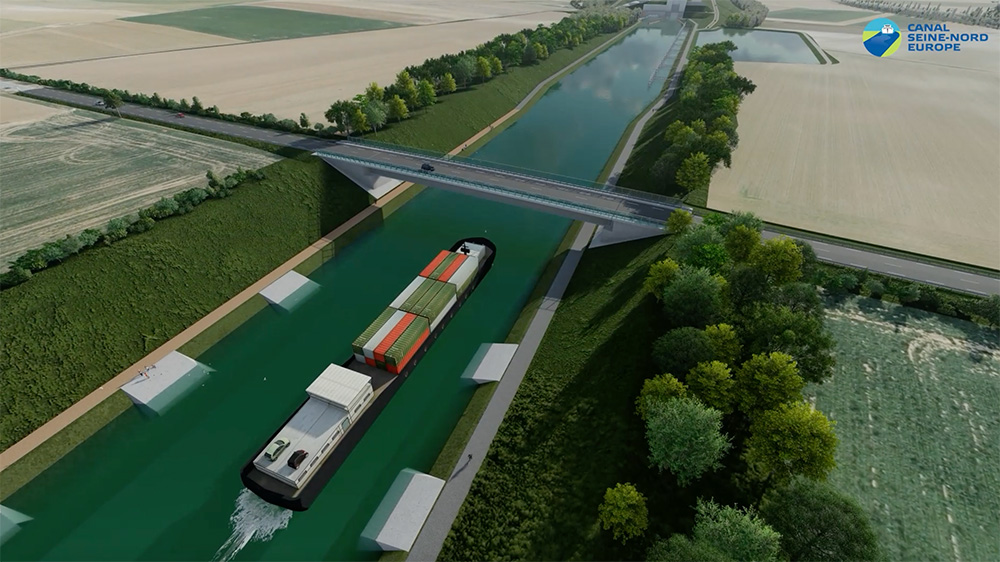
Above: The new canal will be able to accommodate vessels up to four and a half thousand tonnes in weight. Image: Société du Canal Seine-Nord Europe + PIXXIM
2013 is when the EU gave its consent to the plan, and three years later a company was set up to oversee the project — the Société du Canal Seine-Nord Europe, or SCSNE for short.
Another three years passed before the finances were agreed between the EU, the French government and the various local authorities.
Then, in 2022, all was ready for the real work to start, so with that in mind, let’s move on from the project’s raison d'être.
Good lock
Now, you might think that constructing a new canal is all about digging a very long trench and filling it with water.
But there’s a lot more to it than that. Like with most canals, there will be large locks placed at numerous points, and there are seven on the Seine-Nord Europe route. These allow boats to travel through areas of varying terrain and water levels.
Two of the locks will have drops of more than 25 metres, making them the deepest ever built in Europe. Including this one, which doesn’t just have an extreme depth. It’s 12.5 metres wide and 197 metres long.
These giant gateways have to offer unusually high levels of performance. What that means is boats will be able to pass through them quickly, despite their immense size. Lockage times — how long the system takes to empty or fill — must not exceed 15 minutes.
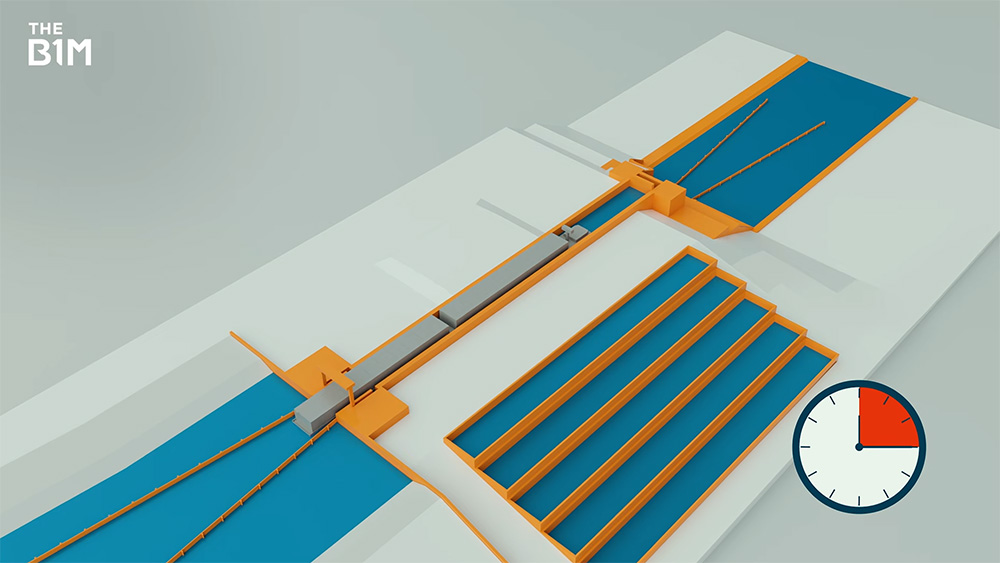
Above: A graphic showing a barge moving through one of the new locks.
So, in order to get water in and out quickly, while limiting the environmental impact, a set of cascading basins will be built off to the side.
They will be connected to the lock chamber — where the boats sit — via a series of pumps and culverts, allowing water to be recycled.
If the water level gets low, more can be drawn in from the 14M-cubic-metre reservoir that’s being built off to the side of the canal, ensuring it won’t dry up in the hotter months.
Tried and tested
Great, but these locks are the sort of thing you don’t want to build without knowing how they’re going to work first.
That’s why they’re being designed using a combination of digital technology and detailed physical models.
Building scaled-down versions means the project team can optimise complex components before they’re made for real.
Like the perforated floor slab, for example. This sits between the lock chamber and the dissipation chamber underneath, managing the flow of water between them.
They could also test factors such as flow rates, employ sensors to measure various forces and experiment with the valves that control the operating system.
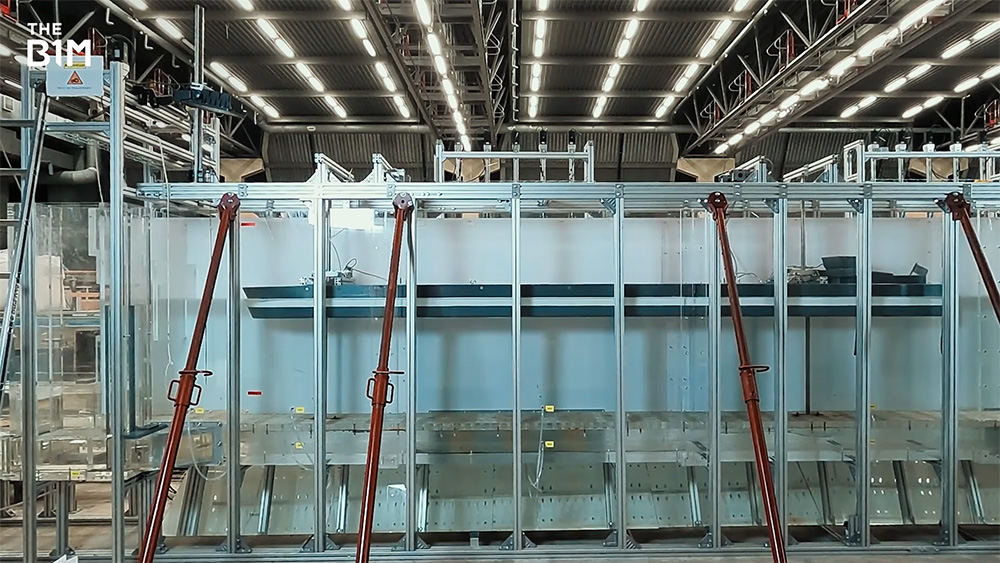
Above: The replica model was used to test the filling and emptying methods ahead of the actual build. Image: Société du Canal Seine-Nord Europe + SPW
But it’s the virtual model created for this new canal that is arguably even more impressive. Egis, the main contractor, had to find a way for hundreds of people to access and manage more than a terabyte of data.
What they needed was a connected data environment — to serve as a digital backbone for the entire project.
This would allow people from various departments to collaborate, and visualise what was going on, in real-time.
“With the federated model it's very easy to understand the project," said Arnold Ledan, BIM manager at Egis. "It's very important for this project to manage the 3D model and manage data because it's the first time [for us] to have 250 people collaborate inside.”
Wise choice
By using Bentley’s ProjectWise software as a common data environment, the team was able to carry out digital design reviews and detect clashes or inconsistencies easily.
It’s been so successful, Egis has now added several modelling applications from the company to its workflow.
“When we started this project we started with ProjectWise. Now, it’s a BIC [Bentley Infrastructure Cloud] infrastructure," said Ledan. "We work with [Bentley] MicroStation, we work with OpenRoads. It’s very interesting to check for the clash detection and to follow the issues inside the Bentley Infrastructure Cloud.”
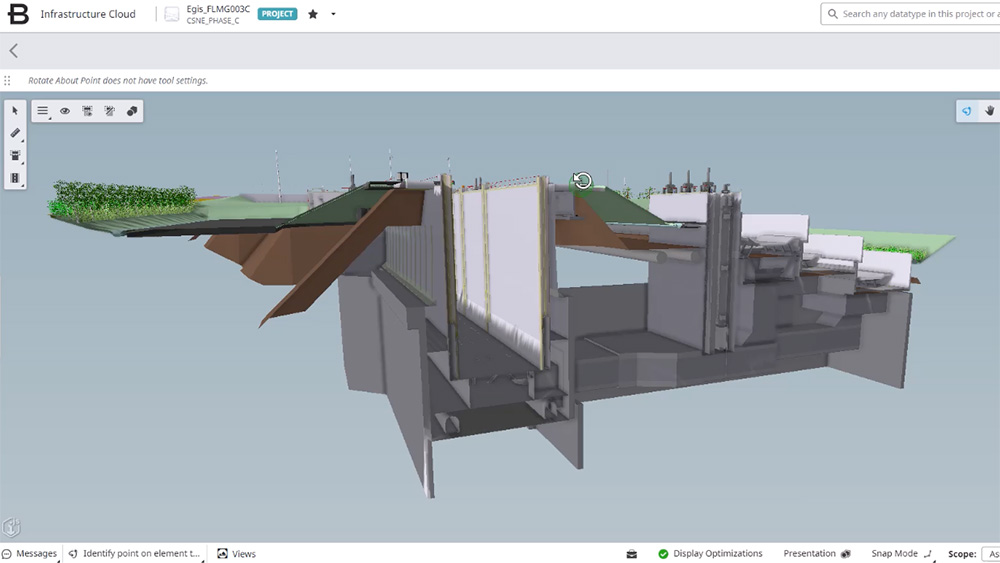
Above: A lock model inside Bentley Infrastructure Cloud. Image: Egis.
Overall, this way of working improved productivity by over 40%, while the time it took to generate the models was reduced by over 60%.
Which meant more time could be spent on tasks such as figuring out how to make this megaproject as beneficial as possible to the French population — and not an eyesore.
The locks will be so big once they’re completed at full size, they’ll be quite noticeable additions to the landscape.
But they’ll be immense feats of engineering in their own right, which is why SCSNE plans to make them a tourist magnet.
It might sound like an unusual attraction, but tell me — who hasn’t walked past a canal lock that has a boat going through it and stopped to watch?
So, when the locks on Seine-Nord Europe are going to be some of the most advanced ever constructed, it's kind of understandable.
Building bridges
Incredibly, we’ve only just begun describing the scale of the challenge presented by this project.
Because it’s being built through a territory full of existing transport infrastructure, planners have had to include 62 road and rail crossings in the design.
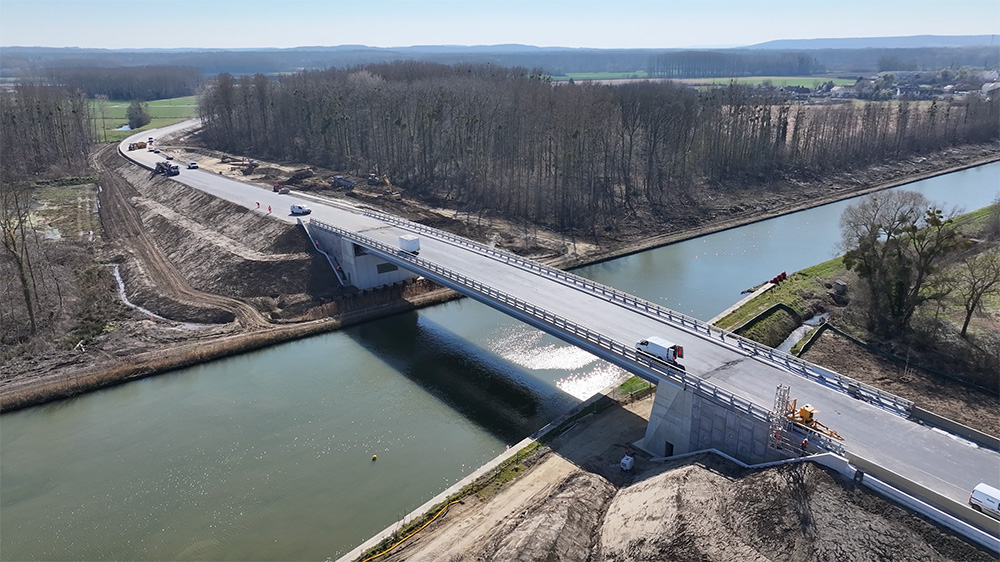
Above: One of dozens of bridges that are also part of this megaproject. Image: Société du Canal Seine-Nord Europe.
Unlike the locks, which are only just beginning construction, several of the bridges that will take traffic over the canal have already been completed.
Including one that was placed across an existing canal that’s set to become part of Seine-Nord Europe — installed using a clever technique.
To start with, the metal frame was assembled on the south bank. This was then placed on temporary supports before a system of cables, pulleys and winches carefully launched the structure over the water.
Once in its final position it could dock on the permanent supports and wait for the 20-tonne prefabricated concrete deck slabs to arrive by boat.
Quay to success
In fact, using the current waterways to build the new one is a big part of the strategy. A total of ten construction quays will ensure that as much material as possible is transported off road, helping to reduce carbon emissions.
One that was built off to the side of the Canal de la Sensée required a serious construction procedure of its own.
After clearing and excavating a large space on the bank, a watertight wall was created using sheet piles driven into the soil, and concrete capping beams.
The surface is later topped with asphalt, like in this other example. That allows vehicles to pick up material from the boats and carry it a short distance to one of the main sites.
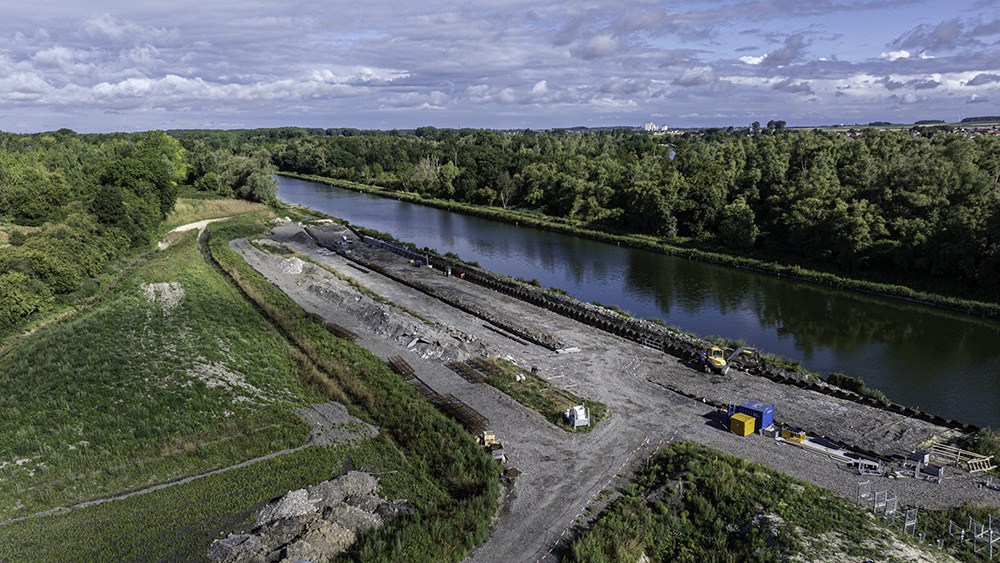
Above: The construction quay being built at Aubencheul-au-Bac. Image: Odile and Jean-Christophe Hecquet + Société du Canal Seine-Nord Europe.
So, there’s a lot going on but the biggest section of all is yet to get underway — the Pont-Canal de la Somme.
It’s an enormous viaduct that will take the waterway over the infrastructure that is already there, rather than under it. Stretching for 1.3km, it’ll be the longest canal viaduct in Europe.
“So, we chose to build a canal bridge for several reasons. The first reason is to allow the Somme River to flow freely. The second reason was primarily environmental, since we cross a protected natural area at this point," said Deleu.
"The canal bridge solution was the one with the least environmental impact. And finally, the third reason is also technical, since we are located in wetlands — in compressible areas.”
Treading carefully
As Benoit said, reducing the canal’s footprint as it crosses the Somme Valley makes sense, as this is a region known for its rich ecology.
Of course, it’s also synonymous with what happened right here more than a century ago — the Battle of the Somme.
The bodies of around 100,000 soldiers who died on the Western Front of World War One are still missing.
That’s why SCSNE has been working with the Commonwealth War Graves Commission on a series of exploratory operations.
This ensures that remains are discovered in advance and given the burial they deserve in an expanded cemetery nearby.
Since its very beginning, the project has been recognised as Europe’s largest preventative archeological initiative, unearthing discoveries going back to the Paleolithic era.
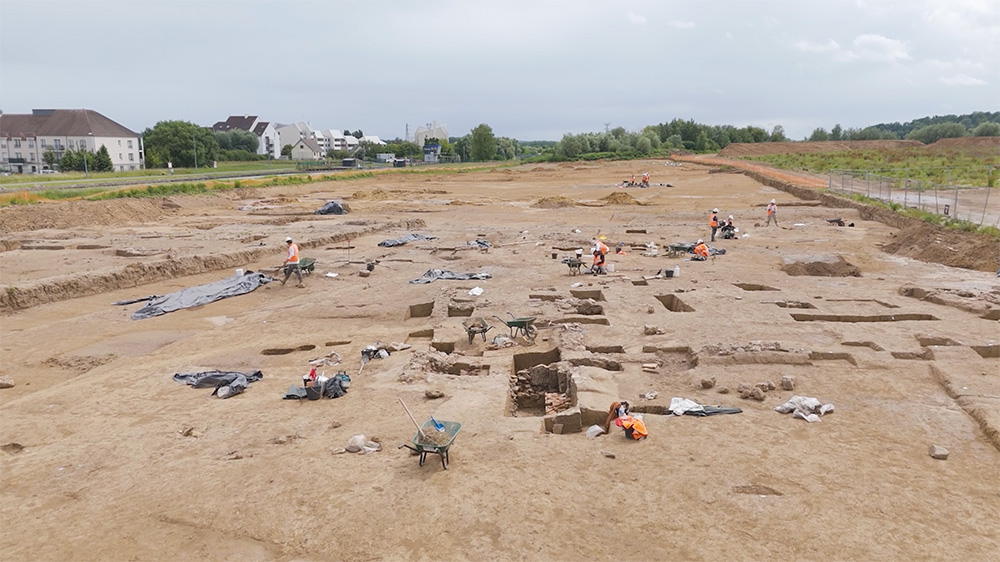
Above: One of the many archeological sites along the canal route. Image: Société du Canal Seine-Nord Europe.
Another way the construction is being compensated for is by dedicating 1,200 hectares of land to improving biodiversity.
There will be wildlife crossings, around 60 sites transformed into wetlands and ponds, new trees planted. SCSNE even claims some species have already returned to the area since construction began.
When is it all due to finish, though? Well, 2032 is the aim, giving France access to that North European network at last.
At the same time, the wider continent will have forged even closer ties with the EU’s second largest economy. And through a category of infrastructure that remains somewhat under appreciated.
Because while railways, highways and base tunnels get most of the attention in the world of big transport, the completion of this new route could prove to be a watershed moment.
Discover how Bentley's open, connected data environment empowers you to build and operate smarter, more resilient assets here.
Additional footage and images: Société du Canal Seine-Nord Europe, Egis, CANALIEAU, Odile and Jean-Christophe Hecquet, PIXXIM, SPW, France 3 Hauts-de-France, Lionsgate Films, Sony Pictures Classics and Universal.
We welcome you sharing our content to inspire others, but please be nice and play by our rules.
Comments