
Why China is Winning The Nuclear Power Race
- Youtube Views 1,733,795 VIDEO VIEWS

22 July 2026
Video hosted by Fred Mills. This video contains paid promotion for Brilliant.
IF you’ve been following our channel over the past few years, especially if you’re in the US, UK or France, you’ll probably know at least one of these names: Vogtle 3 and 4, Flamanville 3, Hinkley Point C.
We’ve singled out these power plants because they’ve all ended up heavily delayed, incredibly expensive and more complicated than planned.
Now, you might assume that if three of the world’s biggest nuclear powers are struggling to build new plants then surely it’s a problem everywhere. But that is not the case.
On the up
Atomic energy generation hit a new global record in 2024, and the figures for 2025 and 2026 are expected to show a further increase.
Several countries played a part in this — like Japan, which has been restarting its reactors after Fukushima, while India and South Korea have been busy building new ones.
But it’s China that’s easily made the biggest impact on the nuclear landscape. Right now, it’s second in the list of countries with the most nuclear reactors. And it’s fair to say the US has a pretty big lead.
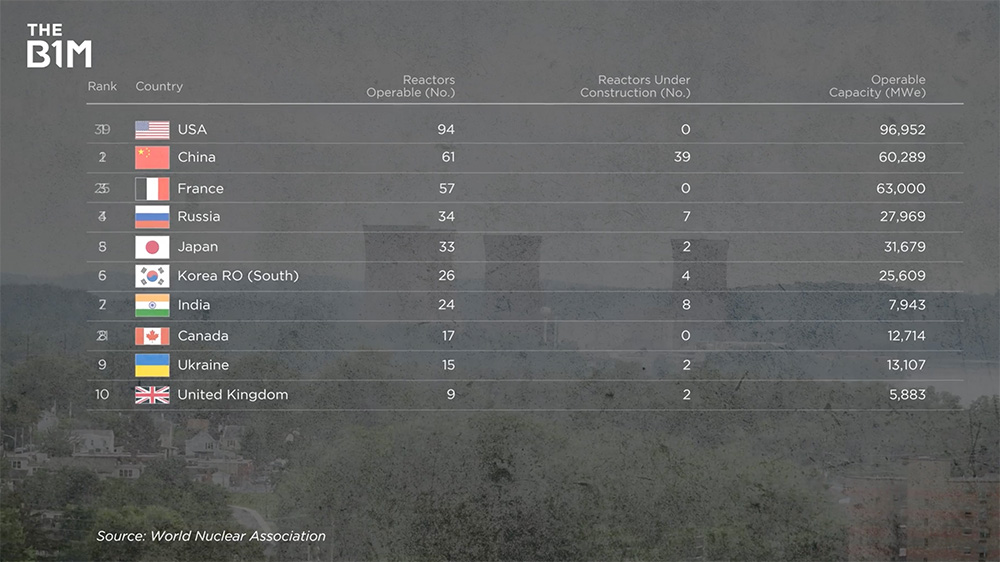
Above: The US has the most operable reactors, but China is now building far more than any other country.
When you look at the number of reactors currently under construction, though, it’s China that’s roaring ahead.
As of June 2026 it had 39 reactors in the works — half of the global total. And when it’s finished them all it will officially have replaced the US at the top of the league table. Because America isn’t currently building any.
Bargain builds
China is putting its plants together at a much lower cost than other countries. According to new research from a group of US universities, China is able to build new plants at around $2 per watt.
That’s about half of what France typically pays, while in the United States it can be a staggering $15 per watt — more than seven times higher.
If you’re wondering why we’ve picked that unit of measurement — it’s what the industry itself uses.
Going by the cost per unit means you can keep track of any increases once things are underway and compare easily with other projects. Even if they’re a completely different size.
There are several reasons for China’s big nuclear push. It uses more electricity than any other country — in fact it’s not even close — and demand continues to rise.
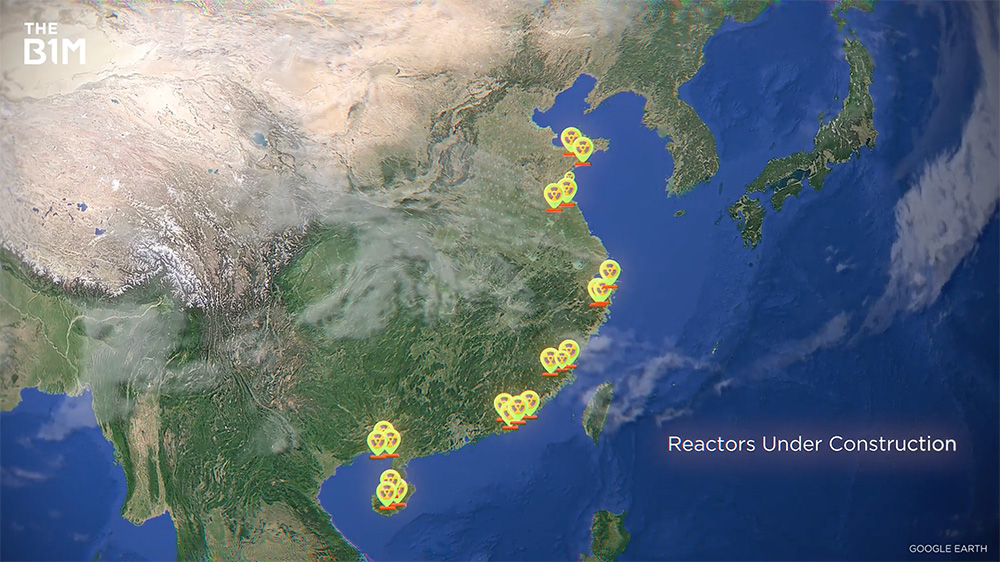
Above: A map of China's current reactor construction sites.
Not only does it manufacture basically everything, as it’s done for decades. China’s having to power a new data centre boom, electric vehicles, a growing high-speed rail network… the list goes on.
Nuclear power is a way to generate huge amounts of energy, without CO2 emissions, while ensuring it’s always available — unlike renewables.
“You think about solar and wind, of course China produces a lot, but it's always intermittent. And right now, in terms of production, it's like a single-digit percentage for what Chinese needs to use,” says Howard Yu, Director of the Future Readiness Centre at IMD.
“The majority of this is coal. And coal — the Chinese government also doesn't like that much because of the pollution.”
Going it alone
Which explains why China is under pressure to get its fossil fuel addiction under control. But Howard believes it’s not the main cause of Beijing’s nuclear push.
“It's not about just sustainability or, you know, just getting rid of carbon, per se. This is not the top agenda, for sure, for Beijing,” he claims.
“I think the top agenda is energy independence. And with the current war going on in the Middle East, for sure the energy independence becomes even more important.”
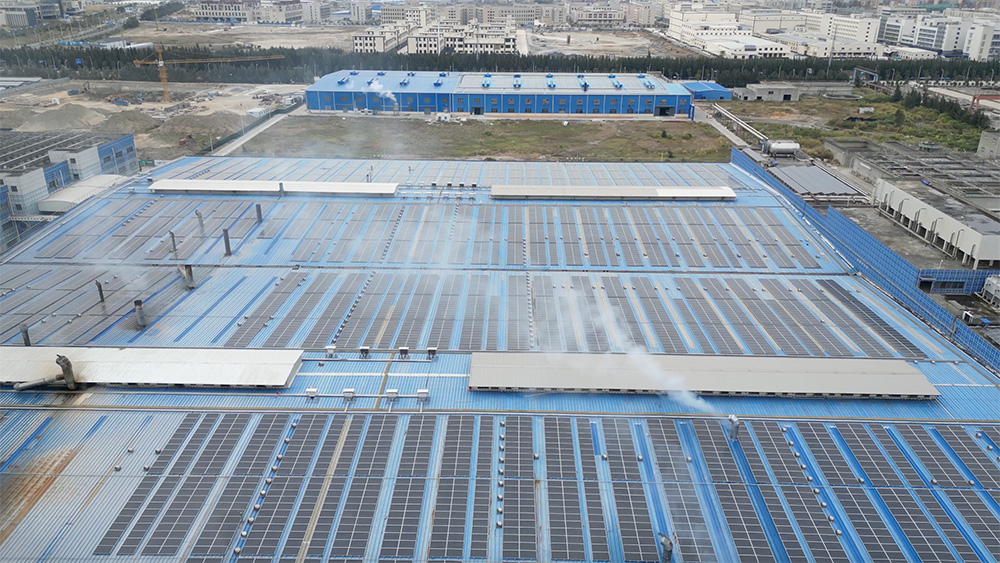
Above: China needs more than just wind and solar to reduce its coal dependency.
As for how China is managing to construct so many new reactors, and do it quickly and cheaply — well, it’s a combination of things.
Firstly, the political system in China allows it to make a big decision like whether or not to build a load of nuclear power plants with little to no pushback.
And yes, we could be talking about virtually any type of infrastructure here. The story is the same with railways, roads, other energy projects — you name it.
Taking charge
Those in power can make long-term plans, which it does every five years, make it a national priority, and chances are it’ll get done.
Whereas in other countries, there’s always a chance a new government will get elected and put pressure on a project, there might be a shift in public opinion… lots can happen.
“It is up to the government whether they are willing to channel resources into certain areas deemed to be of national importance,” Yu explains.
“So, cheap access to capital is one, stabilisation of industrial policy, and then the third one is trying not to reinvent the wheel every single time.”
Which brings us on to one major development here that’s specific to nuclear, and it’s called Hualong One. That’s the name of China’s very own next-generation reactor technology.
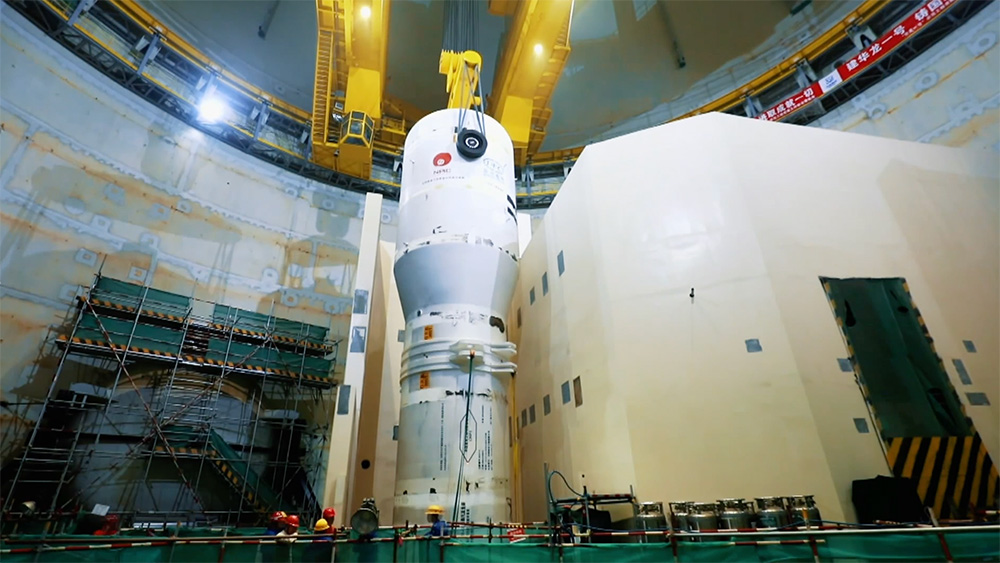
Above: A Hualong One reactor being installed at the Fuqing Nuclear Power Plant. Image: China National Nuclear Corporation.
The reactor, of course, being the place where the nuclear fission actually takes place. This causes heat to be generated, which is used to turn turbines, and that’s how the electricity is produced.
Previously, China had little choice but to use either new reactors imported from abroad or its own models, which weren’t as advanced as what the US and France could make.
Now, though, China considers Hualong One on a par with what the best of the west can offer.
It claims that a single reactor can generate almost 10BN kWh of electricity each year. Apparently, that’s enough to power the lives of around a million people in an average developed country.
Ramping up
Despite debuting only a few years ago, there are now over 40 Hualong One reactors operating, or under construction.
It means China no longer needs to import many parts from abroad to build its new plants, and it can make them all fully standardised.
In other words, most of the design elements can be easily repeated on the next project… and the next.
Which perhaps explains why so many of these construction sites look very similar, despite being situated thousands of miles apart in some cases.
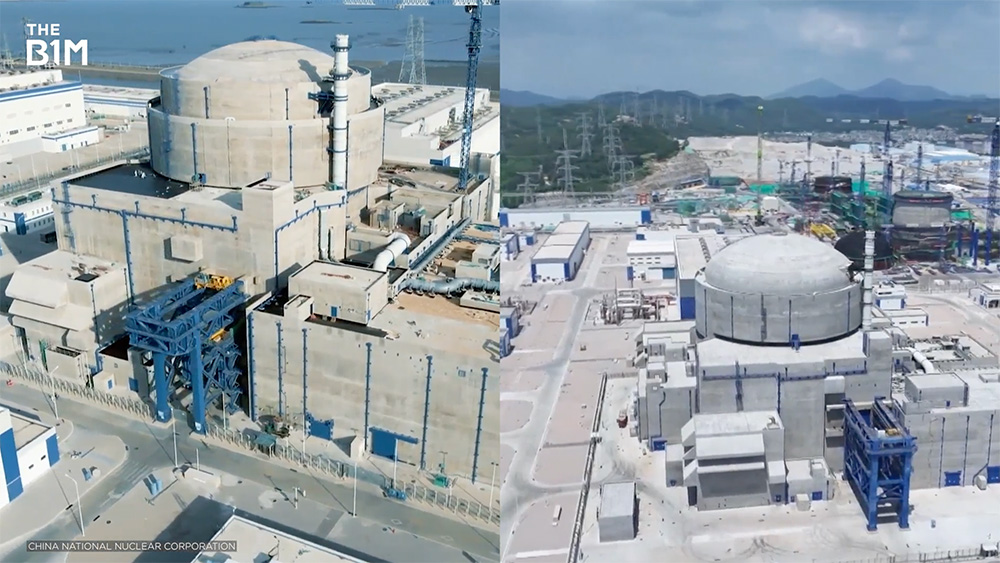
Above: Several of China's new nuclear power plants are virtually identical in appearance.
In fact, let’s stop for a minute and have a closer look at a couple of examples, starting with the Fuqing Nuclear Power Plant.
Although not a new plant, Fuqing was the first to bring one of those new reactors online back in 2021, followed by a second a year later. The four that were already there were an older Chinese model — a predecessor of Hualong One.
Construction began in 2015 with the pouring of the first concrete for the reactor containment building.
Two years later, the structure was topped with a large steel dome made up of 153 prefabricated parts.
Weighing over 300 tonnes and with a diameter of nearly 47 metres, its job is to protect the reactor underneath. As well as stop any radioactive release in the very unlikely event of an accident.
2020 saw the loading of fuel and connection to the grid, with commercial operation achieved the following January.
Speedy assembly
So, it took about five and a half years from the initial concrete pour to completion. China says this is a record for the first implementation of a third-generation reactor. Quite a niche category there, but the point still stands.
The first new reactor at Plant Vogtle in the US, for comparison, took over ten years. And that was a reactor that had been deployed twice before.
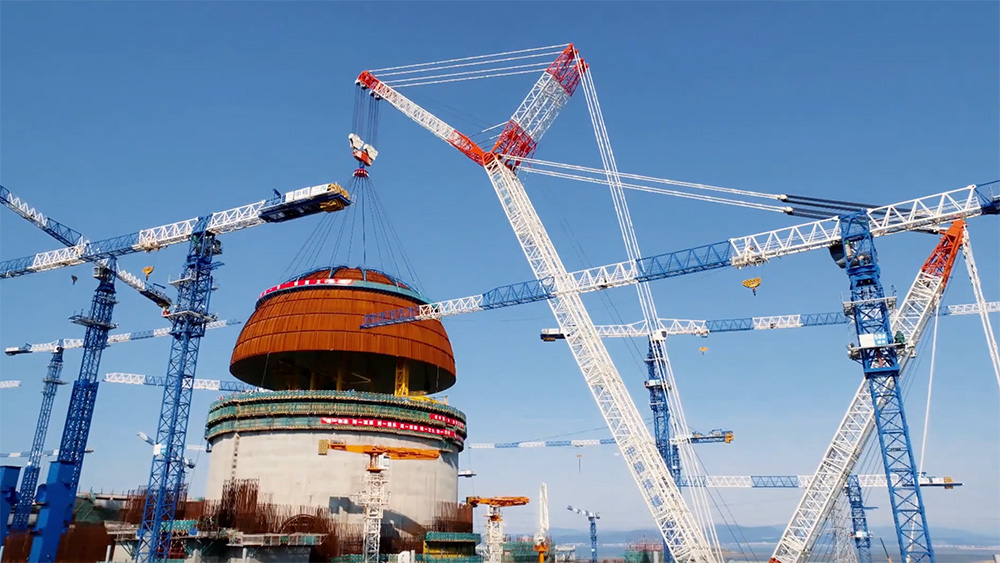
Above: The dome being lifted into place at Fuqing. Image: China National Nuclear Corporation.
Another facility that’s worthy of a mention is the Zhangzhou Nuclear Power Plant. It’s set to be the largest site to feature only Hualong One reactors. It already has two in operation, with another pair under construction, and two more planned.
When all six are complete, that’ll mean 60BN kWh per year of clean energy will have been added to the grid since work began in 2019.
According to reports, that could result in 75% of the energy needs of Zhangzhou itself, and neighbouring Xiamen, being handled by this one plant.
Done by the book
They might be building them super-fast, but it doesn’t mean Chinese plants are of inferior quality or safety.
Yes, China has its own way of doing things but, just like everyone else, its methods are aligned with the IAEA.
That stands for the International Atomic Energy Agency, which has been reviewing China’s regulations to ensure it meets global standards. Especially when it’s not just making power plants for itself.
China is already constructing new plants overseas using its new reactor technology. Pakistan is its only customer so far, but there’s talk of other nations, like Argentina, following suit.
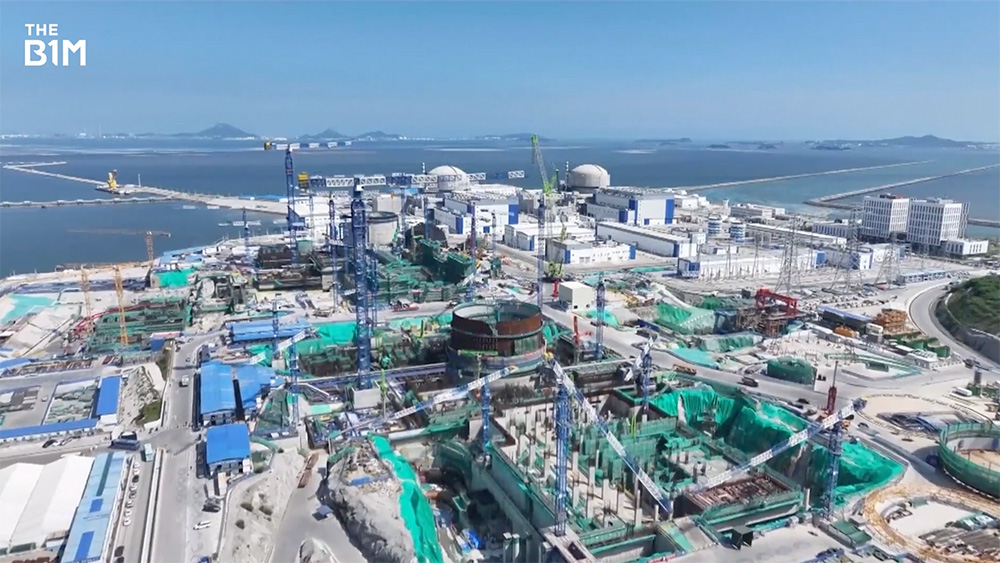
Above: A new unit under construction at Zhangzhou Nuclear Power Plant.
Then there’s the progress China has been making in the emerging fields of nuclear. More than a dozen nations are in a race to develop small modular reactors, or SMRs for short.
They’re a new type of reactor that’s smaller, come as factory-built modules, and can be built and installed much quicker, and more easily, than traditional ones.
Guess what? Yep, China seems to have made the biggest breakthrough with it so far — or at least it’s about to.
Not Linglong to go
2026 is when Linglong One, which China is calling the world’s first fully commercial land-based SMR, is set to come online.
Other SMRs do already exist but they’re either situated on a boat, like Akademik Lomonosov in Russia, or built mainly for demonstration purposes.
Nuclear fusion is yet another area of tech in which China is a frontrunner. This is where hydrogen atoms are forced together at extreme temperatures, releasing huge amounts of energy.
Usually, this is done by forming a super-hot plasma in a magnetic chamber called a tokamak.
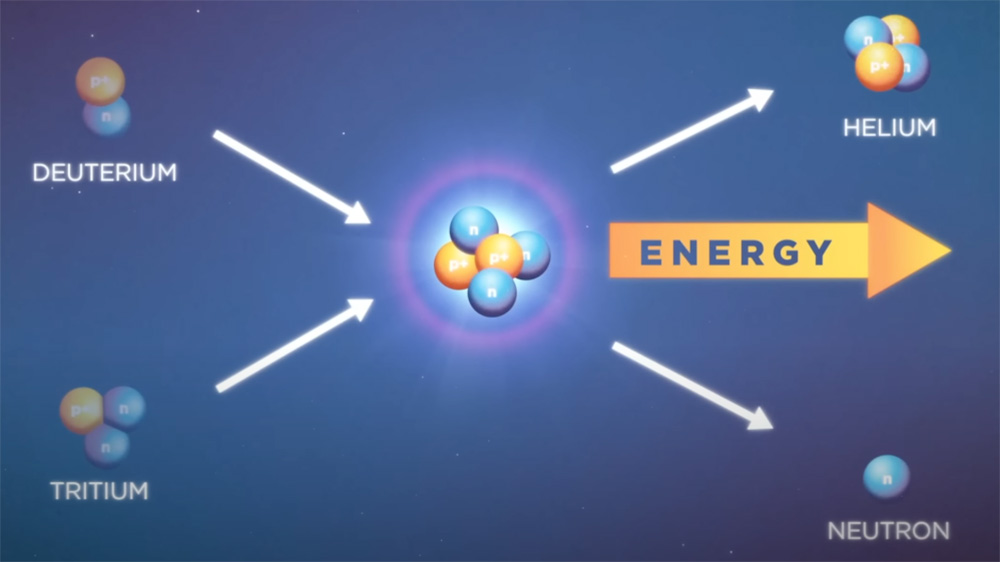
Above: A diagram of the nuclear fusion process.
We’ve covered in the past how France is building the world’s largest experimental fusion reactor, with the US planning to build the first commercial plant.
And yet it’s China that recently accomplished a key milestone that probably won’t mean anything to you at first but I’ll try and explain it.
They managed to keep a steady-state long-pulse plasma operation going for 1,337 seconds, which is about 20 minutes. And that’s a record.
In other words, the tokamak in Shanghai generated plasma and kept it stably maintained for longer than anyone else.
Although only developed for research, it’s part of a wider national effort to eventually build a pilot fusion reactor, which could lead to commercial deployment in the future.
No clear winner
When you look at the ground it's gained elsewhere in the nuclear domain, China might just have the edge in the fusion face-off, too. Or perhaps it’s too early to say where this will all really go.
“What matters is, once it's stabilised, is this nation able to scale it? So for fusion, it remains a little bit experimental, and for SMR — the small modular reactor — it remains to be seen whether it gets scaled,” Yu says.
“And so that next frontier of technologies is, you know, just like the quantum computer, right? We don't know who's going to win yet, but it’s certainly worth paying attention to.”
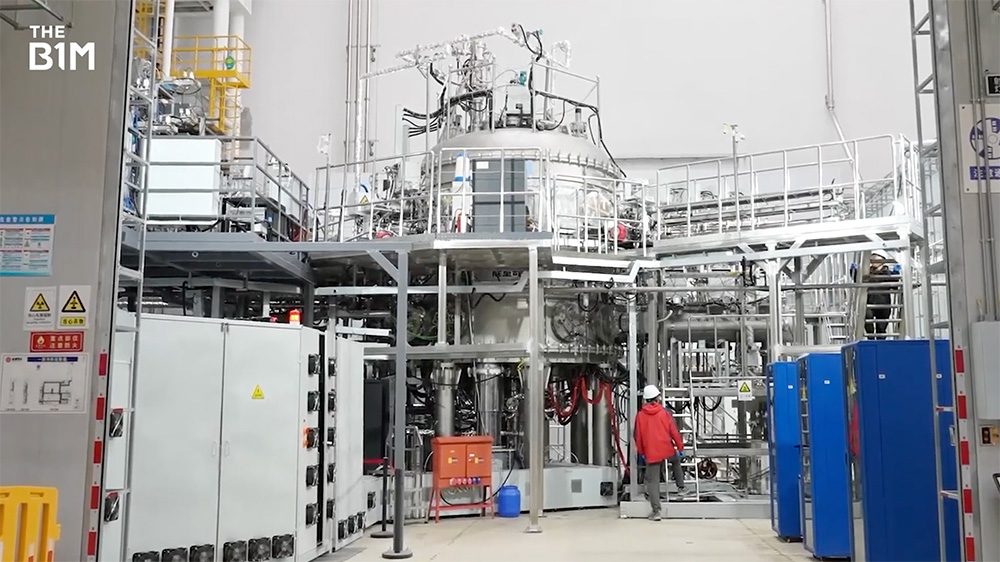
Above: The Honghuang 70 tokamak in Shanghai. Image: China News Service.
Whether it’s China building them or other countries doing it themselves, many consider the worldwide comeback of nuclear power to be a positive step.
After all, because it’s low-carbon, nuclear is seen as a much cleaner alternative to fossil fuels like coal, which is continuing to decline.
In 2025, coal was replaced as the world’s leading source of electricity, but not by nuclear. That would be renewables, like wind and solar, which China is a leader in, too.
But while it remains at the top of the coal league table as well, we can’t give it too much praise.
Still, if nuclear is key to getting the world’s biggest energy consumer to kick its bad habit once and for all, we can expect to see a lot more of this in the future.
Click here to get started with Brilliant’s tutor for free. You can upgrade to Premium to unlock all courses and right now, The B1M viewers can save 20% off an annual subscription.
Additional footage and images: China News Service, China National Nuclear Corporation, ABC News, CGTN, EDF Energy, Georgia Power, Arirang News, NDTV, PATES, Sky News Australia, WION, Xiang Qi and Xinhua.
We welcome you sharing our content to inspire others, but please be nice and play by our rules.
Comments