America actually built something on time and on budget
- Youtube Views 4,019 VIDEO VIEWS

30 September 2026
Video narrated and hosted by Fred Mills. This video and article contains paid promotion for Procore.
IT'S a street that needs no introduction — Park Avenue, New York.
But it's not just about the buildings here. Underneath that iconic boulevard is one of the most important rail lines in North America.
Hundreds of thousands of commuters use it every day, and yet they've been carried over a structure that's more than 130 years old, had come to the end of its life and needed to be completely replaced.
When The B1M heard how this was being done — with the use of giant custom-made machines — we simply had to some and see it.
This is how one amazing team is making this extraordinarily complex construction project a success.
Keeping Manhattan moving
The Metro-North Railroad is one of the busiest railways in the whole of America. Today, well over 200,000 passengers use these trains on a typical weekday.
The eastern side of the network runs from the centre of Manhattan up to the suburbs of New York State and Connecticut. Commuters have relied on this route for almost two centuries.
It's because this was originally part of three historic railways that were combined into one back in the 1800s.
There was the New York and Harlem Railroad, the Hudson River Railroad and the New York and New Haven Railroad.
One of the world's wealthiest men at that time, Cornelius Vanderbilt, was in charge of that merger.
He's the same guy who in 1871 commissioned the Grand Central Depot. It became the Manhattan terminus for those three rail lines and it lasted just over 30 years.
Which isn't very long at all. The massive growth in passenger numbers meant it had to be knocked down and then reconstructed as something far bigger.
And that would turn out to be the Grand Central Terminal we all know today — right where Park Avenue meets 42nd Street, between One Vanderbilt and the Chrysler Building.
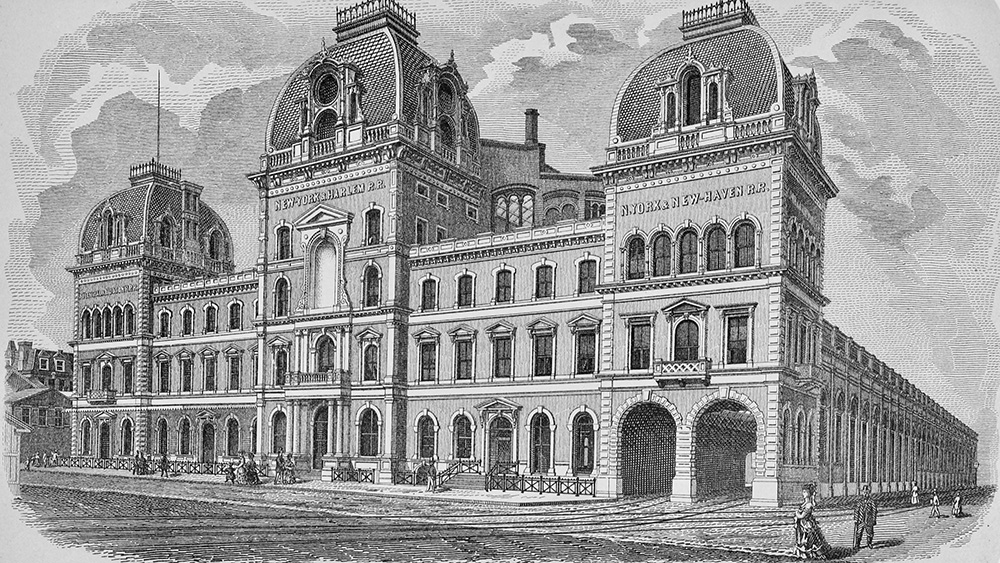
Above: The original Grand Central Depot, with the name of the three railroads visible on each tower.
When it first opened in 1913, tracks running away from the terminal to the north were being placed below grade, capped and covered. Before that, trains used to run through here in open trenches.
After that, a series of broad malls were constructed in the new space above the tracks.
These works were a big part of the Fourth Avenue Improvement Project — Fourth Avenue being the former name of Park Avenue, which believe it or not, wasn't always a desirable part of city.
Of course, that couldn't be further from the truth today. This street is now home to some of the world's most expensive real estate.
Making tracks
A few years before work started on the new Grand Central, construction had already completed on the Park Avenue Viaduct.
Now to be clear, when we say that we don't mean the road that runs around Grand Central, which is also called the Park Avenue Viaduct. We mean the much bigger rail viaduct up in Harlem.
Its job was, and still is, to take passengers over the top of Park Avenue, across four tracks, right from 97th Street up to the Harlem River.
Once trains clear this elevated steel structure that's just over a mile long, they pass onto the Harlem River Lift Bridge before entering The Bronx.
But now, more than a century after it was first constructed, the viaduct has seen a lot more action than it was ever designed for, and according to the Metropolitan Transportation Authority, or MTA, it's been showing signs of disrepair.
That means that if they were to do nothing, it could get worse over time and require frequent maintenance.
It's a single point of failure on a crucial bit of infrastructure, and the chances of it faltering in some way have been increasing.
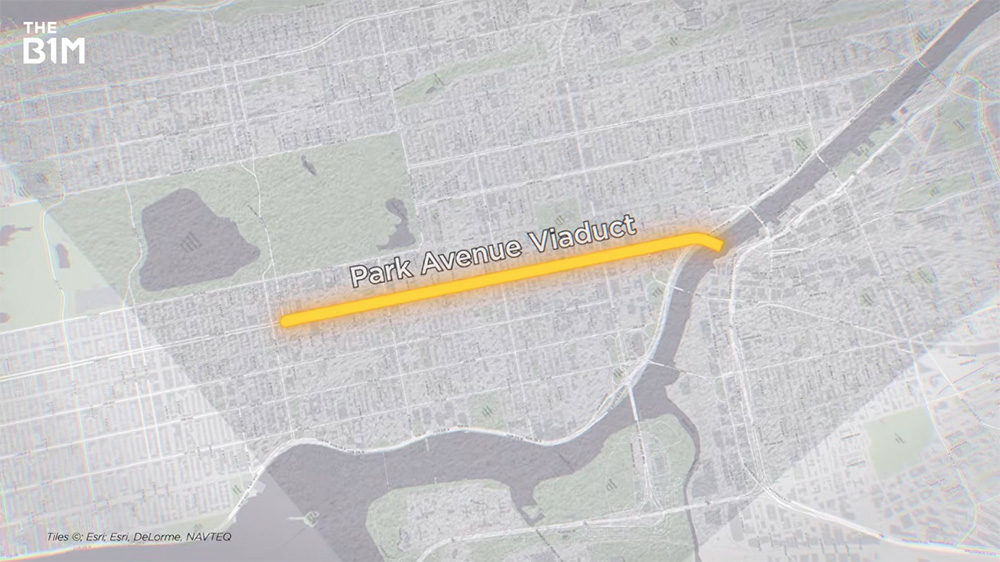
Above: A map showing the position of the Park Avenue Viaduct.
So the MTA, as the owner of this historic asset, is replacing it. Yep, the entire thing, from the foundations, structure and tracks, to the power, communications and signalling systems.
But it's not doing it all in one go, because that could see the whole railway closed for months or even years.
To inconvenience passengers as little as possible, all the work takes place in stages and at weekends.
Putting in the hours
A typical weekend will involve eight pre-built bridge units being replaced.
First, on a Friday evening, after the lines have been shut down, the team begins pulling up and stripping the old track.
Then, throughout the night and into early Saturday morning, they'll start saw cutting and removing the deck panels along with the floor beams.
Once a couple of the spans have been taken out, the fascia girders — that's the structural beams on the outside — will follow.
Next, while demolition continues on the remaining spans, the prefabricated replacement segments will already start filling the gaps that have been left behind.
By Saturday afternoon, all the new parts will have gone in and it will be time to restore the track.
As for Sunday, that's spent getting everything aligned and adjusted before running some tests to make sure the services can resume on Monday. Through it all, they've never missed that deadline.
As you can imagine, there was a lot of sceptical people saying we're gonna take half the viaduct out of service without stopping trains,” said Michael Sheehan, project CEO for MTA Construction + Development division.
“There's over 400 trains here on the weekends that travel over the viaduct. And we did it. We had a plan in place, and we executed it.”
MTA Construction + Development is managing the project, with contractor Halmar International handling both the design and the build.
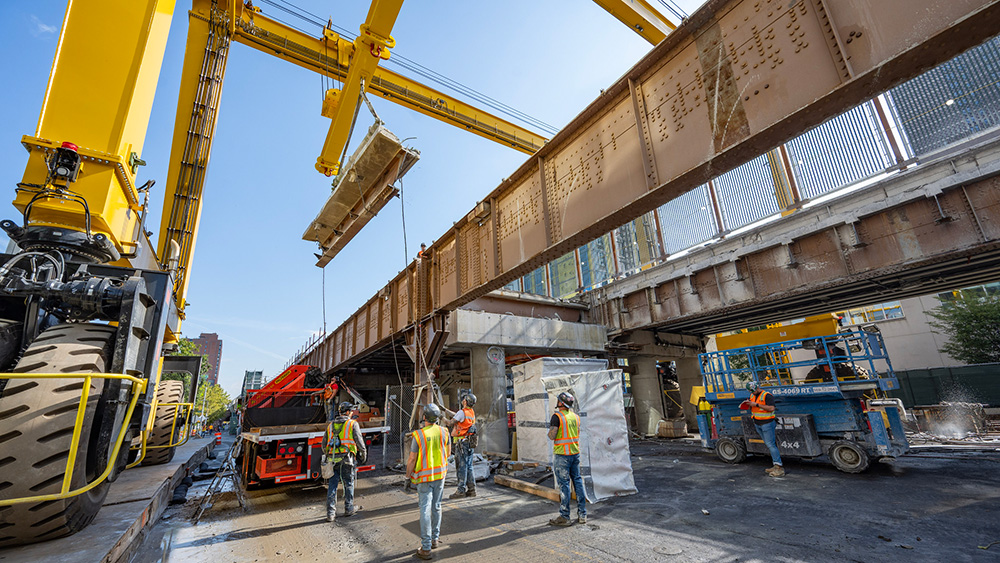
Above: The Park Avenue Viaduct Replacement Project in action. Image: MTA + Trent Reeves.
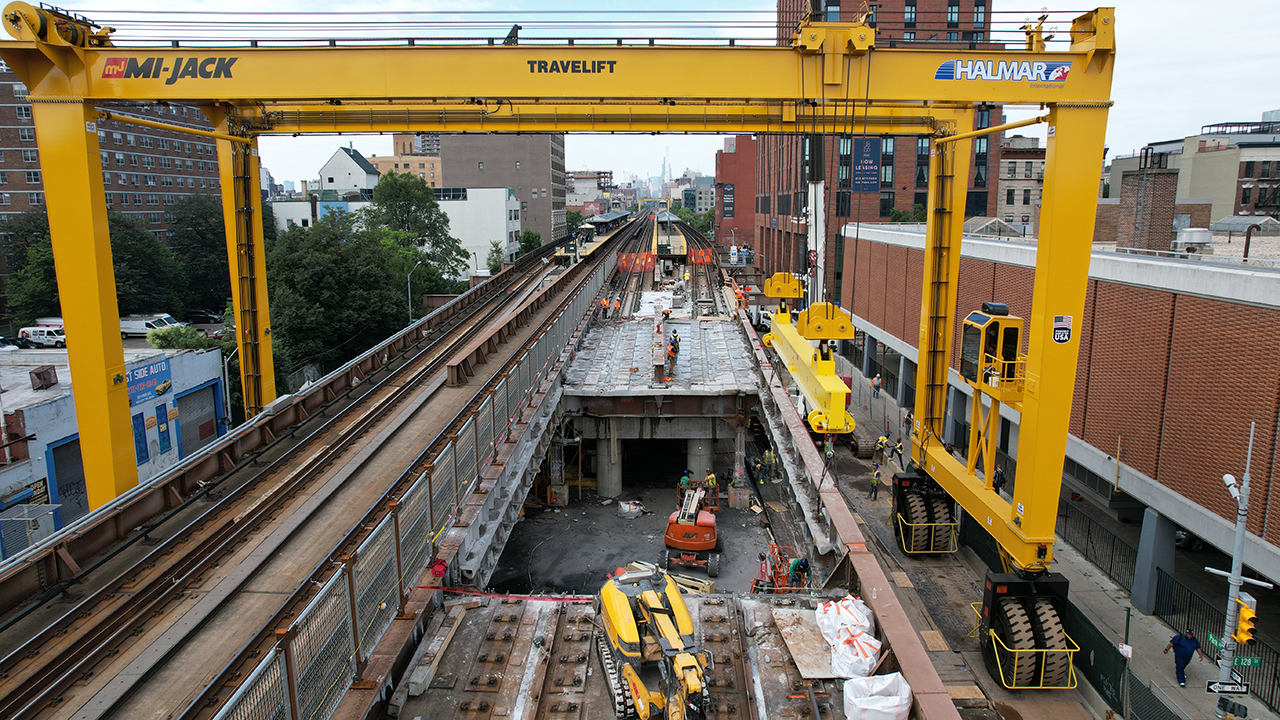
As for how they've been going about it, the big yellow machines you can't help but notice when you’re there have been doing a lot of the hard graft.
These massive yellow gantries were custom built by Mi-Jack Products especially for the project.
They let the team straddle the railway so they can take out old pieces and put new pieces in without taking up too much space.
When an ageing piece has to be carried away or a new part is brought in to plug the gap, the gantries can roll along on giant wheels to where they need to be.
Nick Almeter is the project manager for Halmar. He leads the team that came up with this clever solution.
“In Phase One we replaced 64 spans, which is 128 bridge units. Phase One North, where we're currently at, we're replacing 34 spans and another 68 units,” he said.
“We try to reduce the impact to the travelling public. Believe it or not, but through the course of a day, 750 trains passed through this corridor.”
Keep on truckin'
Getting the truck deliveries right is key to this as well — they have to arrive just in time.
If they're too early or too late it could snarl up traffic in the surrounding area or leave the gantry hanging around waiting, which would mess up the whole schedule.
“New York City is a tight, tight place, right? We plan these weekends out in ten-minute intervals,” explained Almeter.
“So we got trucks coming in, trucks leaving just in time. We don't have the real estate to stage any more than what we can utilise in a weekend.”
Phase One of the project, which began in late 2023, cost around $590 million and took two years to complete.
Overall, more than two and a half kilometres of track, from East 115th Street to East 123rd, were completely upgraded without having to shut the railroad at all.
$500 million of that money — the vast majority of it — was federal funding, with the rest coming from the MTA's own capital programme.
Structured in five-year plans, the programme is funded by local governments, bonds, taxes, tolls and federal grants.
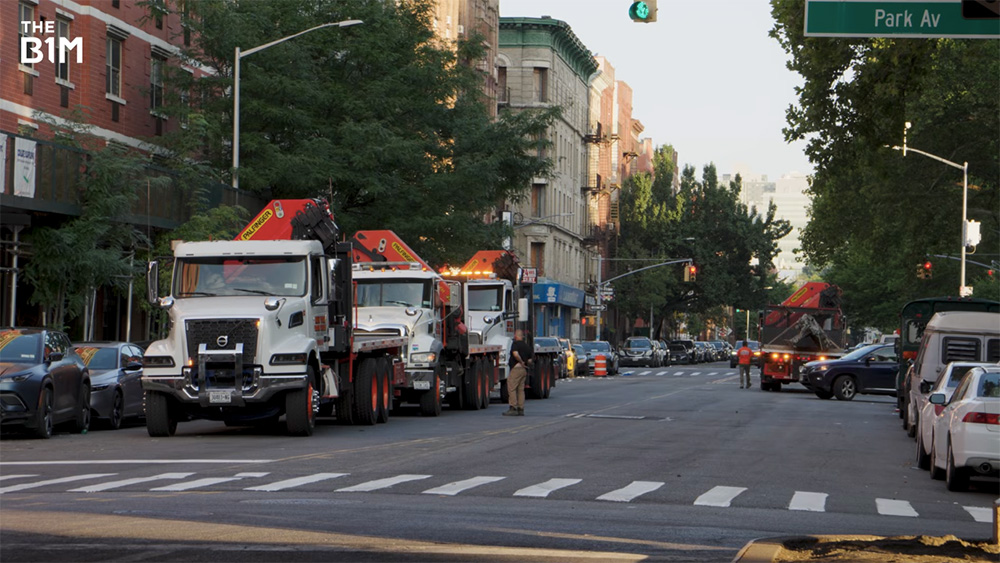
Above: A line of trucks waiting for their turn.
Incredibly, by the end of October 2025, the operation was running almost a hundred million dollars under budget and more than four years ahead of schedule.
Things were going so well that they thought they might as well get a head start on the rest of the project.
Phase One North involved continuing the same process from East 127th Street to East 132nd.
That started back in May 2024, so there was a point where both phases were running simultaneously.
Then there was the timing of it all. Estimates for the cost and timescale were made before Halmar was appointed as the contractor.
The expectation was that the company would employ a more traditional method of carrying out the works.
For example, if they'd used conventional cranes it would have meant longer and more extensive track closures.
But they didn't do that. Nick and his team came up with a different solution that's proven faster and probably more cost effective.
Double team
Another explanation for the swift progress is Halmar being appointed under a design and build contract.
Normally there is more than one contractor, sometimes several, responsible for each of these phases.
MTA felt that having a single company responsible for both tasks would lead to quicker delivery, better coordination and as little disruption as possible for Metro-North.
“We get in, execute our work, and get out of there as planned. The commuters never notice — they leave Friday night, come in on Monday morning, and they don't know what we just did. They don't know half the structure was missing,” Sheehan said.
“But we did what we set out to do every weekend, every night, every time.”
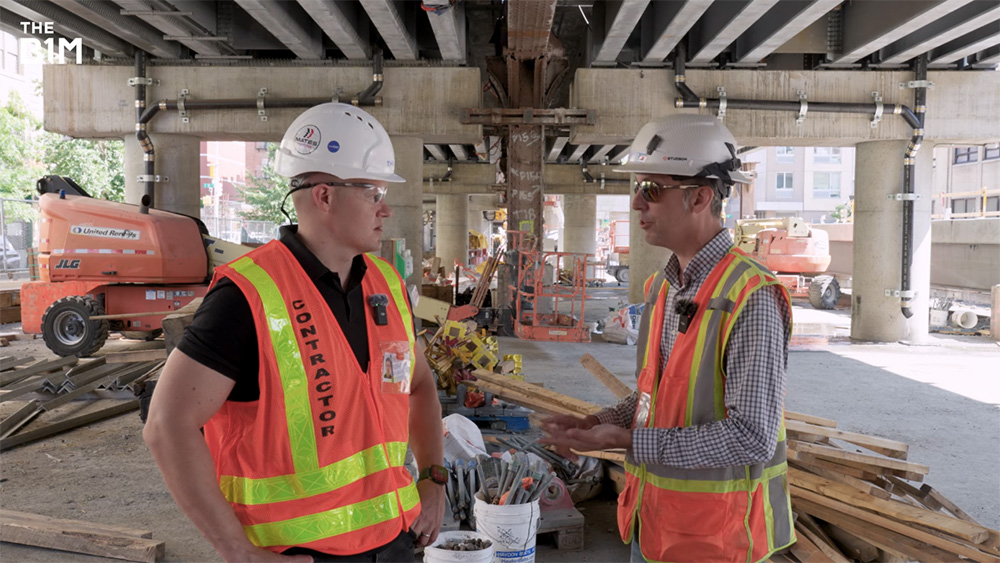
Above: The B1M's Fred Mills (left) with Nick Almeter of Halmar International.
What's also impressive is that they managed to achieve all this in the middle of New York. Big transport projects here don't always go to plan.
Take the Second Avenue subway for example, which has only just begun construction on its own Phase Two.
Its first phase completed almost a decade ago, there was a funding dispute that briefly derailed it and the line was originally proposed way back in the 1920s.
Obviously, replacing an existing piece of infrastructure is a lot less complicated than building an entirely new subway line underground and right through the middle of Manhattan of all places. We're not trying to make a direct comparison here.
But upgrading this viaduct is still a huge challenge. The teams here are having to adhere to strict deadlines, they're moving gigantic segments through the city streets and then putting them into place with the utmost precision. Nothing about any of this is easy.
But we wouldn't be surprised if the success of this project continues. The remaining work, such as cabling and removing temporary fixtures, is due to complete by September 2027 and they're very much on track to smash that target.
And even though most of them might have even realised it was happening, passengers can be assured of a reliable service from here all the way back down to Grand Central, which is now getting a bit of a revamp of its own.
What lies beneath
The train shed at the famous station is now being rebuilt. That's the structure under Park Avenue between 42nd Street and 57th where trains entering the terminal are sorted into their platforms.
In the words of one New York congressman, what's essentially a bridge holding up cars, the road and the skyscrapers of Midtown is slowly deteriorating from age, water and salt.
The restoration is being done in partnership with some of the companies that own themassive buildings on this street.
That's probably not surprising given they have a vested interest in making sure that what happens down there gets sorted out.
The MTA has signed two public-private partnerships that will allow it to share the responsibilities.
One is with J.P. Morgan Chase, now headquartered at 270 Park Avenue, and the other is with Vornado Realty Trust, which is behind the new tower set to rise at 350.
Sector One of the scheme, reconstructing the part of the train shed in the area around 270, is now mostly complete and set to fully wrap up by the end of 2026.
Meanwhile, Sector Two, the part from East 46th Street to East 50th, will see JP Morgan Chase contribute more than $50 million to support the work and handle day-to-day construction activities.
Sector Three has Vornado doing a similar thing from East 50th to East 53rd, putting in $25 million.
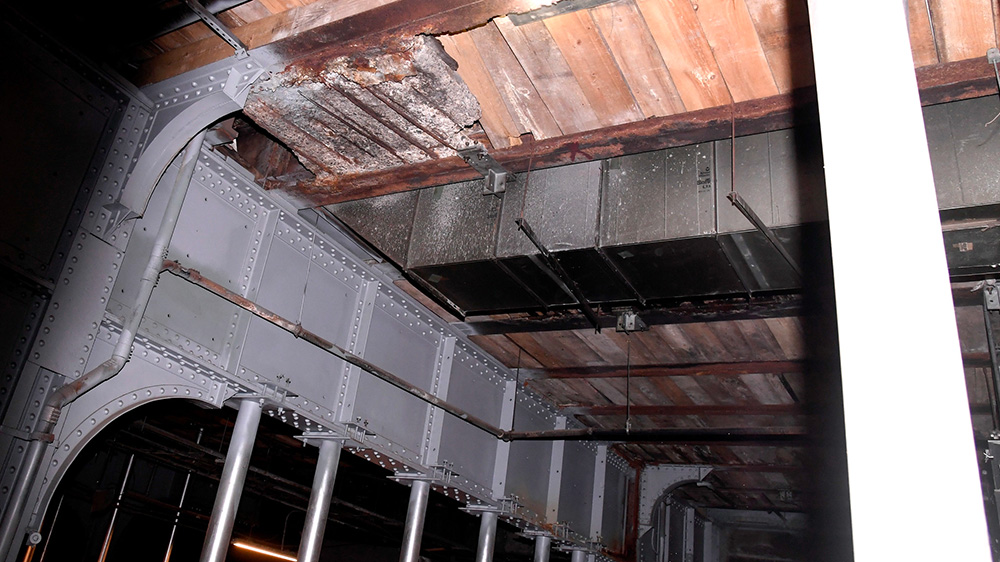
Above: The rebuilding of Grand Central Train Shed is now in full swing. Image: Marc A. Hermann/MTA.
When this project's fully wrapped up, along with the viaduct further up the line, it'll show a commitment to restoring and rebuilding America's infrastructure that hasn't always been there, even though the signs of its deterioration have been plain to see.
The fact this project is ahead of schedule and under budget is testament to the amazing work and planning that's gone into it.
And it's something that everyone in construction, all New Yorkers and indeed all Americans should be immensely proud of.
It also goes to show the best of this industry — this industry that does so much to shape our world — the world that billions of us use every day, in ways that most of us will never even notice.
See how Procore can transform your next project here.
Additional footage and images: MTA, Halmar International, National Museum of American History, Marc. A Hermann, American International Pictures, Foster + Partners and 20th Century Studios.
We welcome you sharing our content to inspire others, but please be nice and play by our rules.
Comments