Why the UAE Is Suddenly Building Railways
- Youtube Views 3 VIDEO VIEWS

11 November 2026
Video hosted and narrated by Fred Mills. This video contains paid promotion for Nathan Mistry.
This is the United Arab Emirates, one of the wealthiest countries in the world.
And yet, before 2011 it had no mainline railway. Anywhere.
Established in 1971 during one of many booming eras for the oil industry, it just so happened the UAE had some of the biggest reserves around.
So it’s really not much of a surprise to learn that the car became king.
That was until 15 years ago, when the government decided it was time to build an expansive cross-country freight railway. Inaugurated in 2023, it’s been pretty successful.
But with major emirates like Abu Dhabi and Dubai undergoing rapid growth, attention has finally turned to services for the general population.
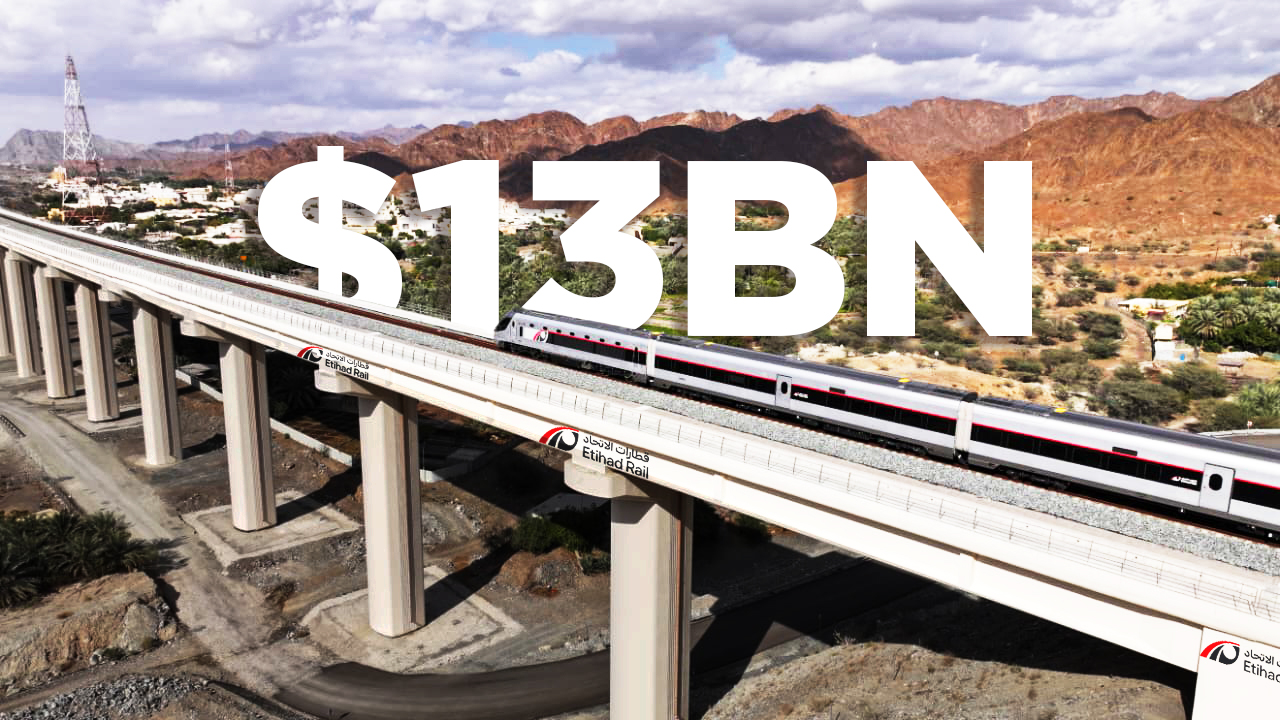
The Etihad Rail passenger network is under construction.
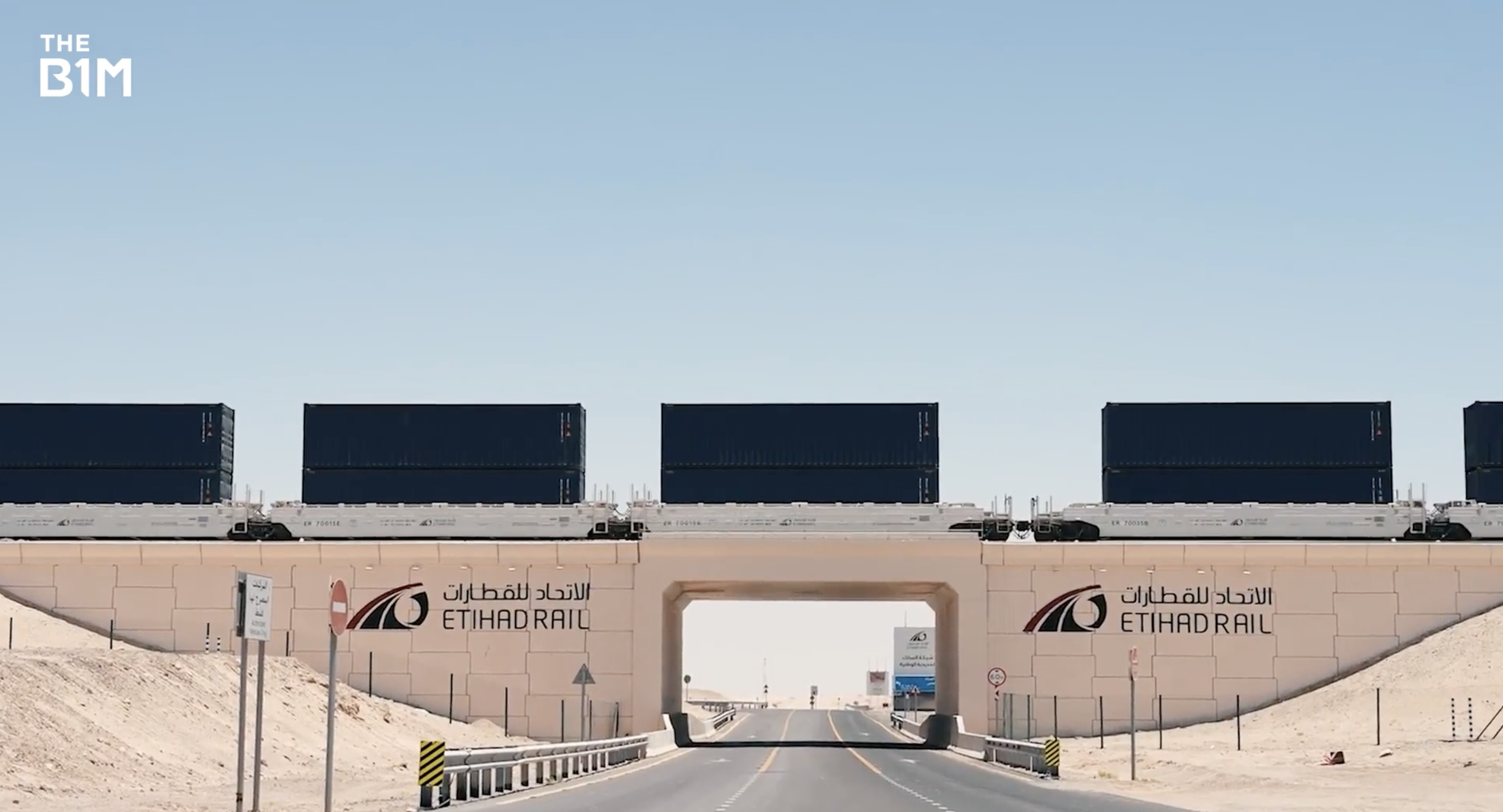
Above: An Etihad Rail freight train crossing above a road. Credit: Etihad Rail.
It’s one of just three huge rail projects being developed in the UAE to better connect this previously rail poor nation.
Through boiling hot deserts and rocky mountains, railways are being carved out and for the economic future of the nation, they’re coming just in time.
London to Munich, New York to Cincinnati. These journeys are about the same distance as the United Arab Emirates’ new 900km passenger rail network.
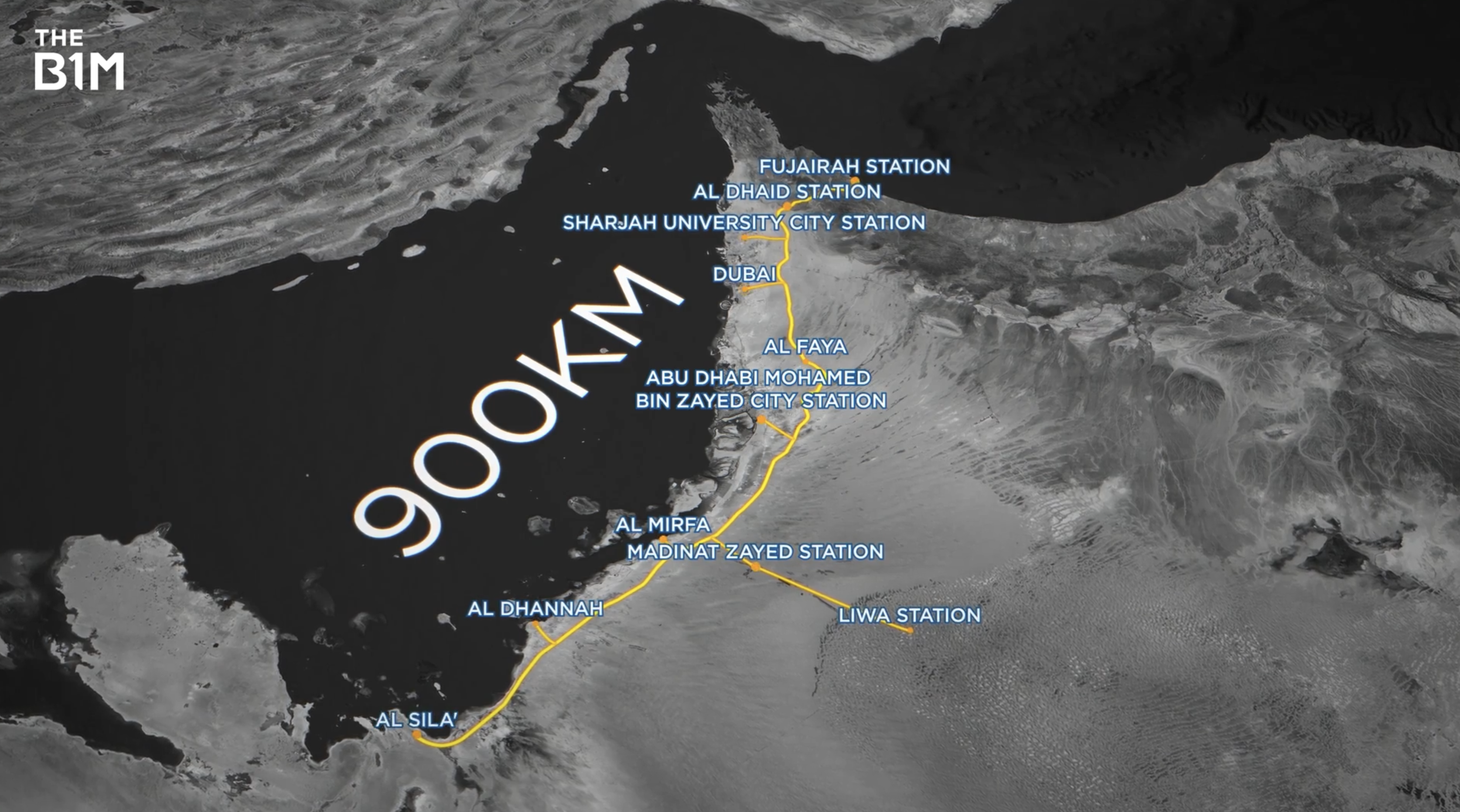
Above: The Etihad Rail route.
Linking major economic hubs, 11 stations will connect 11 of the most important cities and regions including the likes of Abu Dhabi and Dubai.
A cross-country rail line will be created through the desert, offering reliable connections, while facilitating faster commutes.
And it’s just one, admittedly pretty big piece, of a much grander jigsaw.
You might have heard of the Gulf Railway - a 2,117km mega train route carving through Kuwait, Saudi Arabia, Bahrain, Qatar, the UAE and Oman.
When operational in 2030, it’ll serve as a transnational backbone for the region.
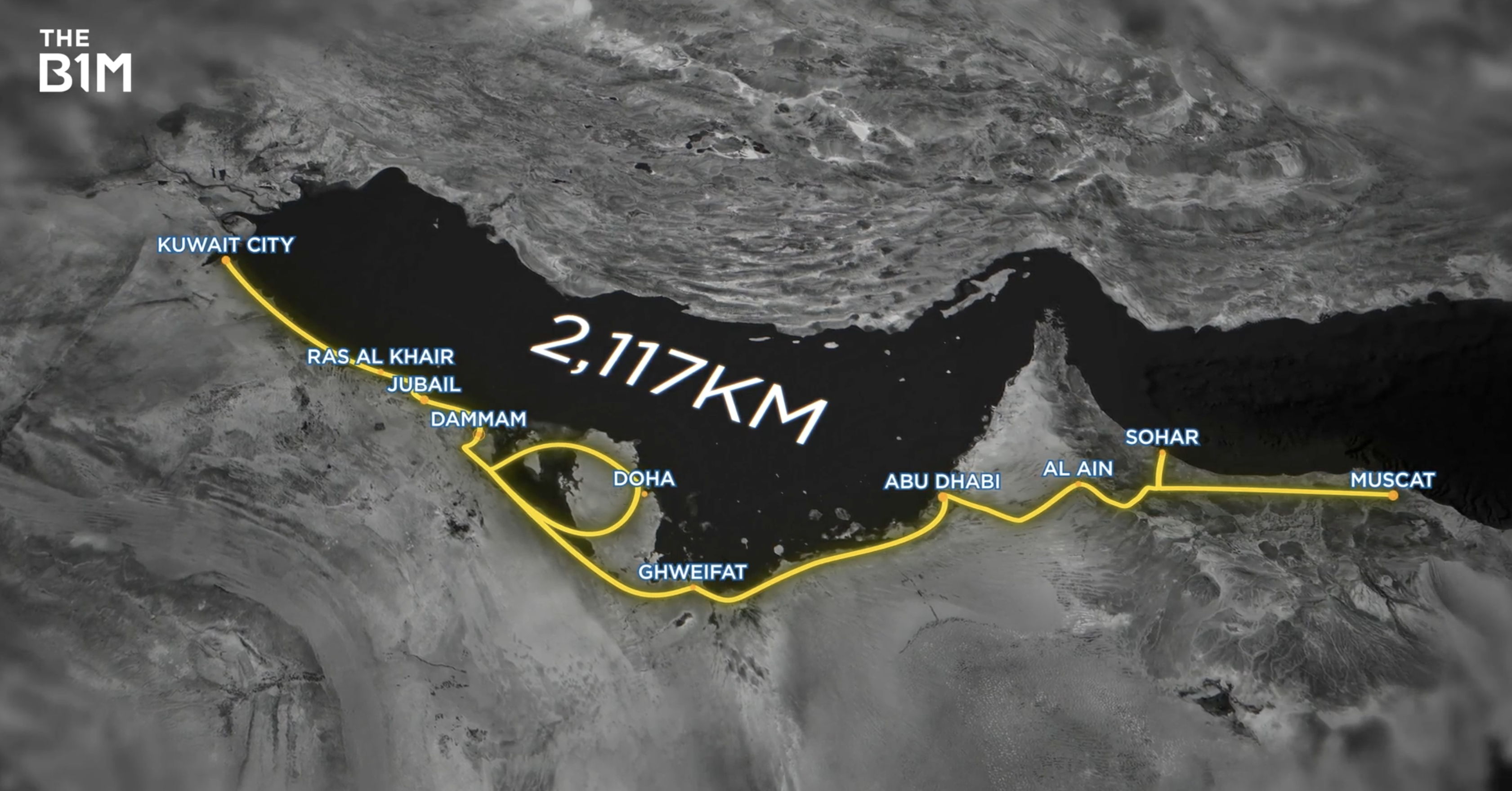
Above: The Gulf Railway route.
In fact, the section of the Gulf Railway that links the UAE and Oman, called the Hafeet Rail project, is already more than 50% of the way through construction.
And with that 2030 deadline looming, it’s a good thing too.
It’ll connect to the Etihad Rail national passenger network which is set to open in March 2027.
Trains will travel at a reported 200 kmph. To get from Abu Dhabi to Fujairah will take about 1 hour 45 minutes.
For context, driving that same distance can take three hours. In a country previously so reliant on cars, this infrastructure will be massive, especially for businesses and the workforce.
We spoke to Nathan Mistry, a UAE off-plan property consultant, to find out how this will shape the future of the region. “Once all of the infrastructure is completed, absolutely everyone will be taking the Etihad Rail because you’re able to buy back so much time, go to your meetings a lot quicker, get work done in Etihad Rail where you can have a nice seat and a table and you can do your work (...) and not have to worry about driving.”
Four connections on the route are already operational. For the very first time you can take a train from Abu Dhabi, travelling through Dubai and Sharjah, all the way to Fujairah.
The remaining stations will open in phases over the coming months to allow for testing and scaling.
Now, it was only back in December 2021 when the project was announced as part of the National Railway Programme.
And even for a Gulf state, completing a project of this scale, through mountains and desert, in little more than five years seems quick.
But they had a pretty big headstart. In 2011, they started building their first freight line.
Just one train can carry the same freight as 300 trucks, so it made complete sense to build a cross-country train route to basically boost supply chain efficiency nationwide.
During construction, temperatures regularly soared beyond 45 degrees celsius.
Crews were battling the desert winds, carving through sand dunes reaching 150 metres high and tunneling through mountain rock. And it’s this freight line that now doubles up for the passenger service.
That’s barring some freshly added connections to the new stations, tunnels, bridges, crossings and track signalling.
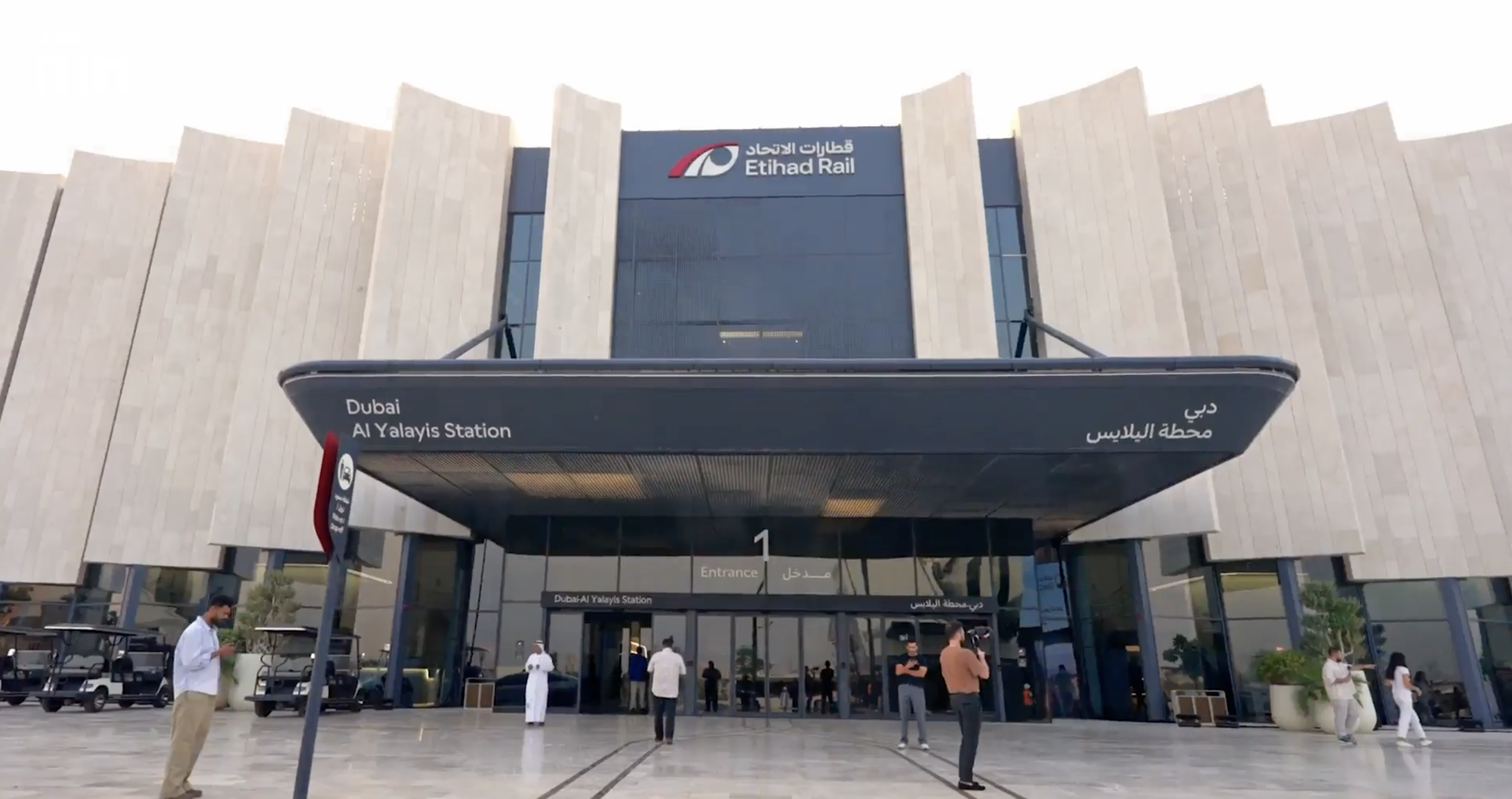
Above: An Etihad Rail Station in Dubai. Credit: Etihad Rail.
With the new passenger network and the Hafeet Rail project, the UAE is fast becoming a train lover’s metropolis.
And it doesn’t end there.
As if the 54 minute connection between Abu Dhabi and Dubai wasn't fast enough, tenders have been launched and contracts awarded to design and build a high-speed rail line between the two emirates.
The plan is to cut the journey to just 30 minutes using 350 kmph trains. Eventually, they’ll carry 21 million passengers every year.
Here’s the thing with high speed rail: it’s more than just showing off, it actually has a secret sauce that often gets overlooked.
The strategy behind high speed rail is to take two centres of commerce and reduce the travel time between them so that they effectively become a single economic unit.
That idea was pioneered in Japan with the opening of the world’s first high speed network, the shinkansen, in 1964.
Running from Tokyo to Osaka, it reduced the journey time between the two cities from nearly seven hours to three hours and ten minutes.
The prize of all of this is massive economic growth. The shinkansen helped fuel an economic boom that lasted decades and more recently, China’s explosive rise in high speed connectivity has transformed the fortunes of cities across the country.
So what does that mean for Abu Dhabi?
Well, once Dubai is 30 minutes away, the two emirates start to behave like one economy and that means doing a lot more of something it’s already good at: luxury real estate.
Some are already taking bets that this strategy will pay off. The idea is to create a swathe of modern, urban spaces big enough to host the likes of the Abu Dhabi Louvre, Guggenheim Abu Dhabi and Ferrari World.
But maybe more importantly, these islands are covered in luxury villas targeting investors.
”Abu Dhabi’s in a real (...) state now where the freehold markets have only been open for seven years and they’re now using this opportunity to sell freehold properties but providing huge value for money for the investors that buy into the property.” Explains Mistry.
“So in five, ten years time when all these people have made their money, they’ll then be encouraged to get more people to invest into the country moving forward (...) similar to maybe what Dubai is now where people have made so much money and people are seeing that success and buying into it again.”
The largest island currently under development is Hudayriyat.
Spread over a space roughly the same size as Manhattan, the already existing land mass is being expanded through a process called reclamation - a pretty common practice across Abu Dhabi’s islands.
To expand your land mass, firstly you carry out a series of studies to monitor waves and currents, check water depth and seabed sediment.
Then comes time for dredging - underwater excavation to remove gravel, rocks, sand and anything else on the seafloor.
First, you have to collect the materials and there are two commonly used methods here.
One involves a trailing suction hopper dredger like this.
That’s a large ship with underwater pipes that it drags along the seabed to suck up sediment.
The second is another ship called a cutter section dredger. It’s kitted out with a rotating mechanism that loosens sediment along the seabed.
That material is then quickly sucked through pipes either to the mainland or to the reclamation area.
Once in place, the sediment is layered to build out the coastline. In theory, it sounds simple, right?
You can see how much Hudayriyat has grown over the years but it’s on the island where the most exciting progression is happening.
We’re talking about schools, shops, world-class wave facilities for international surf events, a golf course and even a velodrome. It’s pretty nuts.
“They are building, probably what is the most luxury and most private real estate the UAE has ever seen. Once it’s all completed, there will only be space for 170,000 people.” Nathan explains, discussing the future of the island.
“Only 27% of the whole of the island will be for residential space and typically, especially in high-rise areas, the GFA ratio to the land is more than 100% because you’re building upwards (...) and they’re building out incredible pieces of infrastructure which only a government entity could do like these manmade hills.”
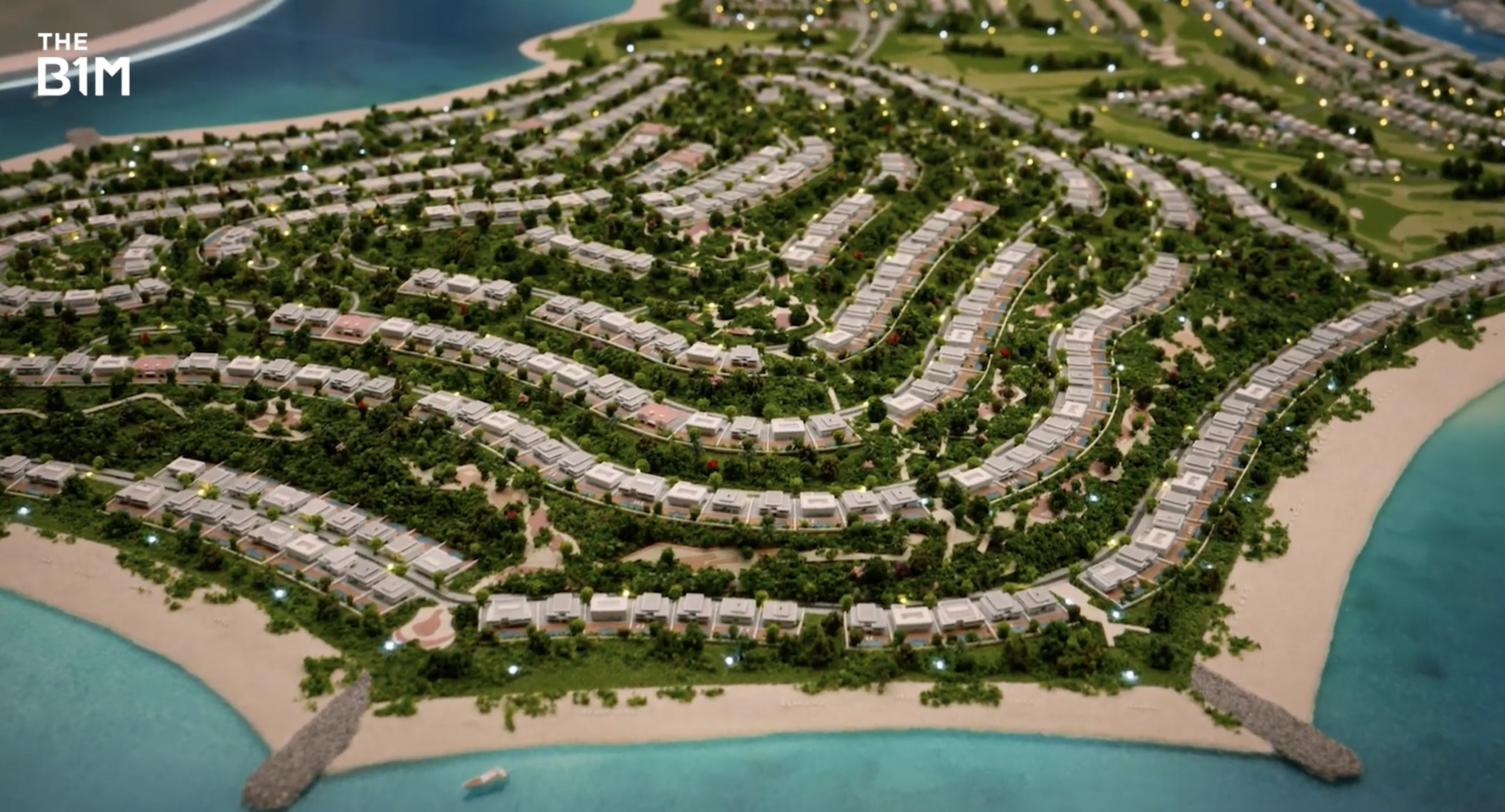
Above: A model of a luxury hillside community on Hudayriyat. Credit: Nathan Mistry.
“They’re designed to appeal to the highest net-worth individual because they tick boxes that maybe even luxury real estate in the UAE doesn’t tick now.”
Those mounds, built for hillside communities, are pretty massive. They reach up around 60 metres tall to offer panoramic views of the island.
To develop them, in basic terms, layers of fill material are rolled, compacted and then buried under yet more layers. Eventually they’ll be covered in soil, vegetation, roads, walkways and luxury villas for investors in Abu Dhabi and from further afield.
Of course, there’s no denying the entire region has been impacted by conflicts throughout the Middle East.
“I think absolutely this conflict – I’d be stupid to say, hasn't had an effect on the market. What we have noticed from a real estate point of view, people who own the properties are not selling” Mistry told us, speaking from his experience working in the area.
“The biggest change is the rate of people who are moving to the country has decreased (...) but it’s not a long-term effect. There is, in my opinion, a clock on this conflict.”
Mistry gave us some insight as to how Abu Dhabi has planned around the current tensions.
“Instead of delivering projects that are handing over in 2028, 2029, they’re now allowing people to pay the property over a longer period of time, all the way up to 2031. The residential sales in Abu Dhabi have now surpassed Dubai in the first half of 2026 especially all on Hudayriyat.”
Oil is a finite resource and its price can be pretty volatile - it’s impacted by new technology, green energy and as we’ve seen this year, war. Abu Dhabi sees its future away from sole reliance on oil and we’re already seeing the diversification efforts.
The emirate’s 2030 Economic Vision focuses on AI, finance and importantly, a core pillar is real estate. The city currently has 409,000 residential units but by 2030 that’ll climb by a whopping 71,000.
”Almost I feel, with Abu Dhabi they let Dubai do their thing, understand maybe the mistakes they’ve made and then try to now diversify their economy into it. But it's not just real estate they're diversifying into (...) they have this huge plan to basically not become reliant on oil.” Explains Mistry.
“The way that they’re viewing their model now in real estate especially is that at the end of the day they’re always going to make money from selling real estate in Abu Dhabi. More transactions, they take 2% of every transaction.”
You might start to think of this as the new Dubai. Glitz, glamour and above all, high-end luxury.
And while some of the core principles are the same - to make money and become a global powerhouse - Abu Dhabi’s approach is fairly nuanced.
Traditionally, Dubai has seen rapid expansion in response to demand. It’s pretty market-led.
Meanwhile, Abu Dhabi, where the federal government sits, strictly controls development to designated areas.
There’s a longer term approach and so you’re not likely to see the likes of the Burj Khalifa or the Burj Azizi any time soon.
What each emirate’s evolution tells us, alongside this major investment into rail infrastructure, is that the UAE isn’t content with just being wealthy.
It wants to become one of the best connected, most influential and economically important countries on the planet. And the Etihad Rail passenger network has a massive role to play.
It’ll connect cities, mobilise the workforce and create opportunities that once seemed out of reach.
And when you consider its position within the wider Gulf Railway, the potential of not just the UAE but the entire region is staggering.
The transit infrastructure being developed here will fundamentally change how people live and once delivered, it will help drive the next chapter for one of the most ambitious nations on the planet.
You can reach out to Nathan Mistry to discuss future investment opportunities by filling out the form here, or check him out on Youtube here.
Additional footage and images: Etihad Rail, Nathan Mistry, The National
We welcome you sharing our content to inspire others, but please be nice and play by our rules.
Comments