Building the World's Most Beautiful Bridge
- Youtube Views 3,441,183 VIDEO VIEWS

09 September 2026
Video narrated and hosted by Fred Mills. This video contains paid promotion for CATIA.
TAIWAN has completed construction on the Danjiang Bridge, a major infrastructure project spanning the Tamsui River estuary near Taipei. The bridge, which officially opened to traffic on 12 May 2026 after seven years of intensive construction, aims to resolve decades of regional traffic congestion while establishing a new architectural landmark for the island.
The estuary of the Tamsui River has long presented a major logistical challenge for planners in northern Taiwan. On the western bank lies Bali, an industrial hub home to one of the busiest container shipping terminals on the island. Directly opposite is Tamsui, a historic coastal town that has evolved into a rapidly expanding commuter suburb, seeing its population double over the last three decades.
Prior to the opening of the new crossing, travel between these two points required a circuitous six-kilometre detour inland. All vehicles were forced to navigate a single bottleneck crossing over the Guandu Bridge, a structure erected in 1983 that was never designed to handle modern traffic volumes. On peak days, traversing a single kilometre leading to the old bridge routinely took more than thirty minutes.
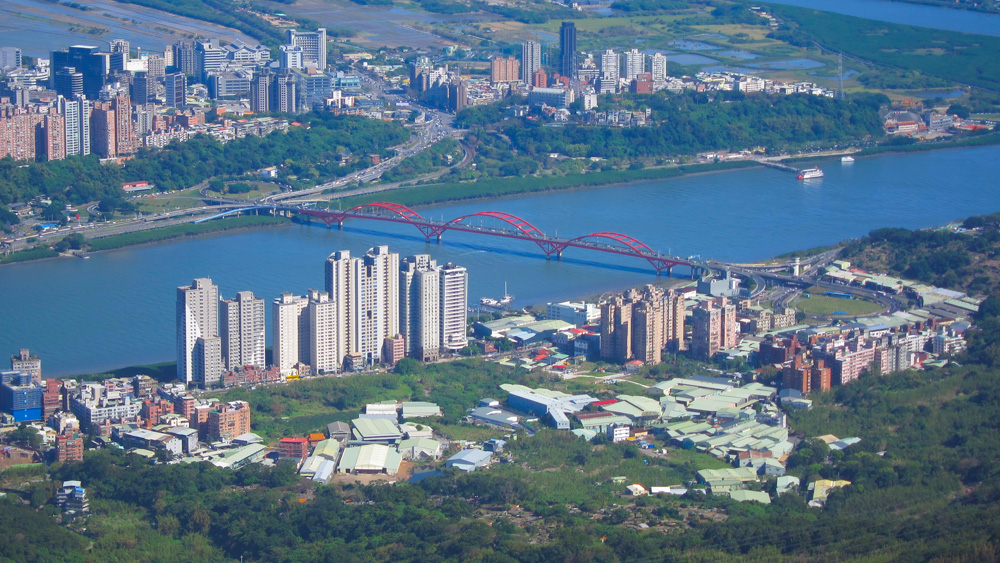
Above: The ageing Guandu bridge, crossing the Tamsui River.
The congestion had reached critical levels, impacting regional supply chains and delaying daily travel for residents. Furthermore, the bottleneck sat squarely in the path of a newly planned urban extension meant to house three hundred thousand future residents. Regional transport authorities recognised that a direct span across the mouth of the river was the only viable long-term remedy.
Building a direct link across the estuary presented a series of formidable civil engineering hurdles. The stretch of water separating Bali and Tamsui measures nearly one kilometre across, requiring an expansive structural span. Additionally, the terrain on both riverbanks consists of soft, low-lying ground that offers minimal natural anchorage for heavy foundation work.
Environmental conditions posed further difficulties. Opening directly onto the Taiwan Strait, the estuary is exposed to extreme coastal winds and seasonal typhoons that regularly sweep across the island with immense force. Because the river mouth serves as an active commercial shipping channel, the bridge deck had to be elevated high enough to allow large maritime vessels to pass beneath without obstruction.
Engineers were tasked with creating a structure capable of enduring high winds, potential seismic activity, and marine erosion, all while anchored in unstable riverbed soil.
Beyond the physical challenges, the project carried significant cultural weight. The mouth of the Tamsui River faces directly west across the Taiwan Strait, providing unobstructed views of the setting sun. Historically celebrated across East Asia, the sunset at Tamsui was listed among Taiwan's famous Eight Views, an ancient designation that bestows high cultural prestige and historical artistic significance.
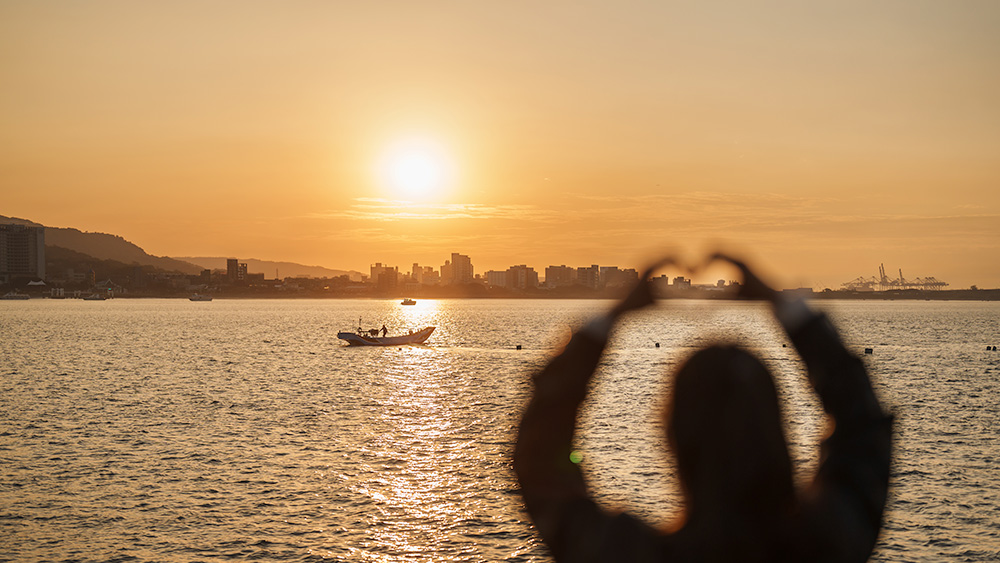
Above: The Tamsui estuary is one of Taiwan's most beloved beauty spots.
For centuries, poets and painters recorded the landscape, making the estuary one of the most photographed and visited scenic areas on the island. Local traditions formed around the location, with students, couples, and photography enthusiasts regularly gathering on the shore at dusk.
Because of this cultural sensitivity, public authorities acknowledged that a standard industrial bridge would be unacceptable. The Highway Bureau decided to depart from traditional infrastructure practices by hiring an architectural firm, ultimately selecting Zaha Hadid Architects to design a structure that would enhance rather than obstruct the natural environment.
The design team prioritised minimal visual impact on the skyline. To avoid bisecting the sunset or damaging the ecologically fragile wetlands on the river's southern bank, designers opted for an asymmetrical single-tower layout. The single mast was positioned close to the eastern shore, leaving the western horizon open to the water.
Rather than utilising thick, heavy cables characteristic of traditional suspension bridges, the design specified a cable-stayed arrangement. The thin supporting cables spread downward from the central tower in a fan formation, blending into the atmosphere when viewed from a distance.
The structural geometry was inspired by fluid movement, drawing direct influence from a world-renowned contemporary dance ensemble based in Tamsui. The primary concrete mast begins as two distinct pillars at the base, merges above the road deck, curves outward, and finally splits into an asymmetric Y-shape at the top. This fluid aesthetic extended even to the roadway illumination, where light fixtures were designed to rise and fall in a rhythmic wave across the deck rather than following a conventional, uniform pattern.
While the sweeping design achieved its aesthetic goals, it introduced severe structural difficulties during the planning phase. Conventional vertical bridge piers are constructed as uniform geometric shapes, such as cylinders or rectangles, which allow builders to use standardised concrete pouring methods.
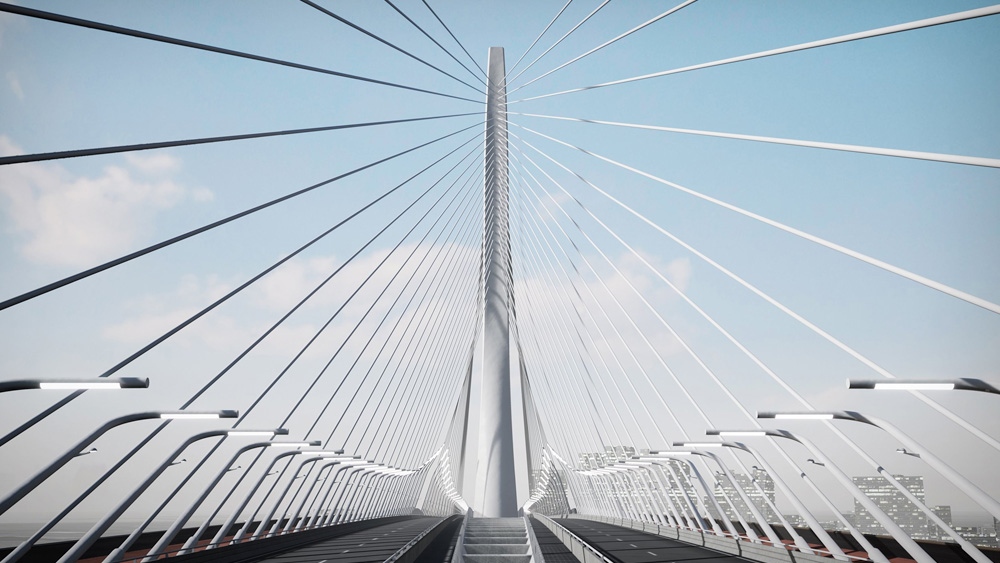
Above: The Danjiang bridge has a highly complex form.
In standard tall construction, contractors utilise slip-forming, a process where concrete is poured into a rigid mould, allowed to set, and then jacked upward incrementally. This technique relies on consistent cross-sectional dimensions throughout the height of the tower.
Because the main tower of the Danjiang Bridge continually altered its shape, angle, and thickness as it ascended, standard slip-forming was impossible. To solve this, construction teams partnered with formwork specialists PERI to develop customised, modular moulds. These moulds were engineered to dynamically adjust their geometry, expanding, contracting, and repositioning at every stage of the climb to accommodate the shifting profile of the concrete.
Despite these engineering preparations, the project encountered a major crisis during the bidding process that threatened to halt construction indefinitely. Taiwanese public procurement regulations dictated that infrastructure tenders had to be submitted using traditional two-dimensional paper drawings.
Attempting to represent a fully three-dimensional, continuously curving structure through flat plan views and elevations created severe ambiguity. Every individual segment of the deck, the structural joints, and the internal steel reinforcement possessed unique dimensions with tolerances measured in millimetres across a span of hundreds of metres.
Contractors examining the flat blueprints found it impossible to assess structural risks, estimate material quantities, or guarantee precise fabrication. Bidding firms concluded the complex geometry was unbuildable within standard budgets and timelines. Consequently, the project was put out to tender seven consecutive times, failing to attract a single viable proposal on each occasion, with construction executives publicly declaring the structure impossible to execute.
The deadlock was resolved through the implementation of advanced three-dimensional cloud modelling software, specifically the CATIA platform developed by Dassault Systèmes. The design team created a comprehensive digital twin of the entire bridge at a one-to-one scale.
This digital model mapped every individual component in virtual space, including every piece of steel rebar within the main mast, every stay cable, and every concrete segment. Engineering teams located in London, Germany, and Taiwan were able to collaborate simultaneously via the cloud, conducting virtual walkthroughs and checking structural alignments before physical work commenced.
The digital twin allowed planners to perform collision checks, verify load distributions, and accurately calculate precise material costs. By displaying interactive three-dimensional models on portable devices, design teams successfully demonstrated the feasibility of the construction process to government officials and prospective contractors, eliminating the uncertainty created by flat drawings.
Reassured by the digital model, Taiwanese construction firm Kung Sing Engineering took on the contract on its eighth tender attempt. Construction began shortly thereafter, spanning seven years of complex marine and structural engineering work.
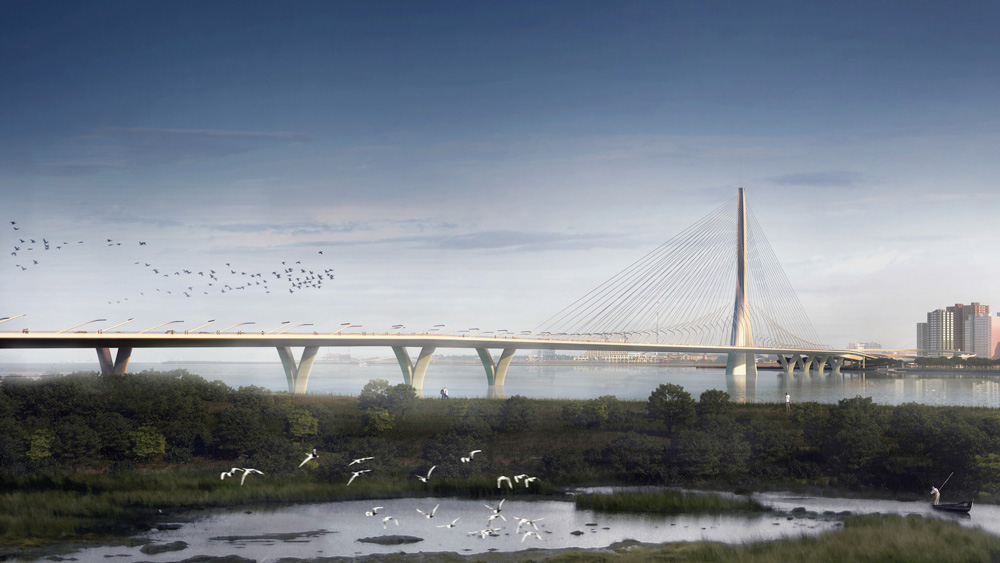
Above: The Danjiang bridge
The completed Danjiang Bridge officially opened on 12 May 2026, delivering immediate benefits to regional transportation networks. Travel times between Bali and Tamsui have been drastically reduced, diverting heavy commercial traffic away from suburban roads and reducing wear on older crossings.
Urban planners anticipate the bridge will catalyse development in nearby residential zones while standing as a major national landmark. Alongside the Taipei 101 skyscraper, the slender, single-tower structure now forms an integral part of Taiwan's architectural identity, demonstrating how modern digital technology can bridge the gap between complex architectural ambition and heavy civil engineering.
Additional footage and images: Focus Taiwan, ZAHA HADID ARCHITECTS, CNA, Times Now, PERI, 哲睿Jerry, XinXingES
Discover CATIA now.
We welcome you sharing our content to inspire others, but please be nice and play by our rules.
Comments