Europe's Biggest Airport Expansion is (Finally) Complete
- Youtube Views 1,084,477 VIDEO VIEWS

05 August 2026
Video hosted by Fred Mills. This video contains paid promotion for Odoo.
THIS is a mega-build that could not afford to fail.
A huge expansion to one of Europe’s busiest airports. One of the largest privately funded infrastructure projects on the entire continent.
A chance to compete with the region’s biggest and best travel hubs before they fly even further out of reach.
But most of all, it had one job — to avoid a repeat of what happened last time.
Yes, this is Germany’s first major airport project after the horror show that was Berlin Brandenburg — an ordeal that sullied its aviation reputation.
Now, with Frankfurt’s long-awaited new terminal up and running after experiencing some turbulence of its own, the question is has Germany achieved a smooth touchdown this time?
A new dawn
It’s the morning of April 23rd 2026, and a plane has just landed in Frankfurt. Nothing out of the ordinary here, you might think. Just one of hundreds of aircraft that touch down at Germany’s largest airport every day.
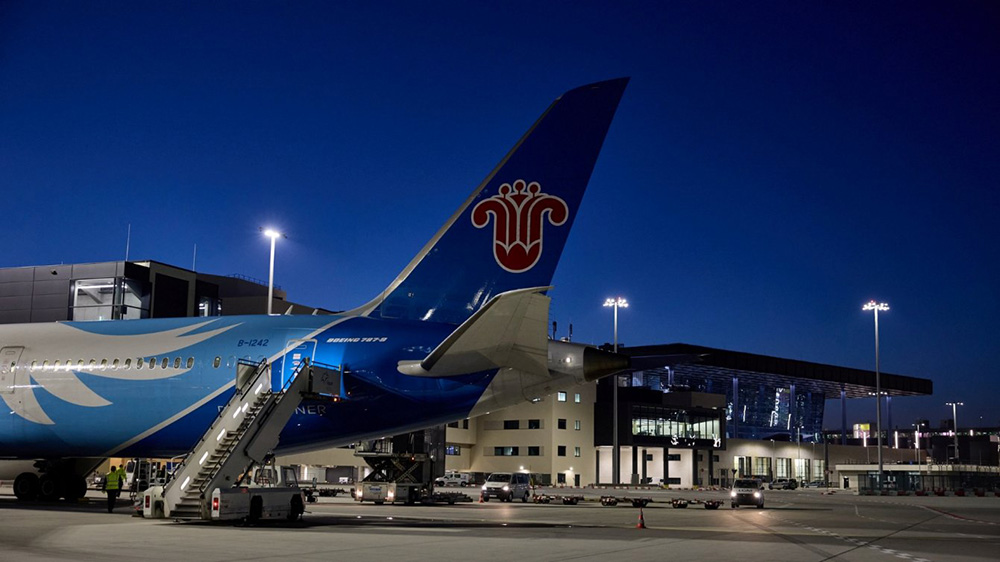
Above: The first landing at Frankfurt Terminal 3. Image: Fraport AG.
But this China Southern Airlines flight was significant, because these were the first travellers to arrive at Frankfurt’s brand-new, and much-anticipated, Terminal 3.
Following more than ten years of construction, it’s the culmination of one of Europe’s biggest airport upgrades in recent times.
This would be a strengthening of what was already a top regional transport hub.
Those lucky folks may have just endured an eleven-hour slog from Shenyang, but the excitement of sampling T3 before anyone else will surely have perked them right up. Because there had been plenty of hype.
Talking it up
Its operator, Fraport, had been calling it “one of Europe’s most advanced terminals” with a “high-quality passenger experience and rapid processes.”
We’ll come on to what that looks like in a minute. But first — while there was excitement ahead of this project’s opening, there would have been a lot of nail-biting too.
And the reason for that is — the country’s previous attempt at airport construction didn’t exactly go very well.
Yes, sorry Germany — just when you thought we’d finally stopped talking about Berlin Brandenburg, we’re going to bring it up again.
Don’t worry though, because we’ve already done an entire video on the whole saga, we’ll keep it brief this time.
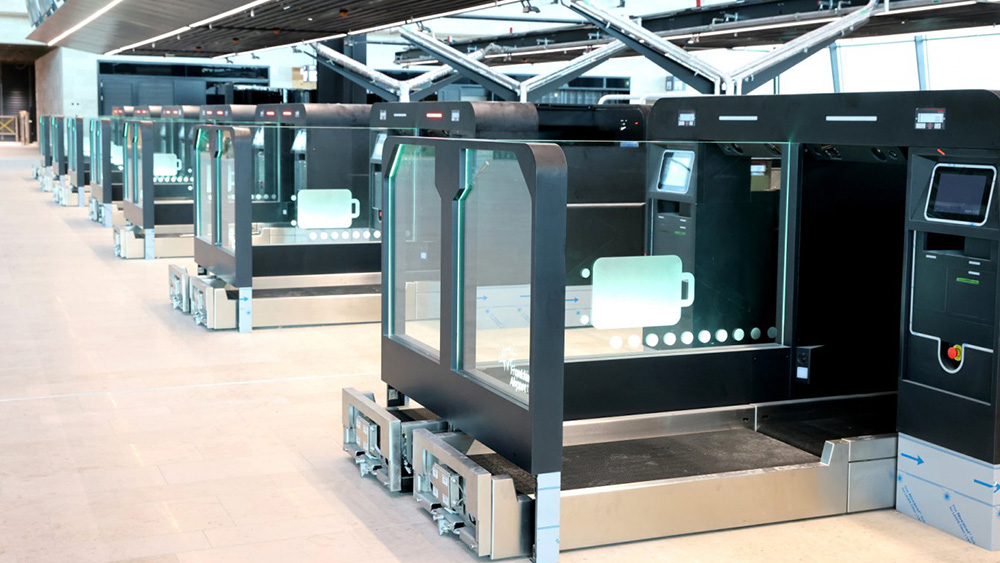
Above: The Fast Bag Drop system at T3 is one of its "advanced" features. Image: Fraport AG.
For those who don’t know, BER finished nine years later than it should’ve done, and went €5BN over budget. It ended up costing more than three times what it was supposed to.
Back in 2013, a year after it was expected to open, a catalogue of errors were uncovered. There would be over half a million of them in total.
The lighting worked but couldn’t be switched off, escalators were built too short and the fire safety system was faulty.
If you were to pass through Brandenburg today, however, you’d find no evidence of its past struggles. In fact, it’s become a perfectly well functioning airport since it actually opened.
The hope was that Germany’s next aviation project would end up with a positive result too, but without any of the chaos leading up to it.
Especially as this wasn’t an entirely new airport, but an upgrade to an existing one – albeit massive.
Frankfurt's fortunes
One more thing and then we’ll get into it, and you might already be wondering this — the reason why the biggest travel hub in Germany isn’t in the capital.
It all stems from when Berlin — and the country as a whole — was divided into East and West after World War II.
That meant Berlin wasn’t very well placed to be a central hub for the more prosperous West Germany.
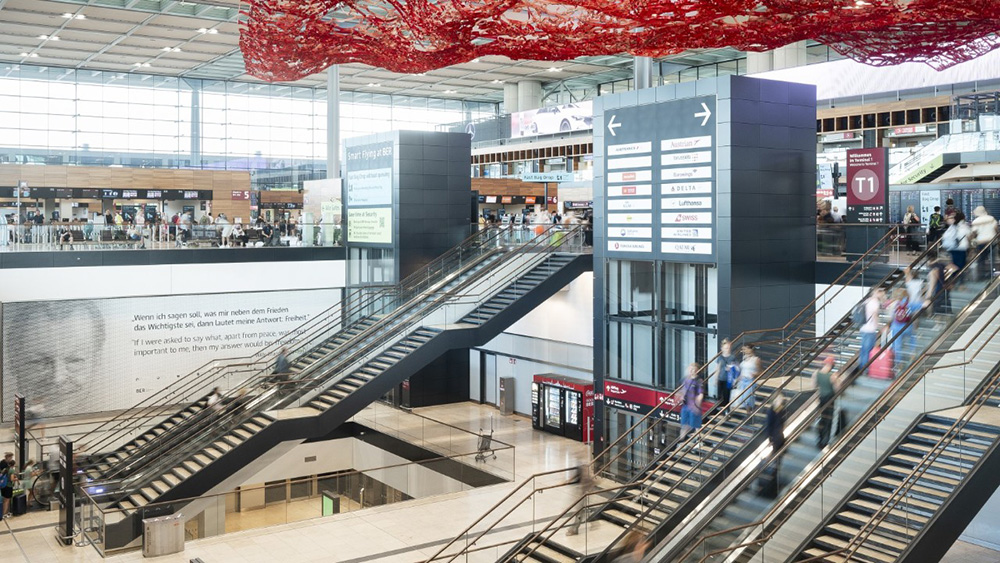
Above: An inside view of Berlin's Brandenburg Airport post-completion. Image: Annika Bauer + Flughafen Berlin Brandenburg GmbH.
1972 was when Frankfurt’s Terminal 1 opened its doors — so, right in the middle of the Cold War.
By the ‘90s it had become overcrowded and air travel was surging, which is why a second terminal was soon unveiled.
To carry travellers between the two terminals, an automated people mover called the Sky Line was introduced too.
This was the first driverless passenger transport system in the whole of Germany, and it was cleverly designed to be expanded in future, should the need arise.
The city is where Lufthansa — Germany’s top airline — is based, it’s a huge industrial centre, and almost half of the country’s population lives within 200km of it. So, its airport grew to become the biggest and has stayed that way ever since.
Growing pains
At a European level, Frankfurt is now the sixth busiest airport on the continent. It serves more than 60 million annual passengers.
Despite this, however, its competitors have been growing faster. The only way it was going to climb the table was to expand — and not just a little bit.
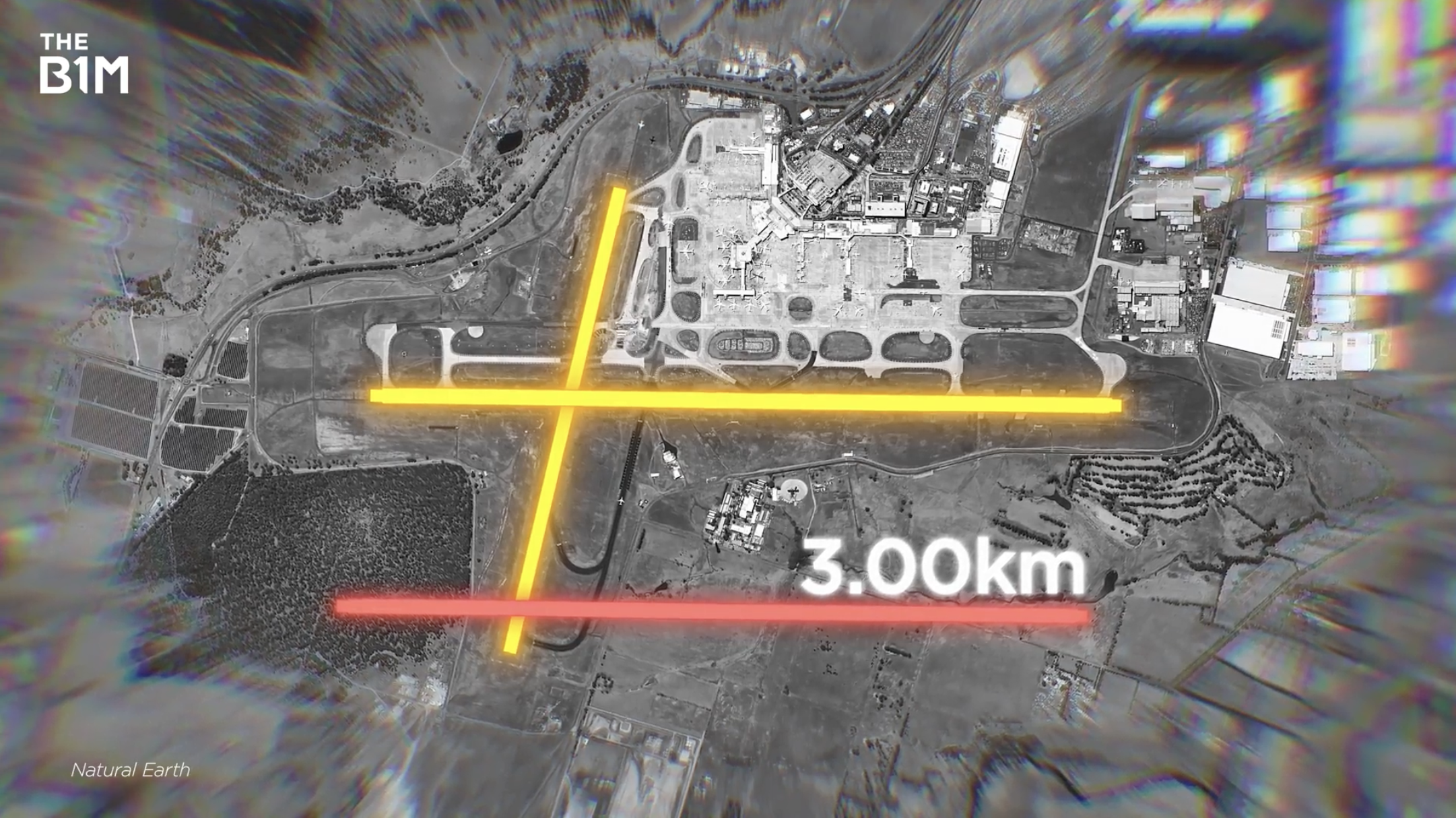
They would have to go big, and that meant building to the south of the airport’s four runways. Terminals 1 and 2 were both built on the north side.
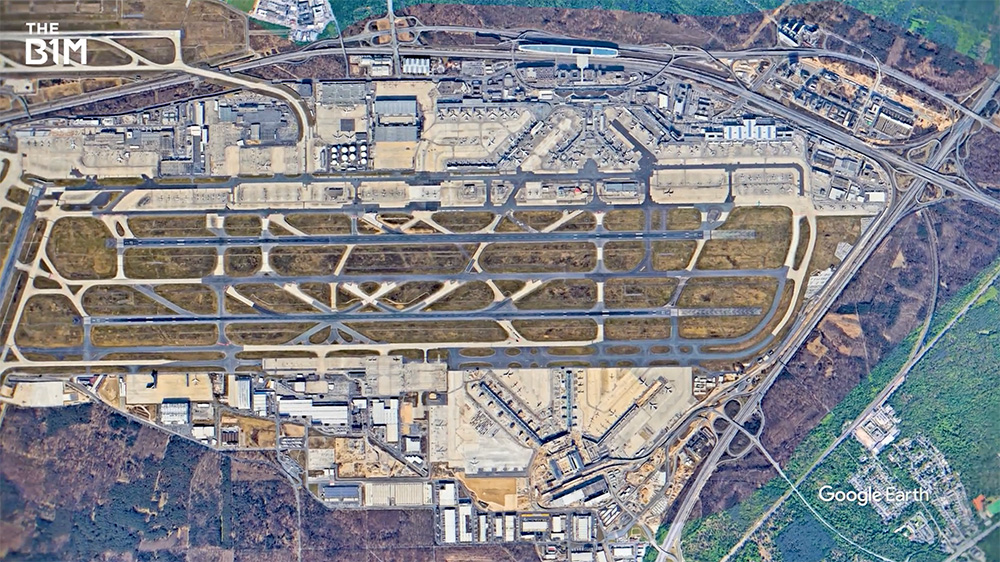
Above: Terminal 3 was built on the opposite side of the runways to Terminals 1 and 2.
Overall, Frankfurt’s new Terminal 3 has a footprint of 176,000 square metres. That’s the equivalent of 25 Deutsche Bank Parks — the city’s 52,000-seat football stadium.
Much of this space is taken up by the giant new concourses — Piers G, H and J. With these, T3 has capacity for up to 19 million passengers each year.
H and J have 24 docking positions between them, with Pier J — the larger of the two — offering four more. These are for wide-body aircraft.
At 600m, it’s 50% longer than Pier H, and has three levels instead of two. This extra storey is for passengers coming or going from outside the Schengen Zone.
Another unique feature of Pier J is the visibility of the Y-shaped columns. These don’t just dissipate the load of the structure above into the ground below; they serve an architectural purpose too.
Room for more
And that’s not all there is to say about the piers. If, or when, the other planned extension — Pier K — gets built in the future, T3’s capacity will rise again to 25 million passengers.
This wasn’t a recent idea, either; Fraport’s mission to add a new terminal began decades ago. T3 was approved in the year 2000 after the local state government decided to back the expansion.
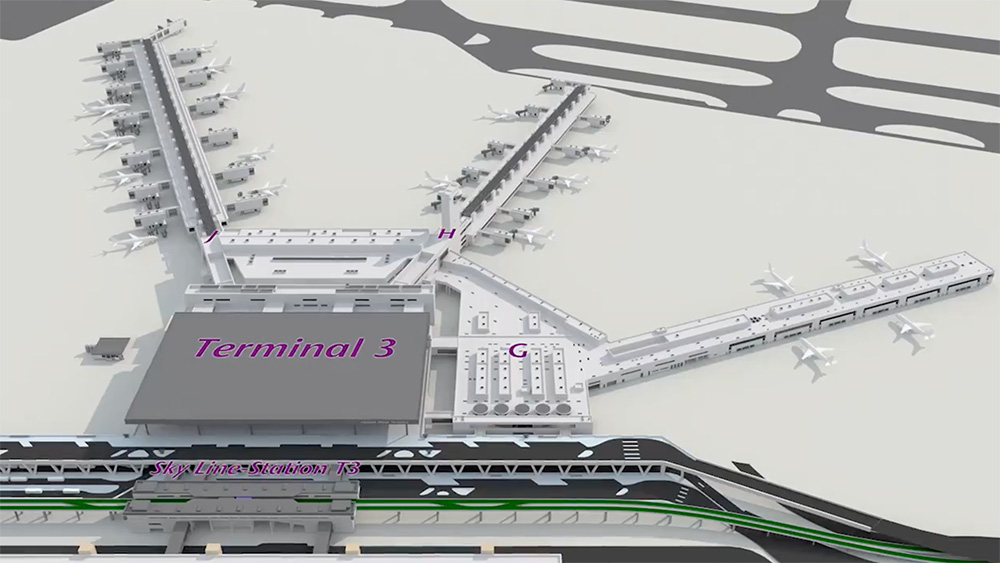
Above: The three piers branching out from the main terminal building. Image: Fraport AG.
Then it was time to bring in the architects with a two-phase competition that saw nearly 50 firms, from across Europe, submit their ideas.
A modular-based approach envisioned by London-based Foster + Partners won the first round. But it was Frankfurt’s own Christoph Mäckler Architects that emerged victorious in the crucial second stage.
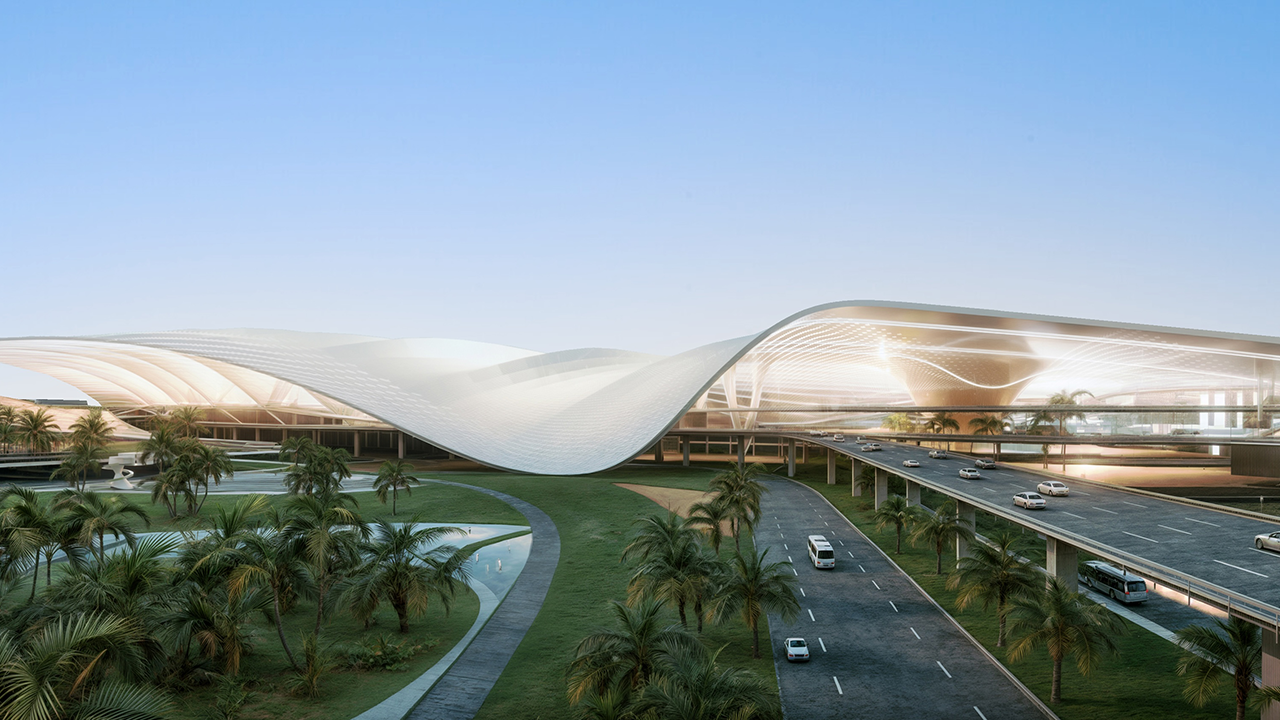
Their job was to take Fosters’ concept and turn it into a detailed design, which Mäckler describes as “modern with a feel-good ambience.”
He wanted the terminal’s main sections — the gates, lounges, piers — to feel like the streets and squares of a city.
Filled with light and packed with amenities, T3 would be somewhere passengers enjoy being, instead of just killing time before a flight.
Making preparations
By now it was 2007, and a zoning plan to figure out what other infrastructure upgrades would be needed aside from the terminal itself, was signed off.
The result of this was an enlargement of the nearby motorway interchange and a new line for the people mover that would run between Terminals 1 and 3.
Which is perhaps even more important than the existing one, when you look at the distance between T3 and the other two.
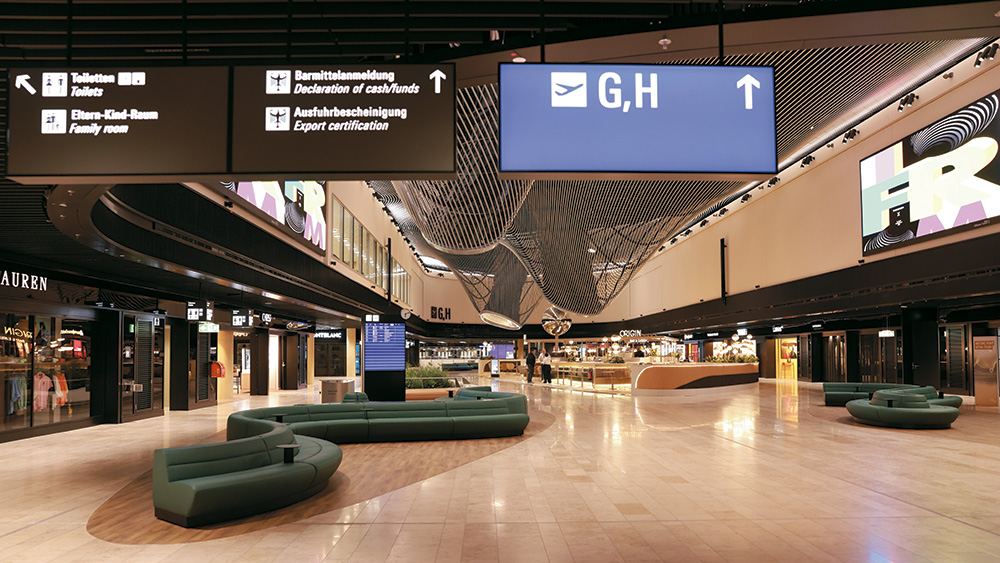
Above: There are much worse places to be before boarding a plane. Image: Fraport AG.
There was a problem, though. The rail line would have to pass around the end of a runway, but also be high enough to get passengers in and out of the terminals.
That’s why it’s built at varying heights. The sections nearest the terminals are elevated on large V-shaped columns.
When trains go past where the planes take off and land, the track drops down to grade level.
So, there was going to be a lot more to this project than just the main building.
Spades in the ground
But because a new runway had to be built first, there was a global financial crisis and Terminals 1 and 2 weren’t yet stretched, the construction permit wasn’t signed until 2015. Once that happened it meant work could finally get started later that year.
And it would take place in a spot already steeped in aviation history. Before T3 was built here, this site was home to an old Air Force base… but not a German one.
It was actually occupied by the U.S. Air Force from the end of World War Two up until 2005, when it was handed back to Germany.
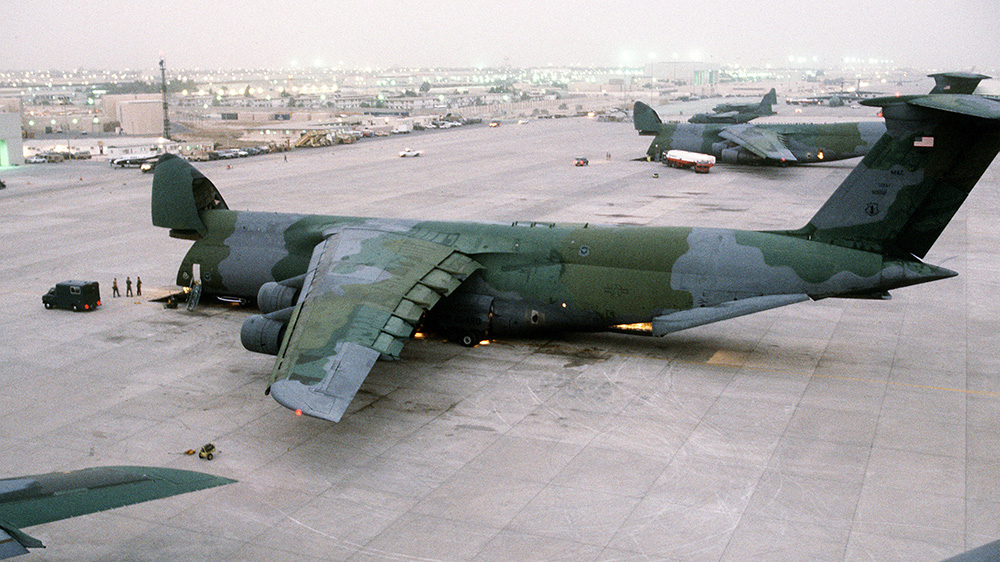
Above: American military planes line up at Rhein-Main Air Base in the early 1990s.
As with any building, they couldn’t start assembling the main structure, or anything inside it, without sorting the foundations first.
Because it was for an entire airport terminal, crews began by clearing a vast amount of space. Around 66,000 square metres to be precise, which is the same as five Reichstag Buildings.
The enormous construction pit that would stretch across this huge area was delivered in two phases.
First up was the Dry Excavation. This involved bringing in diggers, rigs and bulldozers to extract and remove up to 300 truckloads of material, every day, for six months.
Once a depth of five and a half metres had been reached, workers started driving sheet piles into the pit’s sandy bottom to create retaining walls.
These prevented groundwater from pouring in, and allowed the team to dig down a little further before things got a bit… damp.
Deep dive
Which brings us onto the second phase — the Wet Excavation. By this point the floor was heading below the water table, and there was still quite a way to go.
So, down they kept going — to around 11 metres — and that gave them no choice but to let the water in. Lots of it, but all nice and contained.
Next, concrete was poured in to seal the bottom of the pit — yes, underwater — with a team of divers on hand to check that it was all going to plan.
After the concrete had cured, the water was pumped out and sent off to a purification plant before being released back into the ground again.
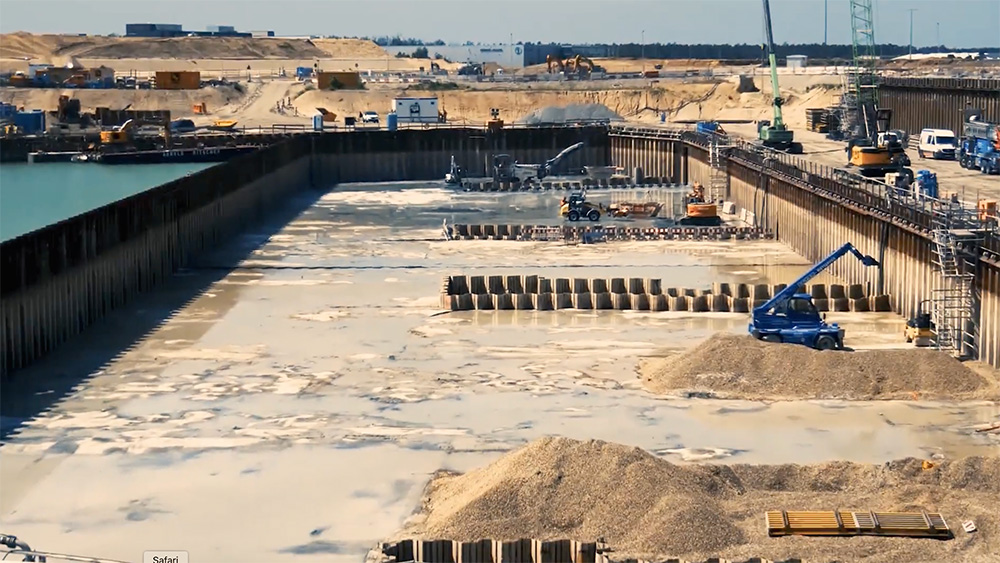
Above: Tackling the two-phase excavation process. Image: Fraport AG.
Fast forward to 2020 and the structural shells, or carcasses, of the main sections were beginning to take shape.
By now those Y-shaped columns were being craned into place on Pier J. There are 86 of them in total, along both sides, weighing over 22 tones each.
At the same time, progress had been made with the construction of the new people mover line.
The columns were in and the track was being installed, with its concrete girders and frames made from prefabricated parts.
A few more years passed before the platforms began to take shape, along with the elevated section that connects with the new terminal building.
And by late 2024, vehicles could be seen racing around on test runs, closely monitored by the control centre.
T3's troubles
But hang on a minute, let’s go back a bit. We mentioned 2020 just then, but something else happened that year, didn’t it?
Yep, we’d rather not go there either but the pandemic is part of the story unfortunately. Although it affected pretty much all major projects, airports were hit particularly hard.
Passenger demand plummeted, causing all kinds of uncertainty for new builds like T3.
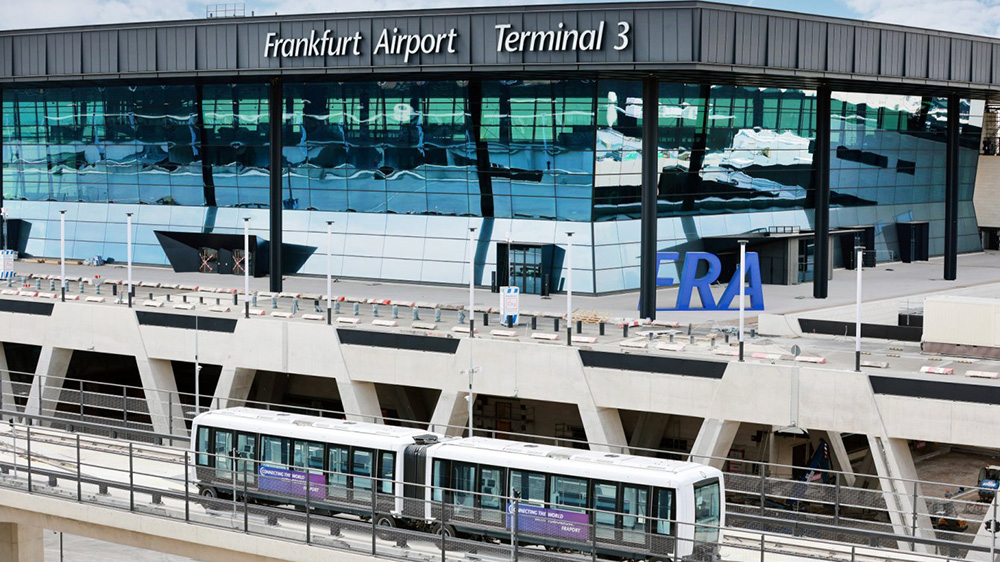
Above: A people mover in front of the terminal entrance. Image: Fraport AG.
And getting the right materials, equipment and people to site became a real challenge. It’s one of the main reasons why the terminal’s opening — originally planned for 2022 — was pushed back by four years.
Extending the timeline came at a cost. The initial price tag was just under €3BN, but the final figure was around €4BN.
Now, sure, that’s not a small increase, and the same can be said for the delay, but it’s nothing compared to the Berlin fiasco.
One thing that kept T3 from falling into the same trap was the so-called ‘design freeze’.
Another issue at Brandenburg was the multiple redesigns, which just led to more time, and money, being spent.
What they’ve done in Frankfurt is decide, right from the start, to pick designs and stick to them, which is a much less costly way of doing things.
Money matters
Speaking of costs, we should point out here where all the capital for this came from. Fraport says it was the biggest project on the continent to be privately funded. At the time of construction, anyway.
This might sound odd when the State of Hessen has a 31% stake in the operator, with the City of Frankfurt holding 21%.
All that does, though, is give them a controlling public influence over the company, and therefore the project.
Those local authorities did not have to take a single Euro out of their coffers for the building of T3.
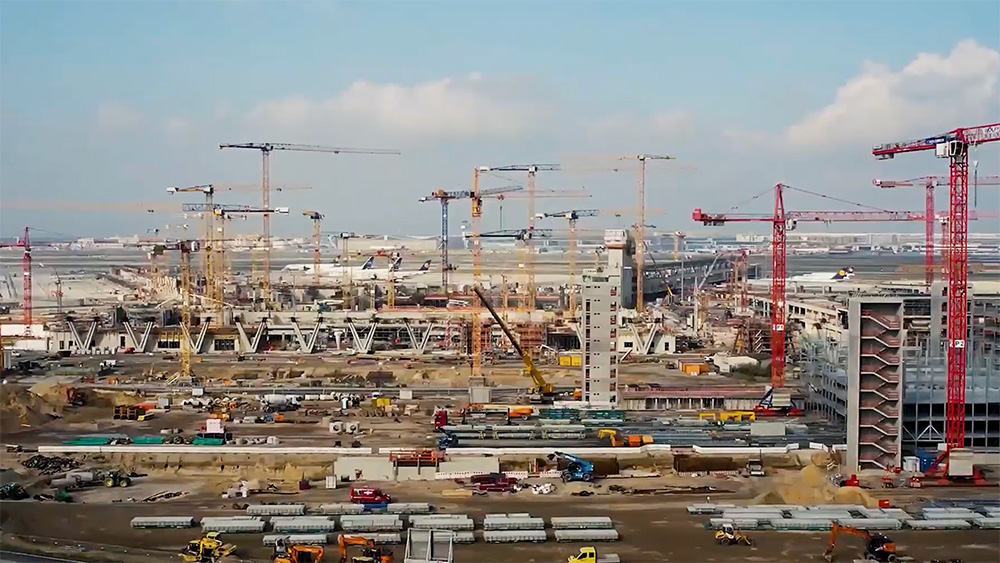
Above: Terminal 3 took more than a decade to build overall. Image: Fraport AG.
So, it’s not been paid for out of public taxes, but now that it’s open, the people of Germany — and the rest of the world — have finally been able to deliver their verdicts.
Regarding architecture and design, the response has been mostly positive. Lots of comments about its visual appeal, the choice of shops and restaurants.
But the experience hasn’t been trouble-free for everyone. Some have complained about painfully long lines at immigration, but that’s partly because of the EU’s new digital border system.
Skyfail
What is more of a fault of the new terminal and its infrastructure is the problem that many passengers faced a month after the opening.
The new Sky Line extension stopped working, giving people no choice but to take shuttle buses between the terminals instead. It took three weeks to get it up and running again.
Since then, things seem to be going relatively smoothly and there have been no major issues during T3’s first summer of operations.
Now, we’re not quite done covering the early feedback because it hasn’t just been travellers giving Frankfurt’s new expansion their approval — on aesthetics at least.
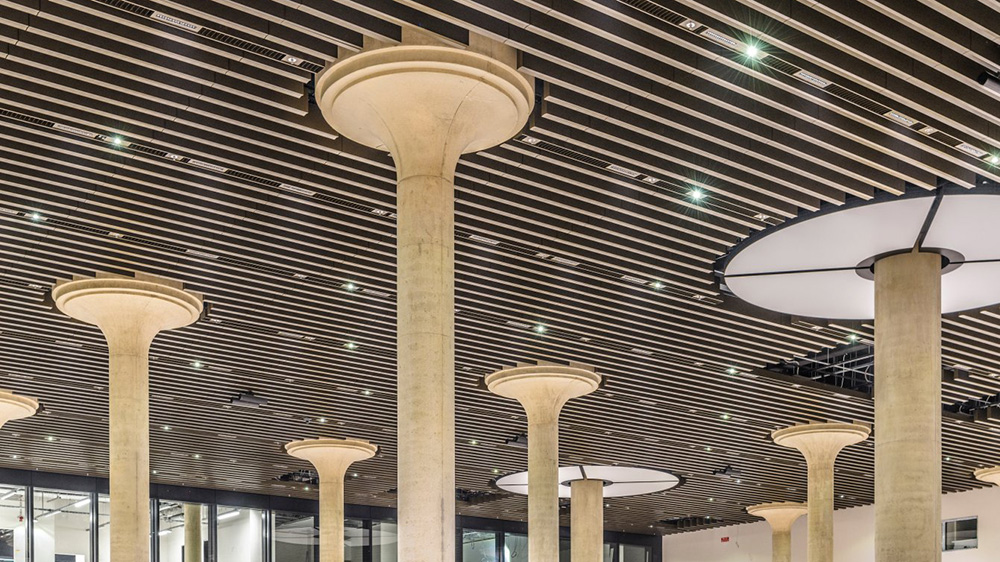
Above: Mäckler's architectural approach seems to have paid off. Image: Fraport AG.
The terminal is one of seven projects included in the 2026 list of World’s Most Beautiful Airports, published by Prix Versailles.
It’s a series of awards given out each year across various categories of architecture, and T3 is the only European entry to make the list this time.
Others include Navi Mumbai and the new Pittsburgh International Airport. You know about that first one already because we featured it on The B1M recently.
As for our summary on T3, well, it hasn’t been perfect, but these projects rarely are. What has been achieved here is great, and there’s recognition of that clearly coming in from passengers.
Which is just as well, because Frankfurt had decided it’s still not done with its airport glow-up.
Round two
In June 2026, Terminal 2 was closed for refurbishment, with all airlines that flew from there relocating to the new one.
With construction not due to start on that until 2030, ahead of a planned reopening in the mid-2030s, it’s another scheme that won’t be done quickly.
But this time the pressure to succeed won’t be quite as intense.
Try your first app free for life at Odoo by heading to the link here.
Additional footage and images: Fraport AG, FBB + Berlin Brandenburg Airport, Al Jazeera, CNBC and DW.
We welcome you sharing our content to inspire others, but please be nice and play by our rules.
Comments