
The €500BN Plan to Fix Germany's Broken Infrastructure
- Youtube Views 755,898 VIDEO VIEWS

11 March 2026
Video hosted by Fred Mills. This video contains paid promotion for Brilliant.
IN September 2024 a bridge in Dresden, Germany collapsed overnight without warning.
Six months later, a ring road in Berlin had to be closed after inspectors found a crack that had grown unexpectedly. The section was immediately demolished, causing traffic chaos.
We could go on, because these are just some examples of how far the backbone of Germany’s transport network has declined due to neglect and poor maintenance.
But help has arrived in the form of a €500BN fund aimed at revitalising the country’s infrastructure — with more than just bridges and railways set to benefit.
It’s an enormous sum of money — one that you’d think should solve these problems once and for all. And yet, incredibly, people are asking — will it be enough?
The scale of the problem
Germany is the world’s third largest economy, but you wouldn’t know it from the state of some of its infrastructure.
Yes, it has one of the largest high-speed rail systems on the planet. When it actually runs on time, that is.
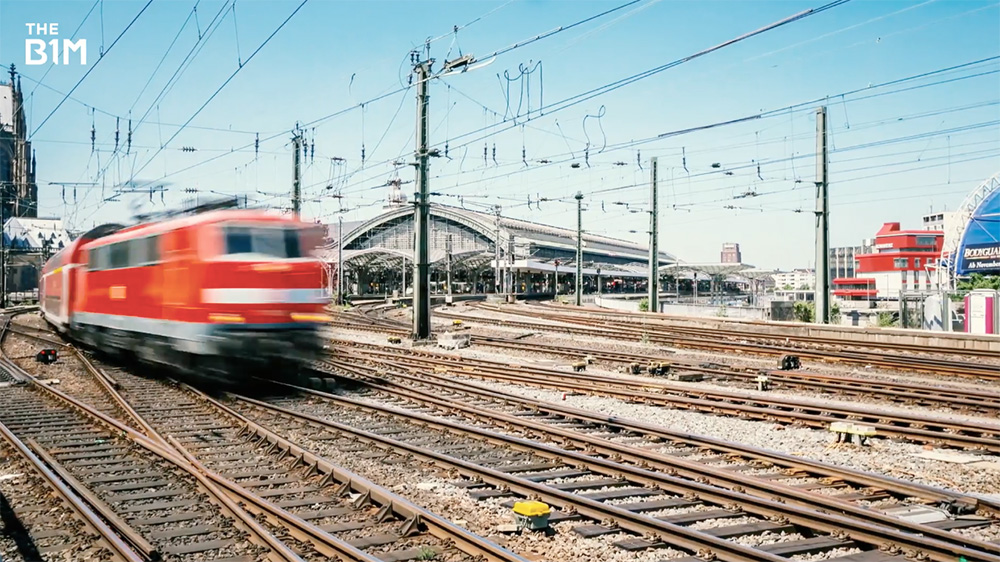
Above: Germany's trains aren't slow, but they're often delayed.
There’s the Autobahn, too, which is great when you’re not being diverted suddenly, or made to slow right down, due to the constant roadworks.
One reason why there’s so much of that is because many of the structures that support those roads are in dire need of repair, or due to be replaced.
Not just a few
Tens of thousands of bridges have been identified as needing upgrades, with the worst cases facing demolition, over the next ten years. But it’s not always been this way.
“We had the situation that a lot of the infrastructure was destroyed after World War II and that gave us the chance to start anew in many cases,” said Dr. Christian Böttger, a professor at HTW Berlin, a university of applied sciences in the German capital. “And so we had quite a modern and advanced infrastructure if you look back to the ‘70s and ‘80s.
“We had a big push in infrastructure with the unification of Germany in the ‘90s, where a lot of the money was provided for upgrading infrastructure in the east that had not been upgraded in the same way after the war as in the west. But since that time it’s been deteriorating.” Explained Böttger.
Still, it could be worse. Yes, there are defects but they’re usually spotted and fixed before they become too serious. After that, things carry on as normal.

Above: A great many bridges across the country — like Hamburg's Köhlbrandbrücke, which opened in 1974 — now have to be replaced.
Recently, however, there have been some big exceptions, with one failure in particular making news around the world.
Just before 3am on September 11th 2024, the Carola Bridge in Dresden fell suddenly into the River Elbe.
Built in 1971 — before reunification — the concrete structure was used by pedestrians, cyclists and trams, including one that had passed over it mere minutes before.
While no one was hurt, the resulting debris blocked ships from accessing this section of the river for months.
The impact
Having two other bridges on the river meant detours were quickly found, but still, the loss of this one has made travelling around the city more difficult than it should be.
“After the collapse it was, of course, shocking and also influencing the traffic much, but today … the traffic found other ways,” said Steffen Marx, a professor at Dresden’s Technical University. He was commissioned by city officials to write a report on the reasons for the Carola Bridge collapse.
"In average we have four to five minutes higher traffic time if you need to cross the city, and you need to cross the river … of course in rush hours the time effort is much higher. You can spend half an hour longer in some days."

Above: A close-up of the collapsed Carola Bridge.
Not only did the incident sever a major transport connection; the bridge also carried utility pipes, leaving many people without heating or hot water.
Professor Marx discovered that material fatigue over time, and cracking caused by hydrogen-induced stress corrosion, are what led to the bridge’s failure. But we’ll let him explain in a little more detail.
“So this means it was already activated during the construction time due to a moisture which was in the air containing acid. And the acid was from the heating of all the coal heaters in all the flats in Germany.
“And so you have this acid fog in the air, it was coming down to the pre-stressing steel, and this damage process was induced. So, the bridge had already, from the beginning of its lifetime, a very much reduced safety factor, which nobody really knew.”
You can see why it sparked a lot of concern about the condition of other bridges across the country.
Drastic action
Germans didn’t have long to wait for the next problem. March 2025 saw a highway bridge in Berlin quickly demolished after a crack had widened faster than predicted.
Although this ultimately prevented disaster, many Berliners feel it shouldn’t have been allowed to get to this stage.
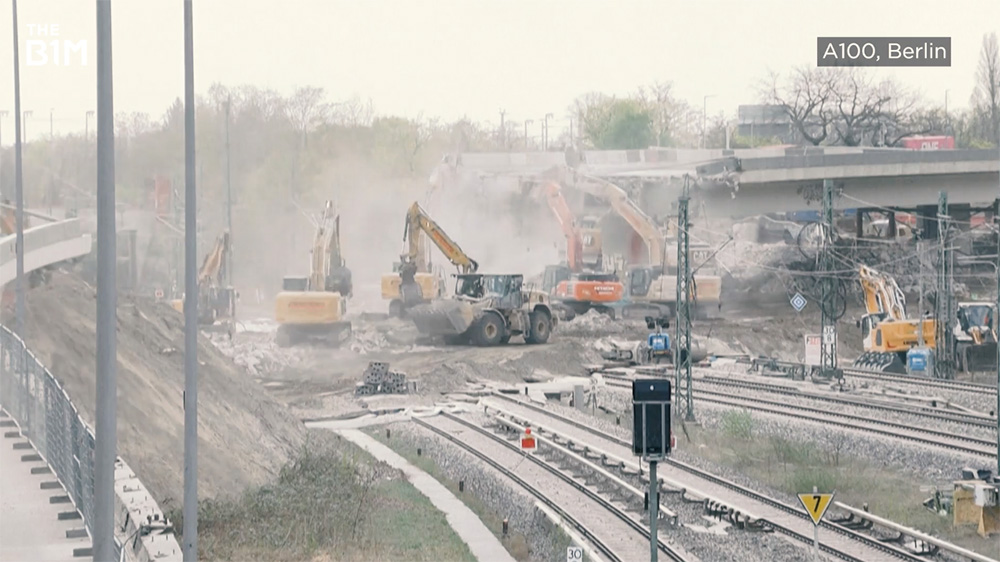
Above: The demolition of the Ringbahnbrücke was no small job. Image courtesy of Der Standard.
On entirely new projects, Germany’s reputation has taken a bit of a hit as well. Brandenburg Airport — also in the capital — famously took decades to open because it was marred by bureaucracy and poor management.
The same goes for other megaprojects that remain ongoing, like Stuttgart 21 and Munich’s new S-Bahn line — both hugely expensive and heavily delayed.
Coming to the rescue
However, there has, at last, been some good news to report. In March 2025, German chancellor Friedrich Merz announced a massive spending push.
A staggering €500BN — that’s around USD $550BN — has now been earmarked for upgrades across the country.
€300BN of that will be given to the federal government for infrastructure projects, €100BN has been set aside for individual states, and the remaining €100BN is for climate-related investments.
It’s not all being splurged in one go though, if that’s what you’re thinking. The spending will be spread out over a 12-year period.
“It makes no sense to spend one year €500BN and then the next year it’s empty again. We need a long-term perspective, so this is good, but at the same time of course this means it is only … €40BN per year,” said Professor Marx.
“It’s also spent not only in bridges; it is spent in energy infrastructure, water infrastructure, schools, street traffic as well as railway traffic.”
In fact, let’s bring up some actual data on that. The graph below shows where the funds will be going in the first few years, according to a summary from Germany’s state-owned development bank KfW.
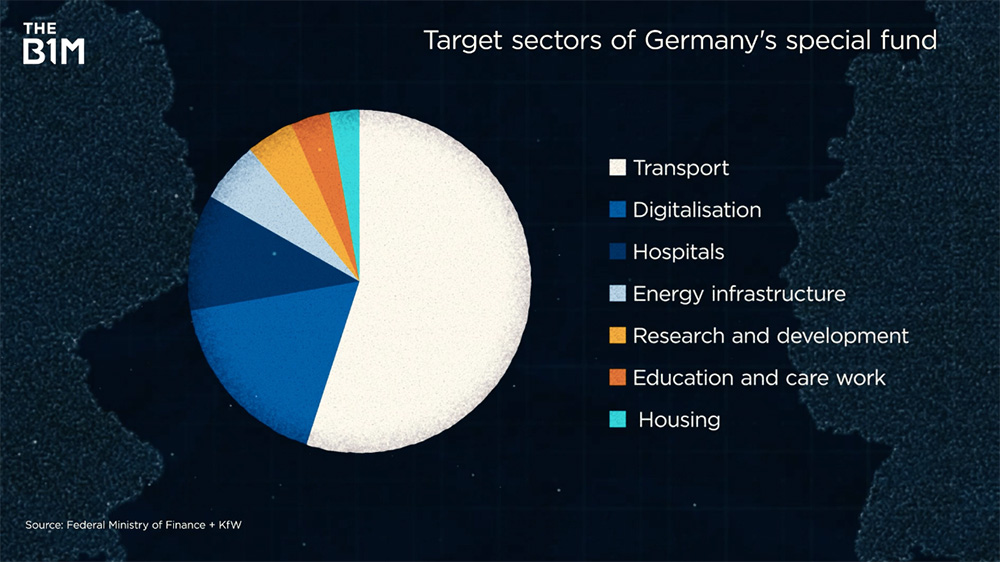
Above: More than half of the money is being invested in transport infrastructure.
Now, transport is obviously a pretty broad category, and it’s not yet clear exactly how that pot of money is going to be divided up.
But it appears likely that Deutsche Bahn — Germany’s national railway company — will get the lion’s share.
One economic research institute claims that almost €19BN has been set aside to support DB in just the first full year of the new fund — 2026.
That would surely be appreciated as the operator has stated it needs as much as €150BN to repair and modernise the network up until 2034.
Financial issues with German railways are nothing new. The system has been underfunded for decades, and services have become increasingly unreliable.
And now it’s got to the point where whole projects — important, international ones — are being put on hold.
"Frustrating our neighbours"
The northern access route of the Brenner Base Tunnel — the world’s longest underground rail connection when it completes — is in limbo over financial constraints.
While the tunnel itself connects Austria and Italy, one of the lines that will feed into it — from Munich — has been temporarily paused.
“We promised them to have a line ready, which will not be ready when Austria is ready. And we promised the same thing to the Swiss when they opened the Gotthard Base Tunnel. Right now we talk about completion somewhere in 2045 or so,” said Böttger.
“The Danish are building a new tunnel connecting the islands of Falster and Fehmarn, and there won't be a connection available on the German side when they are ready. If you really look around, we are really frustrating our neighbours. And so it's really a very disappointing situation.”

Above: The Brenner Base Tunnel. Image courtesy of BBT SE.
Perhaps things are a bit less bleak outside the transport sector? Well, potentially, yes. Several energy projects can expect to be handed a portion of that €100BN chunk, which will help Germany transition to a more climate-friendly power supply.
Investing more in hydrogen infrastructure and renewables is how it plans to do this, and it’s already made a head start on that with some truly amazing feats of engineering.
Take the SuedLink, for example — a massive underground high-voltage power link that will become the longest of its kind in the world when complete.
More than 500km long, it will transport electricity generated by wind farms in the north of Germany to the southern end of the country.
Which requires finding a way around some difficult obstacles. A 5km tunnel is being excavated so the cable can pass 20 metres under the Elbe River, and through areas with high levels of groundwater. Yes, the same river where the Dresden bridge collapsed.
Finding the funds
OK, but how is it that Germany is suddenly able to spend all this money? Why couldn’t it before? Well, it’s all to do with something called a debt brake.
It’s a constitutional rule in Germany which caps new borrowing from the federal government at 0.35% of GDP.

Above: A tunnel boring machine used to construct the SuedLink. Image courtesy of Herrenknecht AG.
This has prevented Germany from loaning large sums of money in the past to invest heavily in infrastructure.
But this new fund is an exception to the rule. It’s been organised outside of the debt brake, so there’s nothing blocking them from splashing out in a big way.
And the reason it can be done now is Germany’s debt-to-GDP ratio is a lot better than countries like France, Italy, the UK and the US.
Trick or treat?
However, some have raised concerns about how the new money will complement the usual funding. In other words, what would have been supplied by the local and national governments in a normal year.
The German Economic Institute found that Deutsche Bahn’s €19BN injection comes at the same time almost €14BN of rail investments have been cut from the federal budget.
So, it’s less of an increase overall than it first appears, and it’s a similar case with road bridges and digital upgrades.
“What you can see for rail, for example, is that they employed another trick in the budget that actually whatever money they had so far for railways and for infrastructure was taken out of the core budget and now financed from this new fund,” explained Böttger.
“So not additional, just shifting money. And that gives you more room in the core budget for all kinds of wonderful things that politicians want to give to their voters.”

Above: Deutsche Bahn is set to receive many billions from the new fund. Image courtesy of Deutsche Bahn AG.
There’s also the fact that money isn’t the only problem. As we mentioned earlier, projects here often get bogged down in bureaucracy and there’s a shortage of skilled workers.
If these issues aren’t eradicated, Germany’s ability to build new infrastructure, and repair what it’s already got, will get even harder.
“Maintenance is completely boring for politics, but it’s essential. If we don’t maintain our infrastructure we will end up in a mess, for sure,” said Professor Marx.
“If we allow a degradation of our existing infrastructure … we will really lose our basis for everything in society, business, but also for everything else.”
Pivoting to the positive
Now, despite everything we’ve just said, before the €500BN package was announced, things weren’t always that bad.
When big highway infrastructure upgrades are properly planned here, they can be very impressive.
After all, Germany does still have some of the world’s best engineers that can pull off a big job as well as anyone.
Like with the A45 Rinsdorf Viaduct near Dortmund, which was originally built in the 1960s.
By the 2020s it had developed structural issues that couldn’t be simply repaired. Which led to one of the most satisfying demolitions you’re ever likely to see.
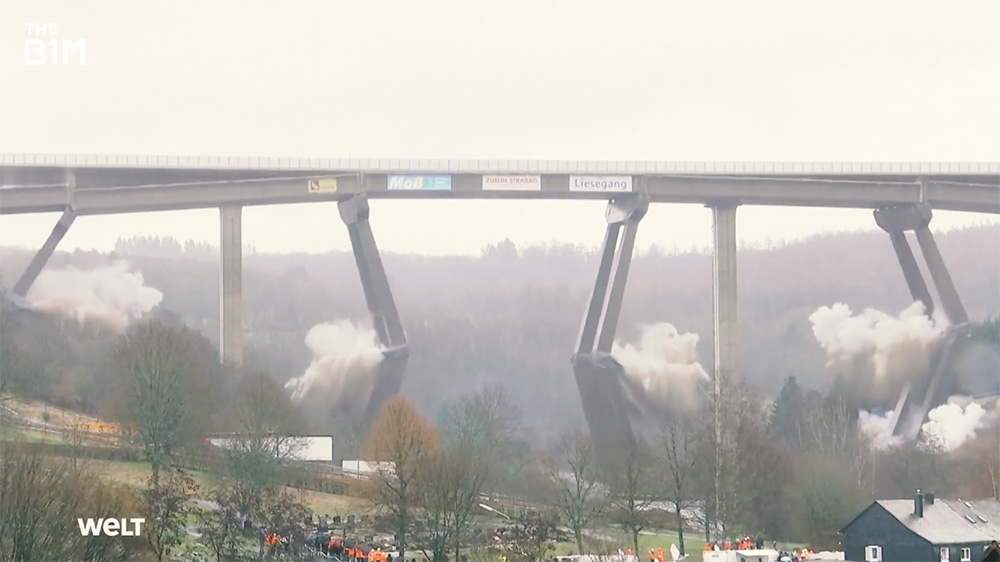
Above: The original Rinsdorf Viaduct was brought down with immense precision. Image courtesy of Die Welt.
Three years after the eastern section came down in 2022, it was time to slide its replacement into position.
Yes, we said slide. The new structure was built away from the live road and joined onto it through what’s called a transverse shift.
Teflon plates, acting as sliding pads, were installed between the specially prepared tracks and the base of the foundation.
Then, with the help of 24 hydraulic jacks engineers were able to move the bridge 20 metres and slot it in next to its neighbour, at a rate of one metre per hour.
It was an astonishing achievement, and showed that if the money is there Germany can build big infrastructure as well as anyone.
Rebuilding the Carolabrücke
But now, let’s go back to that bridge in Dresden for a moment. One question that’s been on many people’s lips since the incident is what happens next.
Well, you’ll be pleased to hear it is set to be replaced. And while it was initially feared a new bridge could take as long as ten years to build, the latest estimate is a bit more agreeable.
Four companies are now competing to design the successor to the Carolabrücke, with the winner set to be announced in mid-2026.
That means we don’t yet know what it will look like, but some details have been revealed. The City of Dresden wants it to be a contemporary structure that also blends seamlessly into the historic cityscape, with construction beginning in 2028 and finishing in 2031.
A mere seven years after the collapse, then — or twice as long as China took to build the highest bridge in the world. Still, at least they’ll get it done — eventually.
“We have to shift the shock and the impact to the city to an advantage to the city,” said Professor Marx. “We right now have the chance to rebuild the heart of the city in a very good way.”

Above: Plans are now in place for a new Carolabrücke. Image courtesy of Christian.sp1998/CC BY-SA 4.0.
There’s no denying that Germany’s once world-leading infrastructure is crumbling — in the past couple of years the evidence has been clear as day.
But now we know more about why this has been happening, and there’s finally a plan in place to fix it.
Hopefully, Germans will soon be able to say auf wiedersehen to all those jokes about their inability to build things, and keep them maintained.
But only if that money that’s been promised gets used in the right way. Otherwise, they could end up back at square ein.
To try everything Brilliant has to offer for free, visit https://brilliant.org/TheB1M/ You’ll also get 20% off an annual premium subscription.
Additional footage and images: Alexander Helbig, BBT SE, Bild, CBS Chicago, Christian.sp1998, Crispin-Iven Mokry, Der Standard, Deutsche Bahn AG, Die Autobahn GmbH des Bundes, DW News, Flughafen Berlin Brandenburg GmbH, Gunnar Baumann Medienproduktion/CC BY 4.0, HTW Berlin, Jörg Blobelt, Kanal13, Kasa Fue, Lucasfilm/Disney, Nordic Today, NDR, PORR Group, TUD, WELT and WQAD News 8.
We welcome you sharing our content to inspire others, but please be nice and play by our rules.
Comments