Why Japan Built a Storm Simulator
- Youtube Views 1,009,937 VIDEO VIEWS

01 March 2026
Video narrated and hosted by Fred Mills.
JAPAN IS NO stranger to extreme weather. Each year, powerful typhoons sweep across the archipelago, bringing torrential rain that can overwhelm rivers, trigger floods and send entire mountainsides crashing down. Roads are washed away, neighbourhoods submerged and communities forced to evacuate with little warning.
In a country shaped as much by water as by land, understanding how rain behaves, and how it causes destruction, has become a scientific priority.
Seventy-five kilometres north-east of Tokyo, in the city of Tsukuba, researchers have built a facility designed to do something remarkable: recreate some of the heaviest rainfall ever recorded on Earth.
Located at the headquarters of the National Research Institute for Earth Science and Disaster Prevention (NIED), the Large-Scale Rainfall Simulator allows scientists to generate artificial storms on demand, replicating conditions that would otherwise be too dangerous to study in real time.
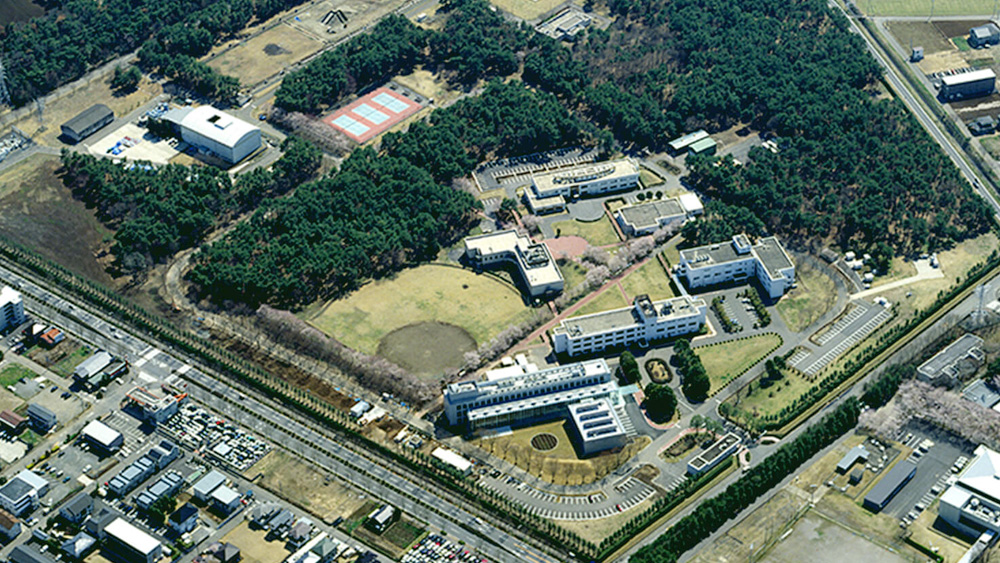
Above: The NIED complex at Tsukuba. Image: NIED.
Housed inside a vast hangar measuring approximately 75-metres long and 15-metres wide, the simulator resembles an aircraft maintenance facility more than a laboratory.
Suspended from the ceiling, 16-metres above the ground, is a dense grid of pipes and precision-engineered nozzles. When activated, they release thousands of droplets of water, carefully calibrated to mimic natural rainfall. By adjusting pressure, nozzle type and flow rate, researchers can reproduce everything from gentle drizzle to violent downpours approaching 300 millimetres per hour.
To put that into context, meteorological agencies typically classify rainfall of around eight to ten millimetres per hour as “very heavy”. The simulator’s upper limit is nearly 40 times greater. Such conditions are rarely observed even during severe storms, but when they do occur, they can have catastrophic consequences.
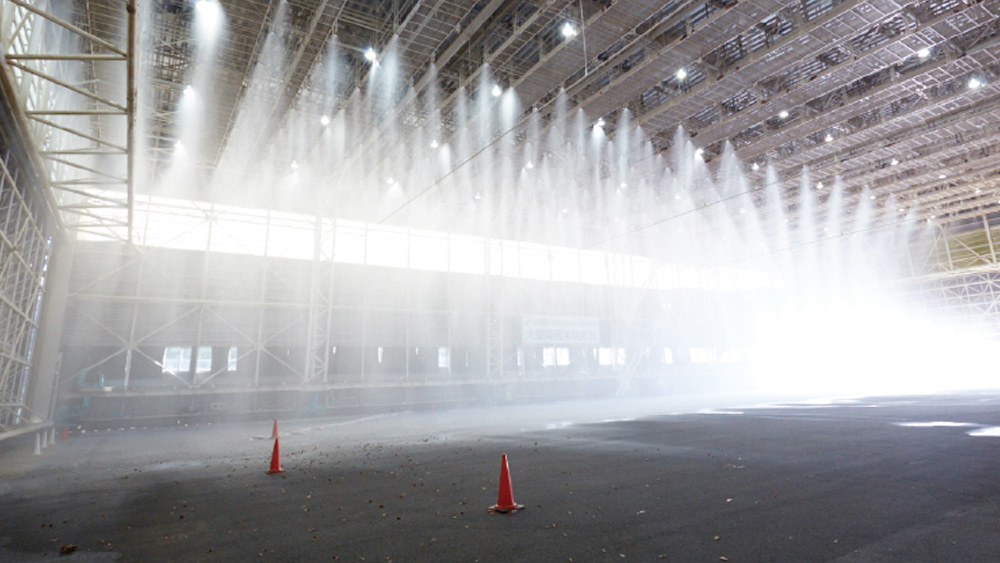
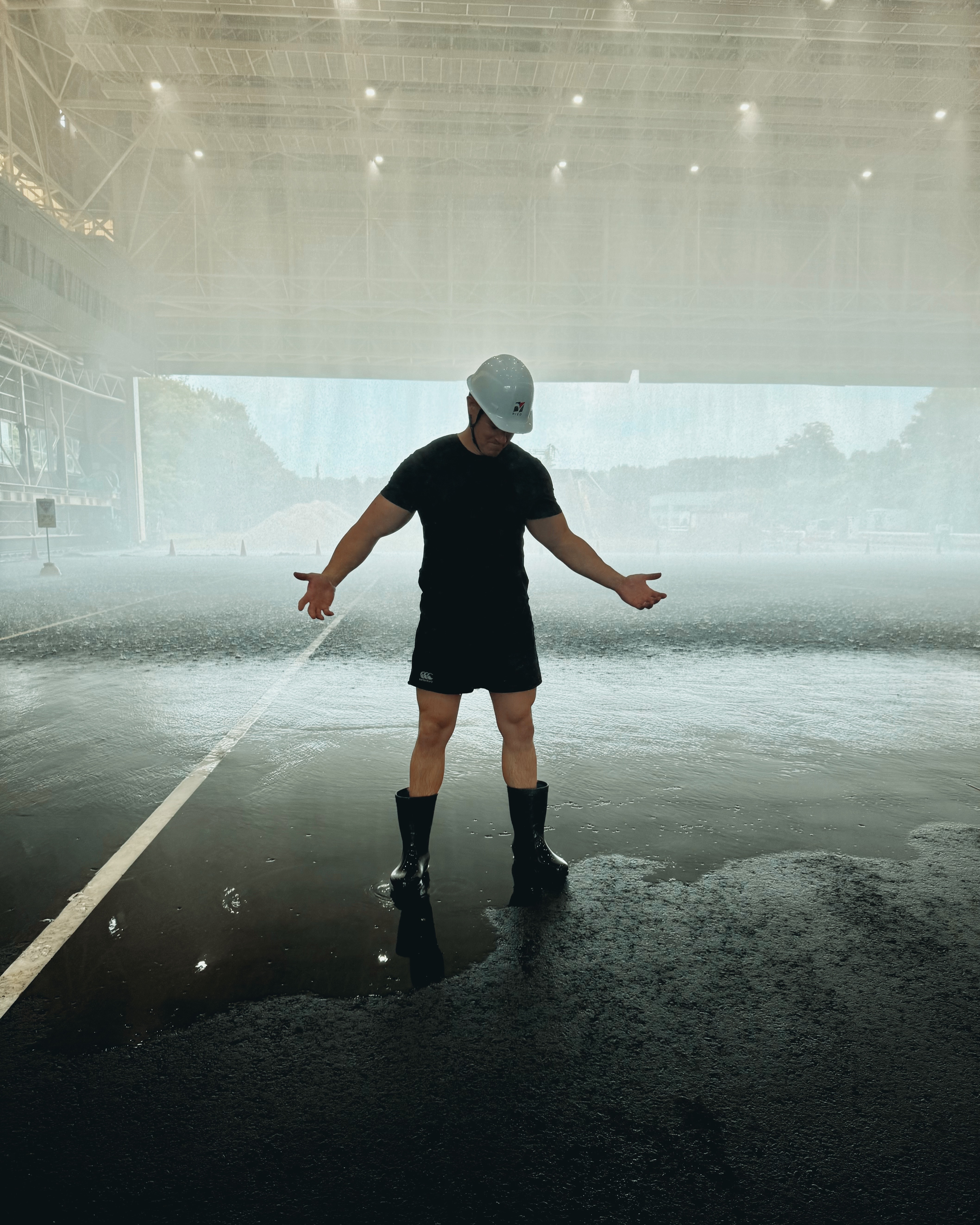
Above: Inside the large scale rainfall simulator. Image: NIED. Below: The B1M's Fred Mills gets (very) wet. Image: Fred Mills.
The facility was established in 1974, following a series of destructive typhoons that exposed gaps in Japan’s ability to predict and prepare for flood and landslide risks. Rather than relying solely on observation of real disasters, scientists wanted a controlled environment where rainfall could be studied systematically, safely and repeatedly.
At its core, the simulator is designed to answer deceptively simple questions. How much rain does it take to trigger a landslide? How quickly does soil lose stability? What building designs are most resistant to flooding? And how can engineers detect danger before it becomes irreversible?
The answers have far-reaching implications. Japan is particularly vulnerable to landslides because of its geography. More than 80% of the country is mountainous, with many towns and cities built along narrow valleys and coastal plains. During intense rainfall, water seeps into the soil, increasing its weight and reducing friction between particles. Eventually, gravity takes over, and entire slopes can collapse.
These events are both common and deadly. Landslides account for a significant proportion of fatalities associated with natural disasters in Japan, often occurring with little warning and devastating force. Even when evacuation systems are in place, predicting precisely when and where a slope will fail remains a major challenge.
The rainfall simulator provides a unique opportunity to observe this process in detail. Researchers have constructed full-scale model slopes within the facility, some stretching more than 20 metres in length, with carefully layered soil to replicate real geological conditions. Transparent panels along the sides allow scientists to observe how water infiltrates different layers over time, revealing the hidden processes that lead to collapse.
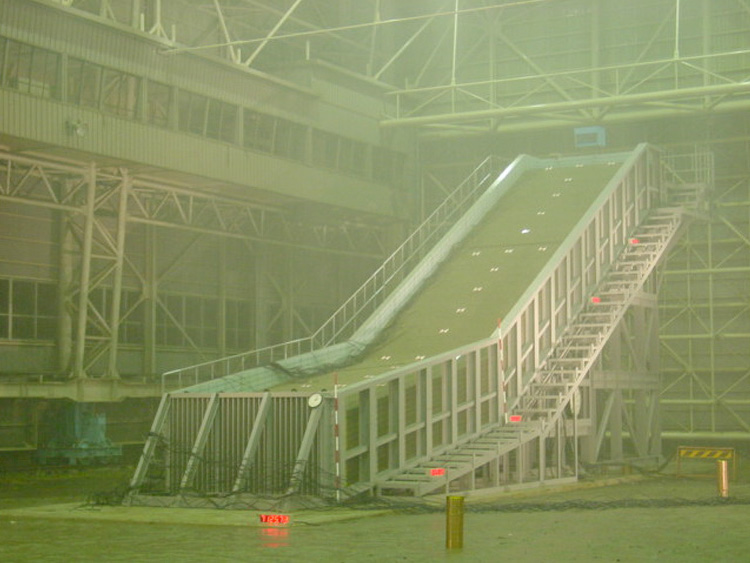
Above: the simulator in preparation for a test. Image: NIED.
By subjecting these artificial hillsides to controlled rainfall, researchers can monitor exactly how long it takes for instability to develop, how cracks form and how failure begins. This information is used to design and refine sensors capable of detecting early warning signs in real landscapes.
Such sensors could eventually be deployed on vulnerable slopes across Japan, providing real-time data on soil moisture, pressure and structural stability. In the future, they may allow authorities to issue evacuation warnings earlier and more accurately, potentially saving lives.
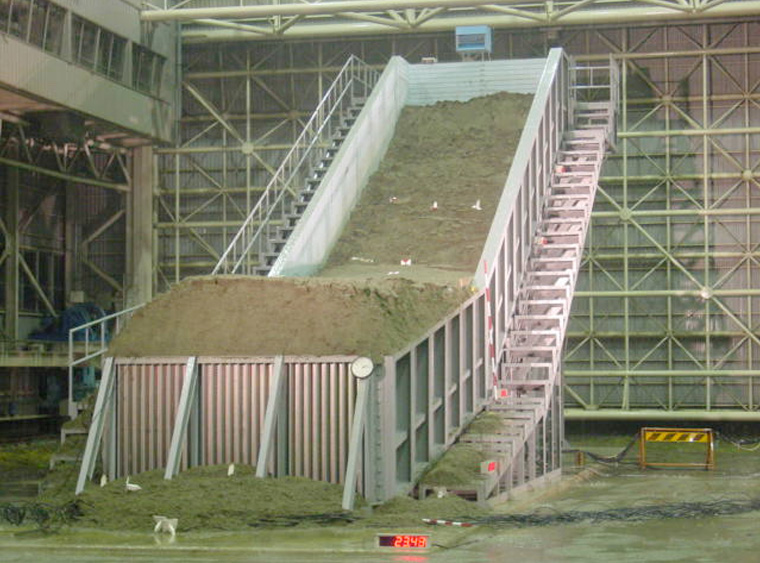
Above: The simulator after a test. Image: NIED.
But landslides are only part of the picture. Flooding presents an equally serious threat, particularly in urban areas where dense development limits natural drainage. Traditional housing is especially vulnerable, as water can enter through doors, windows, ventilation systems and utility connections.
To address this, engineers have used the rainfall simulator to test experimental flood-resistant housing designs. In one project, a prototype home was fitted with a series of protective features intended to prevent water ingress. Windows were sealed using specialised gaskets similar to those found in car doors. Ventilation openings were equipped with float valves that automatically close when water levels rise. Drainage and utility pipes were fitted with backflow prevention systems, allowing water to exit but not enter.
Under simulated storm conditions, these measures significantly improved the building’s ability to withstand flooding. Such innovations could play an important role in protecting homes in flood-prone areas, reducing damage and speeding recovery after disasters.
What makes the simulator particularly valuable is not just its size, but its precision. Rainfall is more complex than it might appear. It varies not only in intensity, but also in droplet size, velocity and distribution. These factors influence how water interacts with surfaces, how quickly it infiltrates soil and how much damage it causes.
The facility’s 2,000-plus nozzles can produce droplets ranging from just 0.1 millimetres to as much as 8 millimetres in diameter. Smaller droplets fall slowly and gently, like mist or drizzle, while larger droplets strike the ground with greater force, accelerating erosion and runoff. By controlling these variables, researchers can replicate different types of storms with a high degree of realism.
The height of the nozzle array also plays an important role. Suspended 16 metres above the ground, it allows droplets to reach their natural terminal velocity before impact. This ensures that the simulated rainfall behaves as closely as possible to real precipitation.
The simulator’s flexibility extends beyond rainfall itself. The entire structure is mounted on rails and can be moved slowly between different test zones across the research site. This allows scientists to conduct experiments on buildings, slopes, vehicles and infrastructure without dismantling and rebuilding the system.
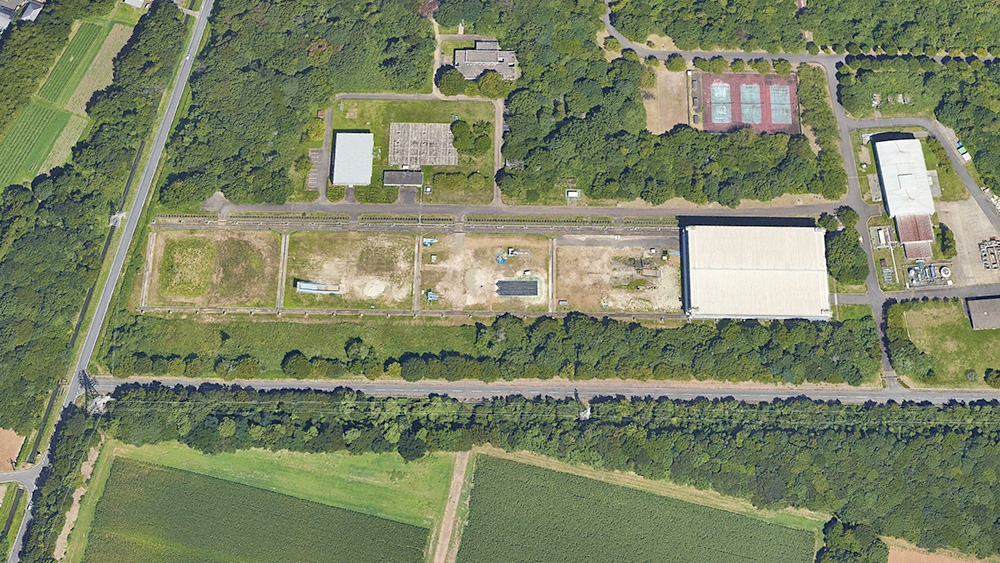
Above: An aerial photo showing the layout of the large scale rainfall simulator. Image: Google.
The scale of the facility reflects the scale of the problem it is trying to solve. Japan’s relationship with natural disasters is shaped by its position along the Pacific Ring of Fire, where tectonic forces have created a landscape of mountains, volcanoes and steep terrain. Earthquakes, typhoons and heavy rainfall are recurring features of life.
This has influenced not only engineering and urban planning, but also housing itself. Unlike in many countries where homes are expected to last for generations, Japanese houses are often designed with shorter lifespans in mind. Many are replaced after around 30 years, reflecting both evolving building standards and the realities of a hazardous environment.
Rather than viewing buildings as permanent fixtures, Japan has embraced a more adaptive approach by rebuilding, upgrading and improving resilience over time. Facilities like the rainfall simulator represent a continuation of that philosophy, using science to anticipate and reduce future risks.
The research conducted at Tsukuba also contributes to global understanding of extreme weather. As climate change intensifies rainfall in many parts of the world, the challenges Japan faces are becoming more widespread. Cities across Asia, Europe and North America are experiencing more frequent and severe flooding, raising urgent questions about infrastructure resilience.
By studying rainfall in a controlled environment, scientists can develop better predictive models, improve construction standards and design more resilient communities. The findings from Tsukuba may ultimately influence building codes, disaster planning and engineering practices far beyond Japan.
For researchers working at the facility, the goal is clear: to better understand one of nature’s most destructive forces, and to reduce its impact on human life. While it may not be possible to stop storms from forming, it may be possible to limit the damage they cause.
In Tsukuba, the push of a button can unleash a storm powerful enough to overwhelm buildings and destabilise mountains. But within this controlled environment, those storms are not agents of destruction. They are tools helping scientists uncover the mechanisms behind disasters, and bringing the world closer to a future where fewer lives are lost when the real rain begins to fall.
Additional footage and images: NIED, Daiwa House.
We welcome you sharing our content to inspire others, but please be nice and play by our rules.
Comments