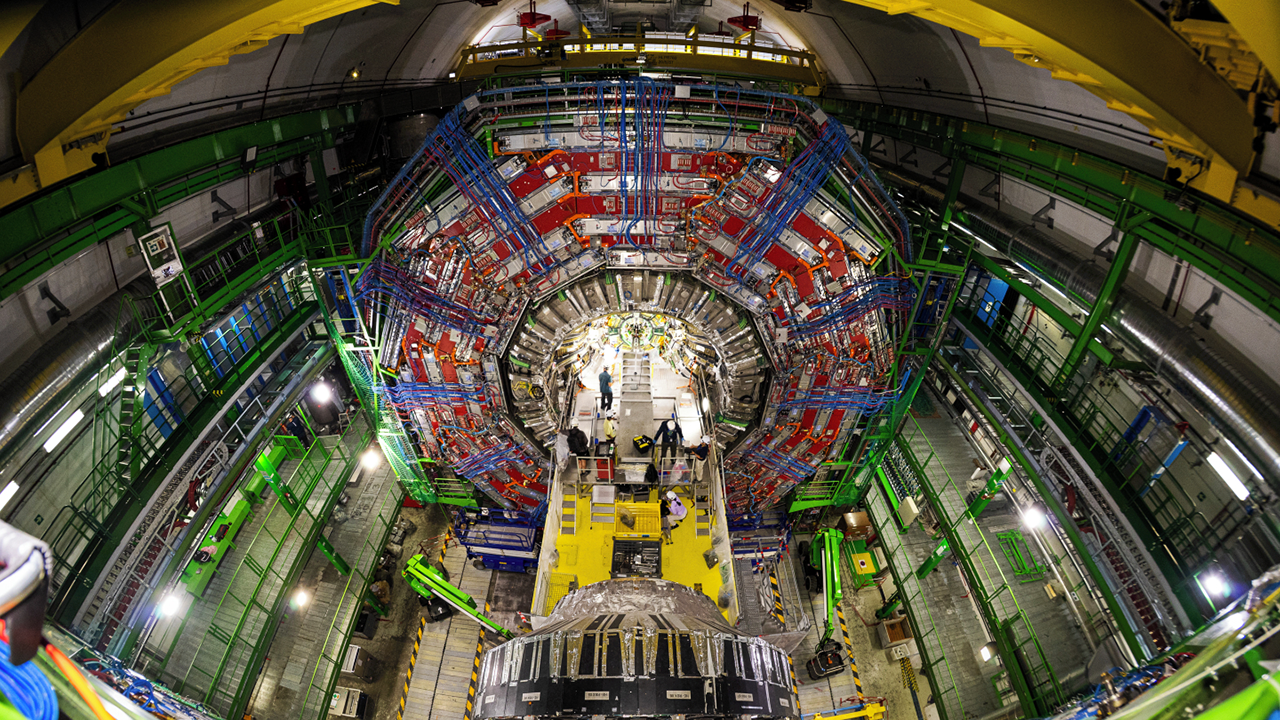



Inside CERN's Huge Upgrade
- Youtube Views 328,473 VIDEO VIEWS

25 November 2026
Video narrated and hosted by Fred Mills. This video contains paid promotion for Schindler.
TODAY, almost 20 years after it began its first experiments, the Large Hadron Collider remains the pinnacle of what human ingenuity is capable of, having delivered one of its greatest achievements of the 21st century so far.
Since 2008, the LHC has been used to recreate the early universe, make a Nobel Prize-winning discovery and answer some of the biggest fundamental questions in science.
But astonishingly, it’s about to get even more powerful as it’s now being prepared for a multi-billion-dollar upgrade.
Lots to offer
Most people come to Geneva for the beautiful lake and its fountain, maybe to pick up a luxury watch, visit a museum or treat themselves to some chocolate.
But perhaps its greatest attraction is the headquarters of one of the world's most important scientific organisations.
CERN is the European Laboratory for Particle Physics and is the largest facility of its kind in the world.
Founded in 1954 when it had 12 member states, there are now 25 involved in the collaboration.
If you're wondering what is meant by particle physics, it's the study of the protons, neutrons and electrons that come together to form atoms.
However, to do experiments on these tiny particles that can't even be seen, you've got to build something very, very big. A particle accelerator.
It's a kind of machine that uses powerful electromagnets to shoot those particles through a high vacuum tube extremely quickly, close to the speed of light.
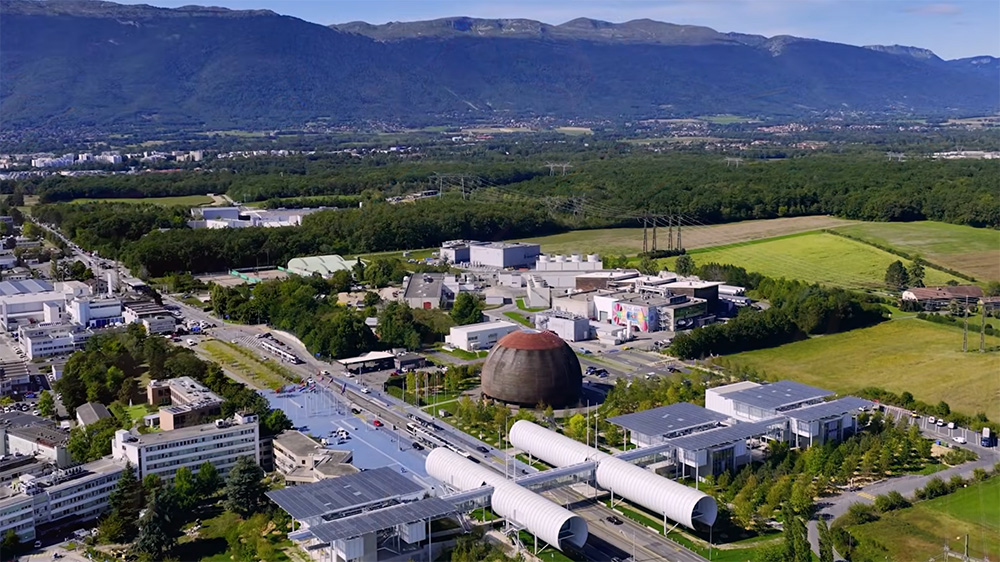
Above: The main CERN campus in Meyrin — just outside Geneva, Switzerland. Image: CERN.
They can be either linear or circular in shape, and in some cases the particles are sent towards a target, whereas other times they're fired towards each other, hence why they're often referred to as atom smashers.
There are several of these systems all around the world, but the Large Hadron Collider is the biggest and most powerful of them all.
It involved constructing one of these systems inside a 27 kilometre ring-shaped tunnel buried 100 metres underground and positioning eight different sites around it.
Only one of them is in Switzerland, the rest are in France. That's right, this place is so big it is actually located in two separate countries.
The dipole magnets that form the LHC are huge. They're 15 metres long and there are more than a thousand of them.
To become superconductive, they've got to be kept lower than minus 270 degrees Celsius, which is colder than outer space.
That's done using the world's biggest cryogenic system, which needs 120 tonnes of helium to operate.
Going round in circles
The magnets join together to bend the beams of particles, usually protons, in a big circle from opposite directions.
Next, they're forced together at several points along the ring, where the outcomes of their collisions are captured and analysed.
Point 1 is the site closest to the main CERN campus, and it's where ATLAS, one of the main experimental caverns, can be found.
What made it necessary to build a cavern for this part of the project kind of becomes clear when you see what's been put inside of it.
“The ATLAs experiment at CERN is one of the big detectors for the LHC. There are four points where protons are steered against each other,” said Martin Aleksa, the technical coordinator for this part of the machine.
“ATLAS is one of these interaction points and this is basically situated 80 metres below our feet. We have protons arriving from both sides and then in the very heart of the detector they will collide.”
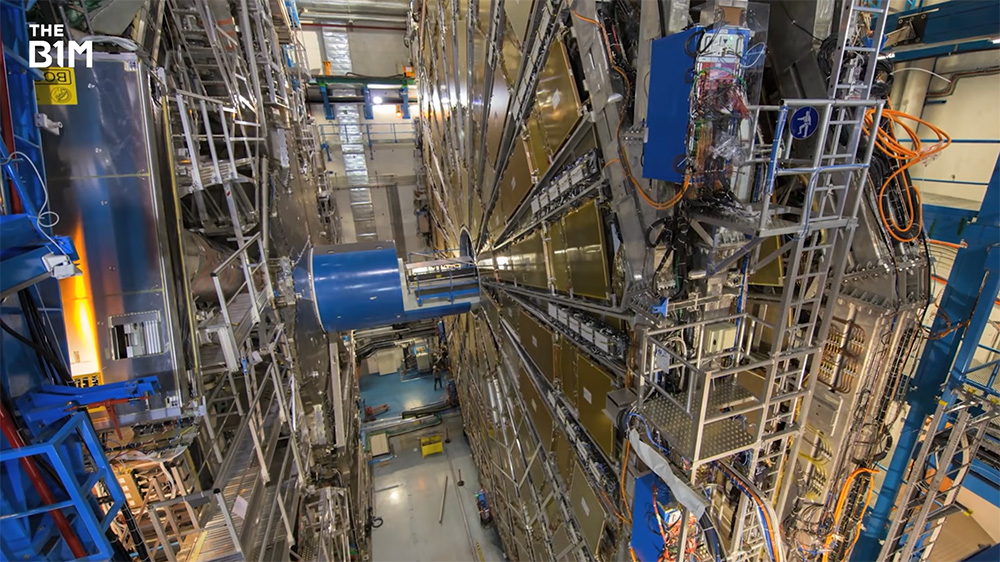
Above: Inside the enormous ATLAS detector cavern. Image: CERN.
ATLAS is 47 metres long with a 25-metre diameter, weighing 7,000 tonnes. The cavern it sits inside could hold half of Notre Dame Cathedral.
2010 is when the LHC began properly operating it was 2012 that saw the biggest breakthrough to emerge from CERN since the World Wide Web was invented here in 1989.
The discovery of a completely new particle. That might not sound as important as the foundations of the internet, but it was the answer to one of the biggest questions in science and led to a Nobel Prize the following year.
The discovery of the Higgs boson, or God particle, proved there is an invisible energy field all over the universe that gives mass to fundamental particles.
Scientists have been using it to understand more about what happened during and after the Big Bang.
The next frontier
Fast forward to 2026 and scientists have kind of got all they can out of the LHC in its current form.
It's now going to enter a new chapter that's going to enable CERN to discover even more secrets about the fundamental laws of nature.
To do that, they've had to turn the whole thing off — a machine that collided protons about 50 million billion times since it started fully operating.
And they're not going to be able to bring it back online again for another four years. It's called Long Shutdown 3 for a reason.
The first shutdown, which ran from 2013 to 2015, was a combination of repair work and reinforcements which allowed LHC to carry out higher energy collisions.
Then Shutdown 2, which took place between 2018 and 2022, involved upgrading the machine's injectors and detectors to boost their luminosity, which in simpler terms means their collision rate.
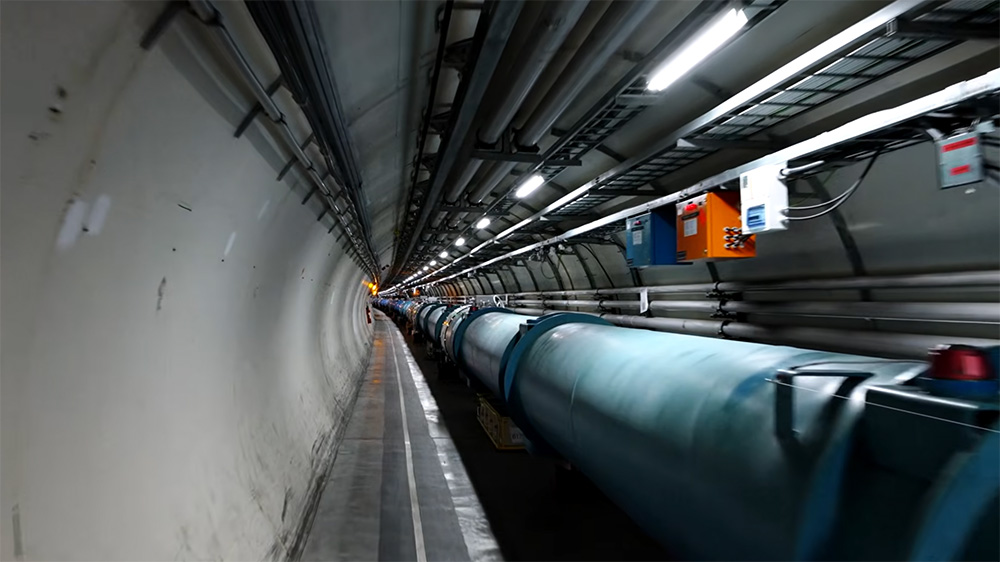
Above: The Large Hadron Collider is now once again in shutdown mode. Image: CERN.
As for why it's been powered down this time, well it's again all to do with that collision rate, but we're not just talking about a minor improvement here.
When this thing comes back online, it's going to be running with 10 times more luminosity than it has today.
That's an overhaul that's going see it perform like an entirely new system, which is why the name is being updated too.
It's going be called the HiLumi LHC, or to use a real tongue twister of an acronym: the HL-LHC.
“The high-luminosity LHC is a major upgrade, it's the next step for the accelerator, which is going to be developed physically from the hardware point of view in the next three years before we start then testing the systems and eventually in four years from now get the beams back,” explained Matteo Solfaroli, CERN’s operations group deputy leader.
“From the operations side, what we are doing is that we are preparing the tools and the procedure and all the scenarios for the commissioning and for the operation of the new accelerator.”
Powering up
Some of the largest and most complex parts of the system are getting an upgrade too, including the giant detectors at Points One and Five — ATLAS being one of them.
Those things have to be updated because they're simply not going to be able to handle the amount of collisions that are going to come at them.
And we mean a lot more. When its overhaul is complete, the new LHC is going to monitor around 5BN collisions every second.
These systems are being assembled in a separate underground facility that's been built specifically for this upgrade.
It consists of a new service cavern, a 300-metre-long equipment gallery and four tunnels that connect to the LHC.
Finally, to provide access to all this, an 80-metres-deep shaft was put in. It's a similar situation over on the other side of the ring at Point Five.
Overall, the HL-LHC is expected to cost around $2BN, with 90% of that coming from CERN's regular annual budgets, which is paid for by the member states.
The rest is in-kind contributions, where non-members supply it with high-tech components.
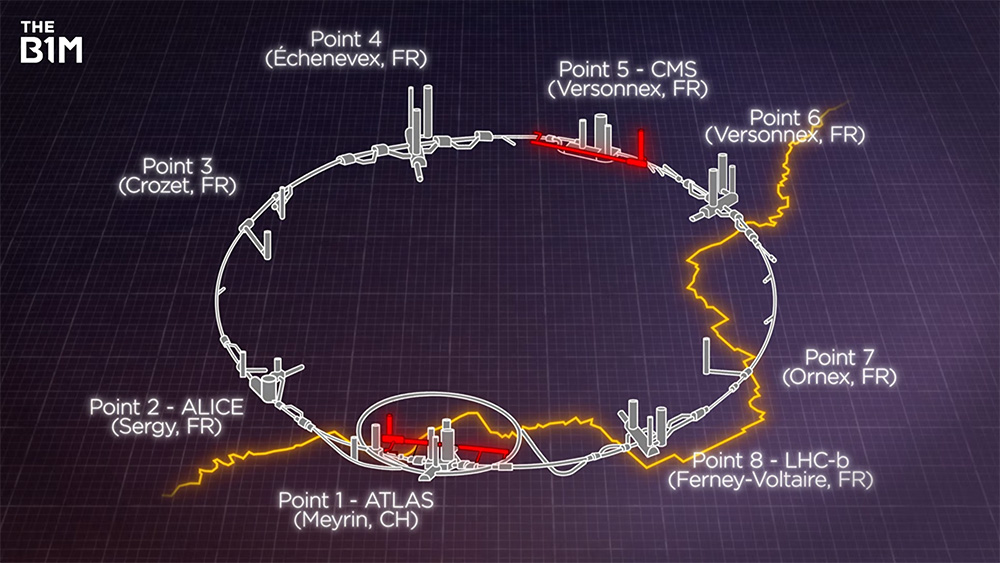
Above: A graphic showing the new installations at Points One and Five (in red).
With the machine now out of action, it doesn't mean the people who aren't working on the upgrade directly are going to have nothing to do.
There's actually a huge backlog of work that should keep them occupied until the machine is turned on again.
Thousands of researchers are spending the time analysing the vast quantities of data that came out of the LHC when it was last on, and the hope is that they're going to continue to make new discoveries.
And despite what many may think, there has been a lot more to come out of this project than just the Higgs boson.
Since 2012, more than 80 new subatomic particles have been unearthed here.
Technologies from the LHC have been used to enhance cancer therapy and even analyse historic artworks.
Supersizing
Now you might think, given everything that's been achieved here already, that this latest upgrade is going to be the end of the road — the peak of what they can achieve.
Well, no, that isn't the case. They’re now planning something even grander — a machine that's going to make the Large Hadron Collider look not very large at all.
In fact, the FCC, which stands for the Future Circular Collider, is going to completely dwarf it.
With a circumference of almost 100 kilometres, it'll require a tunnel much bigger than the existing one — this time passing under Lake Geneva and going even further into France.
But it would be a huge undertaking. Some parts of the FCC will have to go four times deeper than the LHC.
That's going to require the longest elevator shafts in Switzerland, cutting edge lift technology and working around some difficult geology.
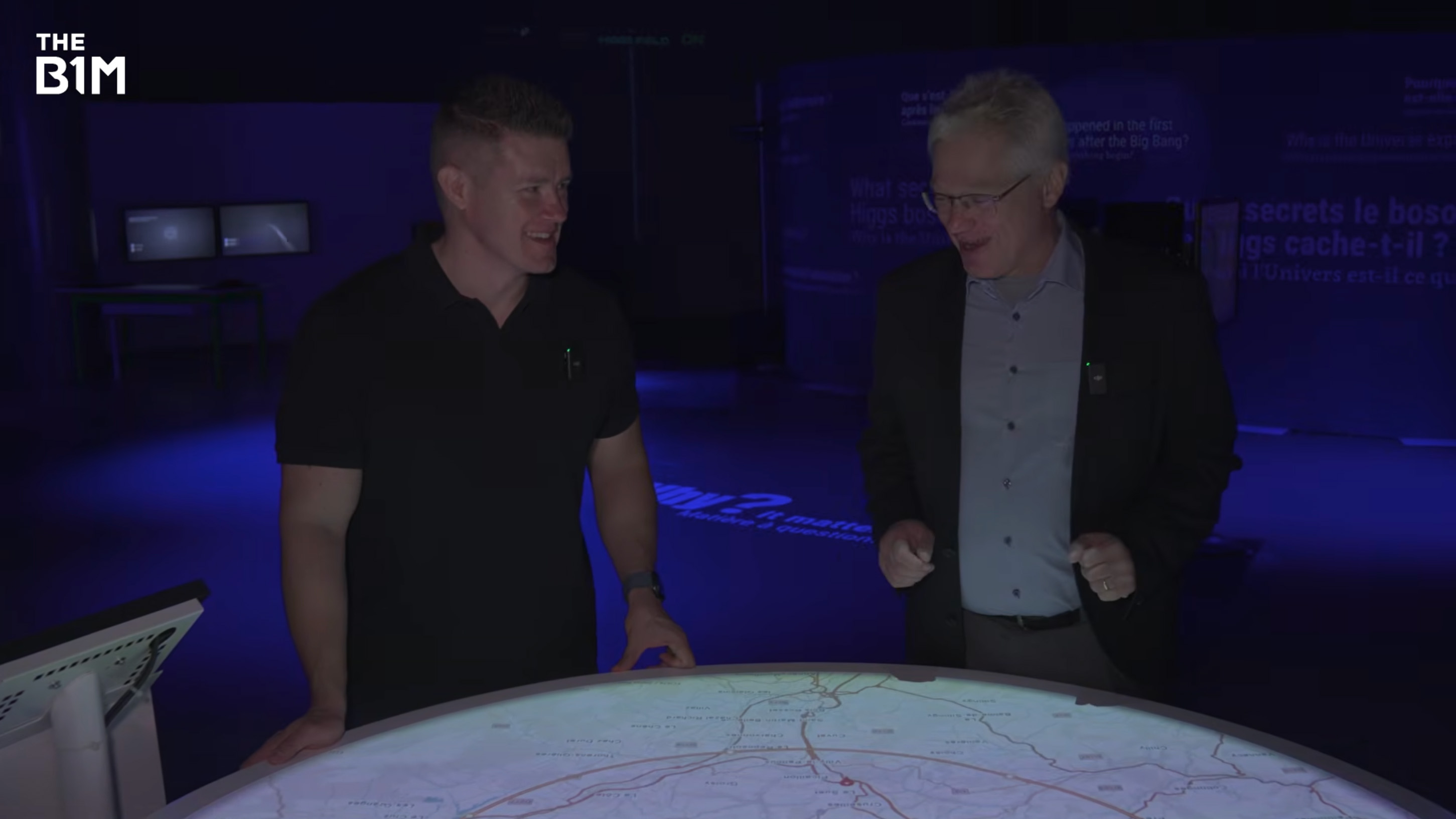
Above: The B1M's Fred Mills (left) and Frank Zimmermann from CERN discuss the Future Circular Collider.
"The average depth is more than 200 metres, the deepest location is 400 metres. We need to go under the lake, and on one side there is the Jura mountain; on the other side there are the Alps,” said Frank Zimmermann, deputy leader of the FCC Study at CERN.
“The tunnel should be mostly in the molasse geological layer, which is very soft rock — ideal for the tunnel boring machines.”
The hope is that, subject to approvals, construction could begin in the early 2030s.
Completion of the first phase, an electron-positron collider, is scheduled for 2045.
But the full version, that would smash protons together like in the LHC, won't start until 2075.
“People are working on other technologies for acceleration, but the progress is not that fast. If you want to build something in our lifetime, I think — or in our children's lifetime — probably the FCC is the best bet,” added Zimmermann.
Learn more about Schindler here.
Additional footage and images: CERN, Al Jazeera, BBC, CBS News, PBS and The Telegraph.
We welcome you sharing our content to inspire others, but please be nice and play by our rules.
Comments