


America is Building a New Particle Accelerator
- Youtube Views 555,550 VIDEO VIEWS

12 August 2026
Video hosted by Fred Mills. This video contains paid promotion for Trolex.
IT'S not often that a science megaproject creates an international media storm.
But that’s just what happened in 2008, when the completion of the Large Hadron Collider saw news trucks from all over the world descend on Geneva for the official switch-on.
Everyone was fascinated by this idea of smashing subatomic particles together in a massive underground ring to simulate what happened at the dawn of our universe.
Who didn’t find that interesting at the time? Especially because of some of the more colourful theories that were going around.
Laying the foundations
None of this should have been a concern, though. Because scientists in America had already been conducting similar experiments for years before that — just on a somewhat smaller scale.
And as far as we’re aware, nobody got vaporised, imploded, or teleported to another dimension.
Anyway, it’s called the Relativistic Heavy Ion Collider, or RHIC, which began operation in 2000 at the Brookhaven National Laboratory (BNL).
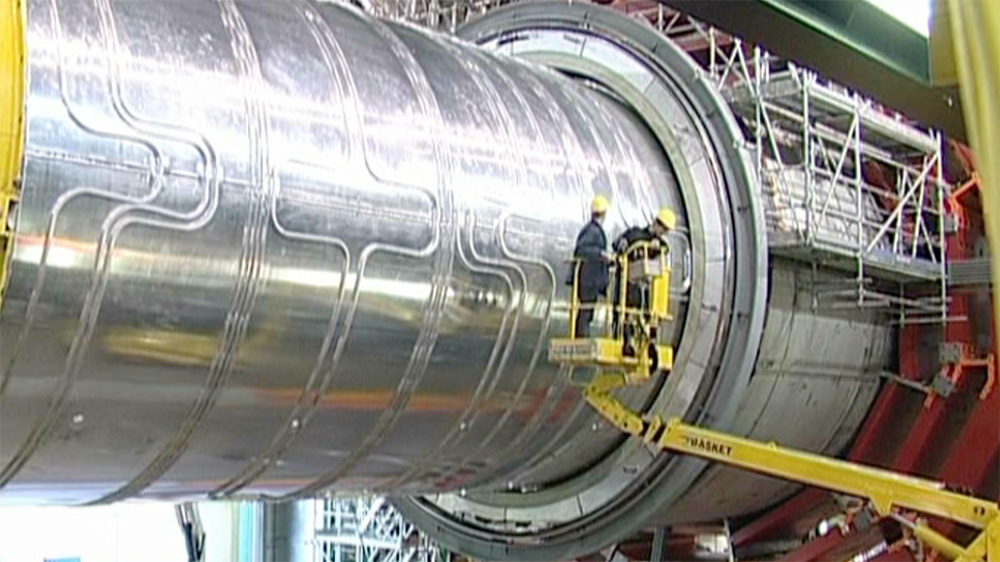
Above: The Large Hadron Collider began operating in 2008. Image: CERN.
It’s one of 17 federally funded research institutions that operate under the US Department of Energy, spread across the country.
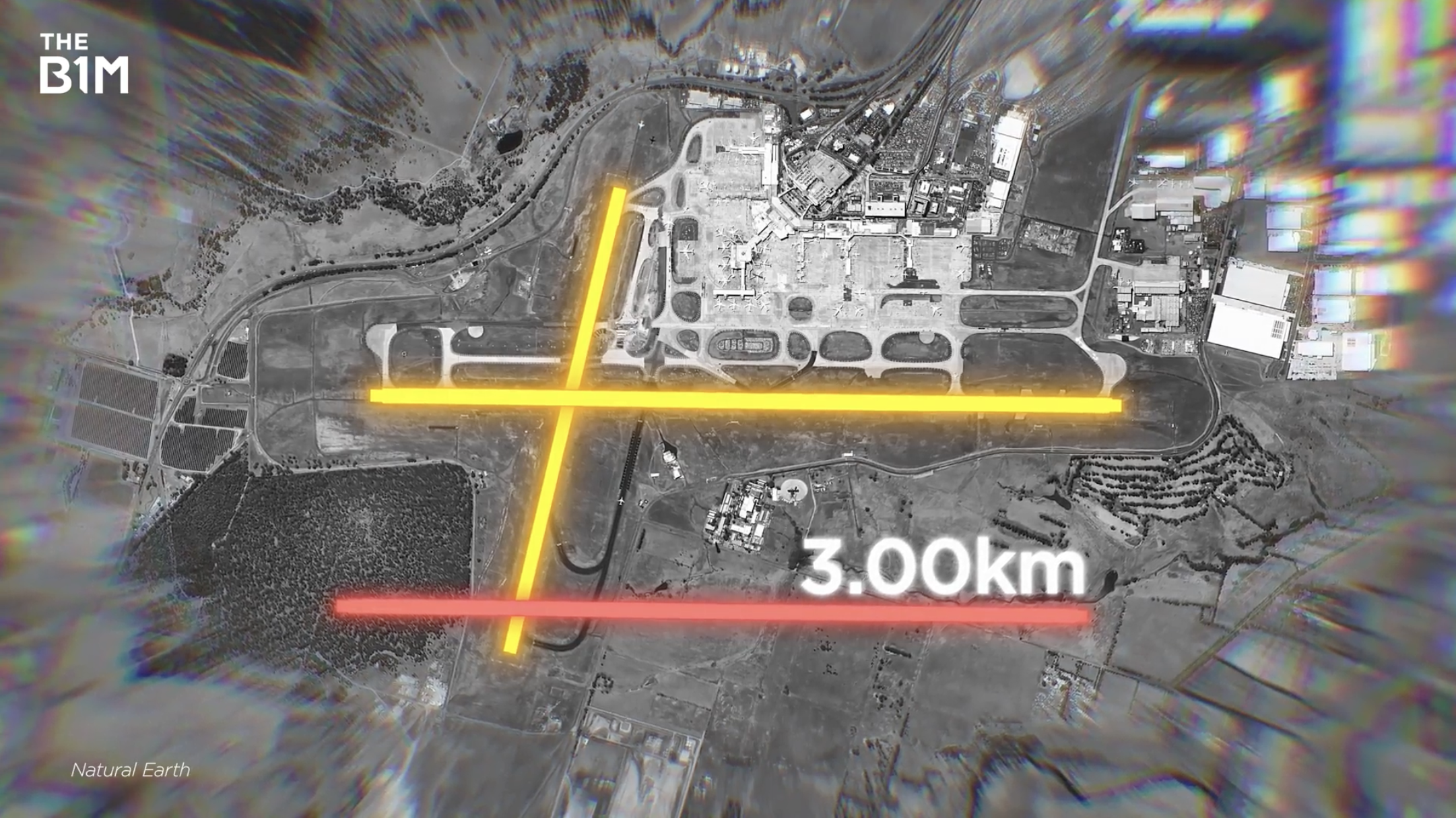
Again, it involved colliding particles together in a huge ring-shaped tunnel — you can clearly see it when looking down from above — at almost light speed.
Like the Large Hadron Collider, its purpose was to effectively recreate the conditions that occurred right after the Big Bang almost 14 billion years ago.
Collision course
It did this by firing two beams of ions, in opposite directions around the 3.8km ring and smashing them together, using over 1,000 superconducting magnets.
These ions would typically be uranium nuclei, or something similar — even gold — and the machine would have them collide together in one of two spots.
We’re referring to the gigantic detectors — named STAR and sPHENIX — where all the data is collected.
When the ions hit each other, they reached temperatures around 250,000 times higher than the core of the sun. That’s about four trillion degrees Celsius.
This caused them to effectively ‘melt’, releasing the tiny building blocks that form protons and neutrons, as well as the glue-like substance which binds them. They’re known as quarks and gluons.
“What the Relativistic Heavy-Ion Collider was trying to understand was what was the state of matter just before the quarks and gluons started forming those protons and neutrons? So, what was this state of the universe when these quarks and gluons were free to roam around in the available space of the universe?” says Abhay Deshpande, associate laboratory director for nuclear and particle physics at Brookhaven National Laboratory.
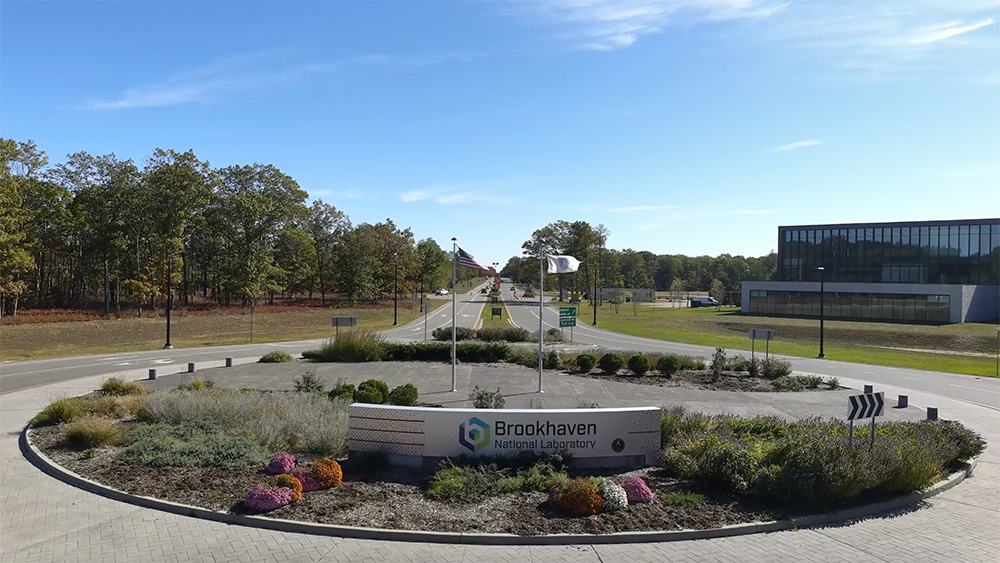
Above: BNL is based in Upton on Long Island, New York. Image: Brookhaven National Laboratory.
Now, the reason they often used gold, which might sound unnecessarily expensive at first, is because it’s one of the heaviest common elements.
That means it’s packed with protons and neutrons, which increases the likelihood of a successful collision — one that would create what’s known as a quark-gluon plasma.
It’s another name for the type of matter that existed at that time period Abhay was referring to. Somewhere between one millionth and one trillionth of a second after the Big Bang.
“That form of matter … where quarks and gluons are free to move around, was something that we had never seen before RHIC came along,” Deshpande says. “So, the questions for RHIC were about what is that form of matter? How does it behave? What are its properties? So that's what RHIC was doing.”
Once the universe expanded and cooled, this plasma transformed to become the ordinary visible matter that makes up pretty much everything we know today.
Microscopic details
If your brain hasn’t melted like one of those ions by now, then all this talk of protons and neutrons might sound familiar.
Because B1M regulars will recall when we took a trip to Sweden and went inside a neutron research facility under construction there — the European Spallation Source.
Imagining something as tiny as a neutron was difficult enough; now, we’re talking about the bits and pieces that exist inside those.
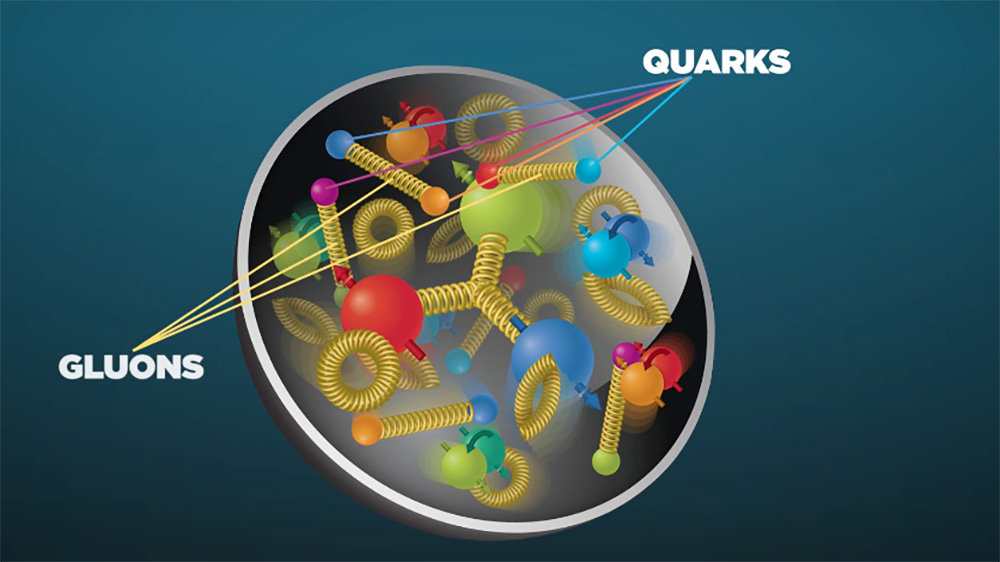
Above: Quarks are what matter is made from, and gluons are what hold them together. Image: Brookhaven National Laboratory.
RHIC was the first to prove how this plasma that appeared after the Big Bang behaved more like a liquid than a gas, which is what many scientists thought at the time.
Then, when the much bigger Large Hadron Collider came along a few years later, it was able to build on these findings by carrying out higher-energy experiments.
So, while CERN may have become one of the world’s best-known scientific organisations thanks to LHC, it was Brookhaven where many of the early breakthroughs were made.
But it didn’t all begin with RHIC. Just south of that giant ring is a smaller one, where the world’s leading particle accelerator at the time was launched in 1960.
The starting point
Called the Alternating Gradient Synchrotron (AGS), it was capable of shooting out protons at much higher energies than what was previously possible.
In fact, AGS was so successful, three Nobel Prizes were awarded off the back of it, and it’s still in use today.
Those ions that were sent into the RHIC machine came from the Synchrotron, and it also provides particle beams to NASA’s Space Radiation Laboratory on the same site.
As for RHIC itself, well, construction for what became that took place in the 1970s. But it was meant to be for a completely different project that never actually completed.
That would be ISABELLE, and a decent amount of progress had been made, including excavating the tunnel, before it hit trouble.
Problems with the superconducting magnets proved to be too great, and the whole scheme was cancelled just five years after it started.
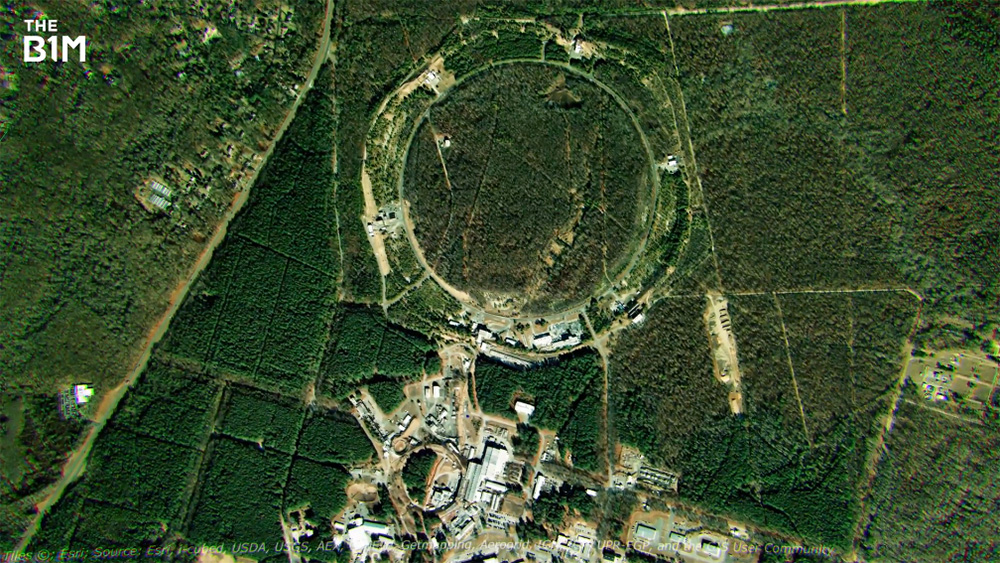
Above: The tunnels for the Relativistic Heavy Ion Collider (large ring) and Alternating Gradient Synchrotron (small ring) are both clearly visible from the air.
A year later, it was suggested that the tunnel, and the parts already made that were usable, could be used in another accelerator.
And that would turn out to be RHIC, which began its first experiments almost two decades after ISABELLE was scrapped.
For more than 25 years, particles were being whacked together without most New Yorkers even realising it was there.
Until early 2026, when scientists decided they had done all they could do with RHIC, and it was switched off — permanently.
The next chapter
Basically, it had fulfilled its mission. That plasma they were hoping to make with it — this incredible machine didn’t just achieve that; researchers spent years studying it in depth.
And yet, there were still questions that hadn’t been addressed, which only a new collider could answer.
The main one being how are the quarks and gluons — those ingredients that are found inside protons and neutrons — actually structured, and what binds them together. That’s what RHIC’s replacement, the Electron-Ion Collider, will set out to achieve.
Unsurprisingly, when you look at what it’s called, it’ll collide electrons with ions — the only accelerator in the world capable of doing so.
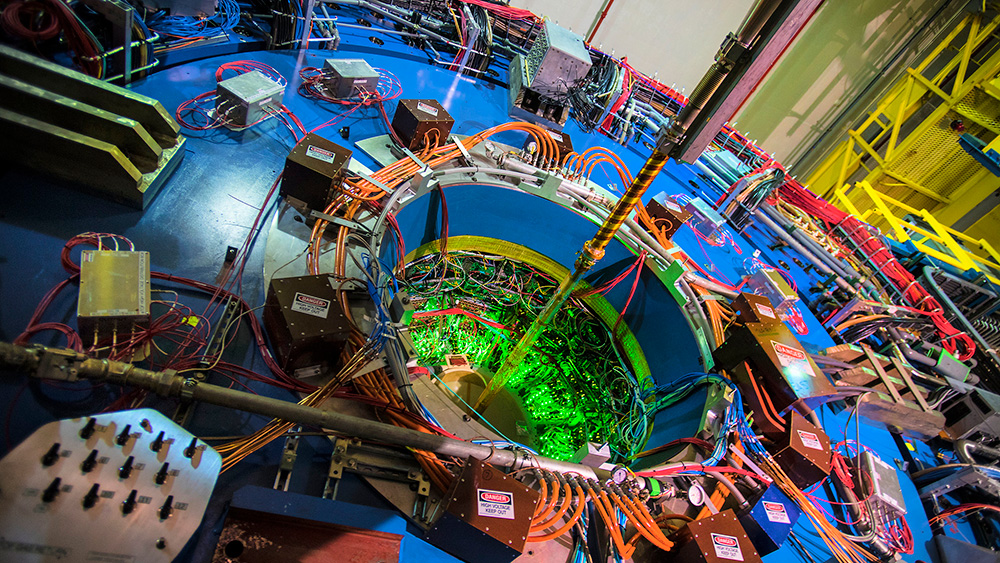
Above: RHIC's STAR detector. Image: Brookhaven National Laboratory.
Quarks and other particles are scattered off of the target nucleus, which are then picked up by a new detector. It’s where the results of those collisions will be, yep, detected.
This allows teams to study the forces generated and uncover some of those secrets about quarks and gluons that continue to elude us.
Including one that follows on from the LHC’s most famous discovery — the Higgs Boson. That’s the particle that gives all other fundamental particles — like quarks — their mass.
But when they come together to form a proton, these quarks only account for a small percentage of the proton’s overall mass. As for the rest...
“That is where the Electron-Ion Collider comes into the picture. LHC determined and explained 2% or 5% of the mass of the universe,” Deshpande explains. “That gluon interaction is critical and unless we understand that we won't understand the remaining 95% of mass.”
Circular economy
A tricky task, then, which is why it goes without saying that building particle accelerators is not an easy thing to do.
But, much like its predecessor, EIC already has a head start. Brookhaven plans to use much of the existing infrastructure, including RHIC’s giant tunnel. Although they will need to make some big changes on the inside.
Because it will still be using ions, one of the two rings is staying where it is, while the second is being replaced with a ring that fires electrons.
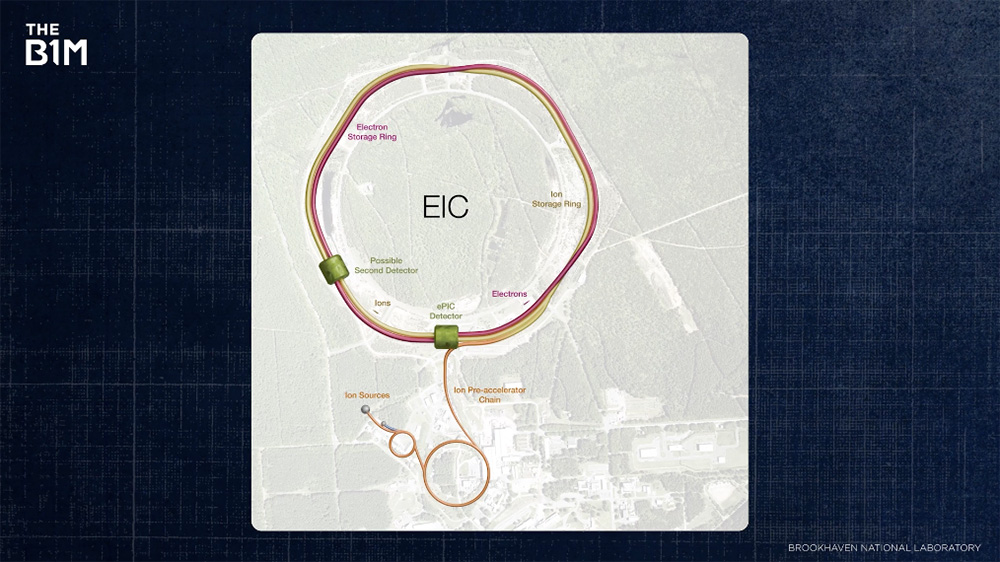
Above: The EIC will work in a similar way to RHIC, with ions shooting off one way and electrons going in the other direction, before they collide at a specific point. Image: Brookhaven National Laboratory.
Which will be at the ePIC detector. Just this one part of the machine will be bigger than an American school bus.
Inside will be a ten-metre-long barrel detector as well as additional instruments that will extend 45 metres in each direction down the beamline.
Other additions include an electron accelerator — complete with a new source for generating those particles — built off to the side.
Then you’ve got the buildings that will be needed for supplying and amplifying power, plus they might choose to add a second detector later on. It’s just a possibility at the moment.
Down to business
While RHIC had only been offline for a matter of weeks when we spoke to Abhay, his team wasted no time getting started with the disassembly.
“One of the rings of RHIC has already been disconnected — there is no power on it — and we are systematically taking each magnet out and placing it in the storage area,” Deshpande says.
“Some magnets are moving from one part of the rig to another part of a rig to be useful in the future operations of the Electron-Ion Collider. That's the biggest activity which is going on right now.”
More than 1,000 magnets used on RHIC will be retained in total, along with the same ion source, meaning AGS won’t be put into retirement itself for a good while yet.
Support buildings, roads, electrical and refrigeration facilities … they’re all being carried over to the EIC too. In total, the EIC complex will comprise 34 buildings covering over 34,000 square metres.
We know you’re desperate to find out what that is in American football fields, so the answer is — approximately six and a half.
Add 42 substations to that, along with 15 cooling towers, 28 chiller units, five miles of tunnel piping and you’ve got a pretty comprehensive system to figure out.
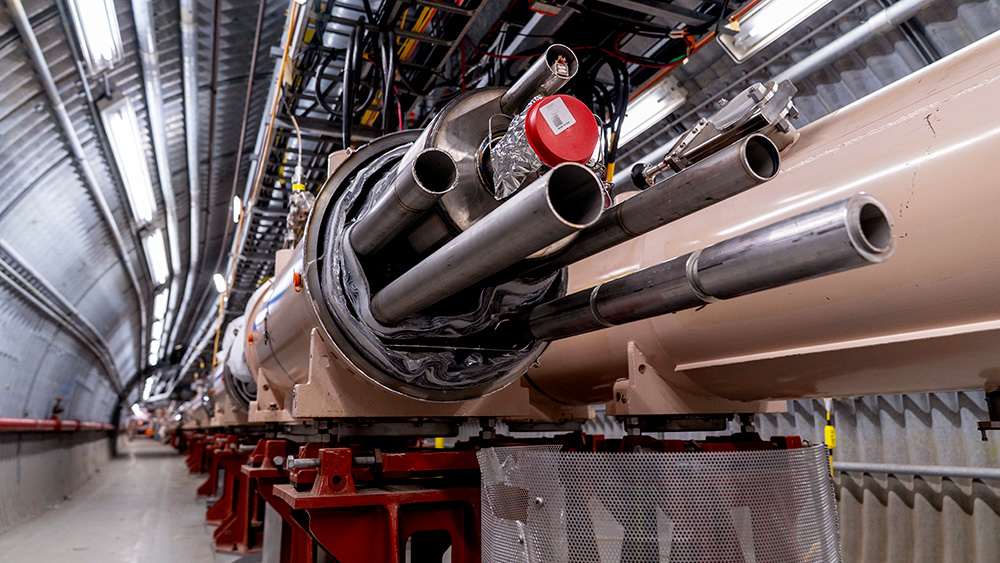
Above: The removal of a cryostat following the shutdown of RHIC in early 2026. Image: David Rahner + Brookhaven National Laboratory.
The new collider is expected to cost almost $3BN, and that’s on top of the $2BN that was already invested in RHIC’s infrastructure. It’s not going to be a quick job, either; the timeline doesn’t have the machine operating until the mid-2030s.
You see, while there’s a lot less to do than if they were starting completely from scratch, this is still going to be one of the most complicated projects on the planet.
We’re talking about components that are incredibly specialised because nothing like this exists anywhere else, and it’s really not the sort of thing you want to rush. Fortunately, BNL isn’t working entirely on its own here.
“Currently we have … institutions from around the world forming about 1,600 to 1,800 people who are interested in coming and working with us,” Deshpande reveals. “And this is going to grow before we start operating. We're going to go at least one and a half or two times larger by the time we start running the collider. Roughly it is 50% US and 50% rest of the world. So it is truly an international endeavour.”
Shared goals
Several of the partner firms are supplying it with high-tech components too. For example, huge magnets that were once part of the Advanced Photon Source at Argonne National Laboratory in Illinois are being repurposed for the new collider.
It’ll represent the next leap forward in particle physics, and when even more advanced accelerators are built in the future, they will likely be influenced in some way by the EIC. That doesn’t just mean bigger, fancier toys for scientists to play with.
To give an example, the upgrades being made here could lead to improved particle beams that are used to fight cancer. Or enhance the accelerators used in industry to design computer chips and develop new forms of clean energy.
So, if you’ve spent most of this video thinking that the origins of our universe shouldn’t be something we spent too much time thinking about in 2026, what about a project that could end up changing the future of our world? It’s hard not to be inspired by that.
Find out how Trolex’s AIR XD monitors ensure your tunnelling processes aren’t exposing you and your workers to hazardous dust here.
Additional footage and images: Brookhaven National Laboratory, CERN, Al Jazeera, Angst Productions, BBC, CBS, euronews, David Rahner, Jefferson Lab, Kevin Coughlin, Network 10, New Jersey Network, Sean Preins, 7NEWS, Tiffany Bowman and VIRTUE.
We welcome you sharing our content to inspire others, but please be nice and play by our rules.
Comments